The Renault Megane III Grandtour (Phase II, 2012) 1.5 Energy dCi (110 Hp) Start&Stop: A Pillar of European Efficiency
The Renault Megane III Grandtour (Phase II, 2012) 1.5 Energy dCi (110 Hp) Start&Stop represents a significant iteration of Renault’s popular C-segment vehicle, specifically tailored for the demanding European market. As a compact family station wagon, or “estate” in European parlance, this model, produced for the 2013 model year, embodied the brand’s commitment to practical design, fuel efficiency, and technological integration. While never officially sold in the United States, the Megane III Grandtour played a crucial role in Europe’s highly competitive family car segment, offering a compelling blend of space, comfort, and particularly, outstanding fuel economy thanks to its advanced diesel powertrain and the innovative Start&Stop system.
This particular variant, part of the “Phase II” facelift introduced in late 2012, brought subtle but effective styling updates and refined engineering to an already well-regarded platform. The “Energy dCi” designation highlighted Renault’s focus on maximizing efficiency from its diesel engines, making it a benchmark for low running costs and reduced environmental impact in its class. For European consumers, it presented an attractive option for daily commuting, family trips, and cargo hauling, all while adhering to stringent Euro 5 emission standards.
Engine & Performance: The Heart of the Renault Megane III Grandtour
At the core of the 2013 Renault Megane III Grandtour (Phase II) 1.5 Energy dCi (110 Hp) Start&Stop lies a highly optimized K9K 1.5-liter (1461 cm³) inline-four turbodiesel engine. This powertrain, renowned across various Renault and Nissan models for its reliability and efficiency, delivers a respectable 110 horsepower at 4000 rpm. More importantly for real-world driving, it generates a robust 177.01 lb.-ft. of torque from a low 1750 rpm, providing ample pulling power for both city driving and highway cruising, even with a full load.
The “Energy” designation signifies a suite of advanced technologies aimed at boosting efficiency. These include a sophisticated common-rail direct fuel injection system, a turbocharger, and an intercooler, all working in concert to optimize combustion and power delivery. A key feature for its time was the Start&Stop system, which automatically shuts off the engine when the vehicle is stationary and restarts it instantly when the driver presses the clutch, significantly reducing fuel consumption and emissions in urban traffic. Furthermore, the engine was equipped with a particulate filter, ensuring it met the strict Euro 5 emission standards prevalent at the time of its production.
Power is delivered to the front wheels via a smooth-shifting 6-speed manual transmission, a common and preferred choice in European markets for its engagement and efficiency. This setup allows the Megane Grandtour to achieve a 0-60 mph acceleration time of 11.8 seconds, with a top speed of 118.06 mph (190 km/h). While not a performance car, these figures are entirely adequate for a family-oriented station wagon. Where the 1.5 Energy dCi truly shines is in its fuel economy: an astounding 60.3 US mpg in urban conditions, 73.5 US mpg on the extra-urban cycle, and a combined average of 67.2 US mpg (3.5 l/100 km). This, coupled with CO2 emissions of just 90 g/km, made it one of the most economical and environmentally friendly vehicles in its class, offering substantial savings on fuel costs for its owners.
Design & Features
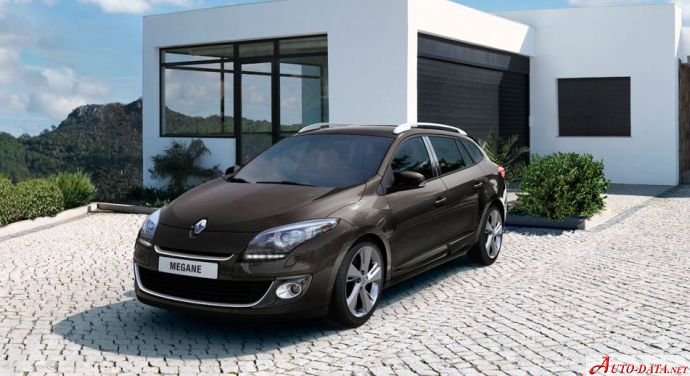
The Renault Megane III Grandtour (Phase II) maintained the elegant and practical design language of its predecessor, with the Phase II updates bringing a refreshed aesthetic. The “Grandtour” designation clearly indicates its station wagon body style, a highly popular choice in Europe for its versatility. With five doors and seating for five passengers, it offered a comfortable and spacious interior suitable for families.
Visually, the Phase II facelift introduced subtle changes, typically involving a revised front bumper, grille, and updated headlight designs, giving the car a more contemporary and assertive look. The overall silhouette remained sleek for a station wagon, balancing aerodynamic efficiency with cargo capacity. Dimensions of 179.49 inches (4559 mm) in length, 69.53 inches (1766 mm) in width, and 57.52 inches (1461 mm) in height, coupled with a generous 106.42-inch (2703 mm) wheelbase, ensured a stable ride and ample interior room.
Inside, the Megane III Grandtour focused on ergonomics and utility. The trunk space was a major selling point, offering a substantial 18.5 cubic feet (524 liters) with the rear seats in place, expanding to a cavernous 56.33 cubic feet (1595 liters) when the rear seats were folded down. This made it highly practical for hauling luggage, groceries, or larger items. The maximum payload capacity stood at 1239 lbs. (562 kg), and it could tow a braked trailer up to 3306.93 lbs. (1500 kg), further underscoring its utility.
Standard features for a car of its era included an independent McPherson front suspension and an elastic beam rear suspension, providing a comfortable and predictable ride. Braking was handled by ventilated discs at the front and solid discs at the rear, augmented by an Anti-lock Braking System (ABS) for enhanced safety. The electric power steering system, a rack and pinion setup, offered ease of maneuverability, particularly in urban environments with a minimum turning circle of 36.25 feet (11.05 meters). The vehicle rode on 195/65 R15 91H tires, mounted on 6.5J x 15-inch wheel rims, a practical choice balancing comfort and cost-effectiveness.
Technical Specifications
The following table details the comprehensive technical specifications for the Renault Megane III Grandtour (Phase II, 2012) 1.5 Energy dCi (110 Hp) Start&Stop:
| Category | Specification | Value |
|---|---|---|
| General Information | ||
| Brand | Renault | |
| Model | Megane | |
| Generation | Megane III Grandtour (Phase II, 2012) | |
| Type (Engine) | 1.5 Energy dCi (110 Hp) Start&Stop | |
| Production Start/End | 2013 year / 2013 year | |
| Powertrain Architecture | Internal Combustion engine | |
| Body type | Station wagon (estate) | |
| Seats / Doors | 5 / 5 | |
| Performance Specifications | ||
| Fuel consumption (urban) | 3.9 l/100 km (60.3 US mpg) | |
| Fuel consumption (extra urban) | 3.2 l/100 km (73.5 US mpg) | |
| Fuel consumption (combined) | 3.5 l/100 km (67.2 US mpg) | |
| CO2 emissions | 90 g/km | |
| Fuel Type | Diesel | |
| Acceleration 0 – 60 mph | 11.8 sec | |
| Maximum speed | 118.06 mph (190 km/h) | |
| Emission standard | Euro 5 | |
| Engine Specifications | ||
| Power | 110 Hp @ 4000 rpm | |
| Torque | 177.01 lb.-ft. (240 Nm) @ 1750 rpm | |
| Engine layout | Front, Transverse | |
| Engine Model/Code | K9K | |
| Engine displacement | 1.5 Liters (1461 cm³ / 89.16 cu. in.) | |
| Number of cylinders | 4, Inline | |
| Compression ratio | 15.2:1 | |
| Number of valves per cylinder | 2 | |
| Fuel injection system | Diesel Commonrail | |
| Engine aspiration | Turbocharger, Intercooler | |
| Engine systems | Start & Stop System, Particulate filter | |
| Space, Volume and Weights | ||
| Kerb Weight | 2870.42 lbs. (1302 kg) | |
| Max. weight | 4109.42 lbs. (1864 kg) | |
| Max load | 1239 lbs. (562 kg) | |
| Trunk (boot) space – minimum | 18.5 cu. ft. (524 l) | |
| Trunk (boot) space – maximum | 56.33 cu. ft. (1595 l) | |
| Fuel tank capacity | 15.85 US gal (60 l) | |
| Permitted trailer load with brakes (12%) | 3306.93 lbs. (1500 kg) | |
| Permitted trailer load without brakes | 1510.17 lbs. (685 kg) | |
| Dimensions | ||
| Length | 179.49 in. (4559 mm) | |
| Width | 69.53 in. (1766 mm) | |
| Height | 57.52 in. (1461 mm) | |
| Wheelbase | 106.42 in. (2703 mm) | |
| Minimum turning circle | 36.25 ft. (11.05 m) | |
| Drivetrain, Brakes and Suspension | ||
| Drivetrain Architecture | Front wheel drive, Internal Combustion engine | |
| Number of gears and type of gearbox | 6 gears, manual transmission | |
| Front suspension | Independent type McPherson | |
| Rear suspension | Elastic beam | |
| Front brakes | Ventilated discs | |
| Rear brakes | Disc | |
| Assisting systems | ABS (Anti-lock braking system) | |
| Steering type | Steering rack and pinion, Electric Steering | |
| Tires size | 195/65 R15 91H | |
| Wheel rims size | 6.5J x 15 | |
Legacy & Market Impact
The Renault Megane III Grandtour (Phase II) 1.5 Energy dCi (110 Hp) Start&Stop carved out a strong niche for itself in the highly competitive European C-segment. Its primary market was firmly in Europe, where compact station wagons are a staple for families and businesses alike due to their blend of practicality, efficiency, and maneuverability. In this segment, it faced stiff competition from established rivals such as the Volkswagen Golf Variant, Ford Focus Estate, Opel Astra Sports Tourer, and Peugeot 308 SW.
The Megane’s reputation in its market was built on several pillars: exceptional fuel economy, robust and proven diesel powertrain technology, and a strong emphasis on safety—a hallmark of Renault vehicles. The 1.5 Energy dCi engine, in particular, was lauded for its ability to deliver impressive mileage without sacrificing adequate performance for daily driving. This made it a favorite among fleet buyers and private owners who prioritized low running costs and environmental consciousness.
The “Grandtour” variant specifically addressed the needs of consumers requiring more cargo space than a traditional hatchback, without the larger footprint or higher fuel consumption of an SUV. Its generous trunk volume and flexible interior configuration cemented its status as a highly practical family car. The Phase II facelift, though subtle, helped keep the Megane visually fresh and competitive against newer entrants, ensuring it remained an attractive proposition throughout its production run.
Ultimately, the Renault Megane III Grandtour 1.5 Energy dCi (110 Hp) Start&Stop represented a mature and highly refined product within its segment. It showcased Renault’s engineering prowess in developing efficient and practical vehicles for the masses, leaving a legacy as a dependable, economical, and family-friendly option that successfully navigated the evolving demands of the European automotive landscape.