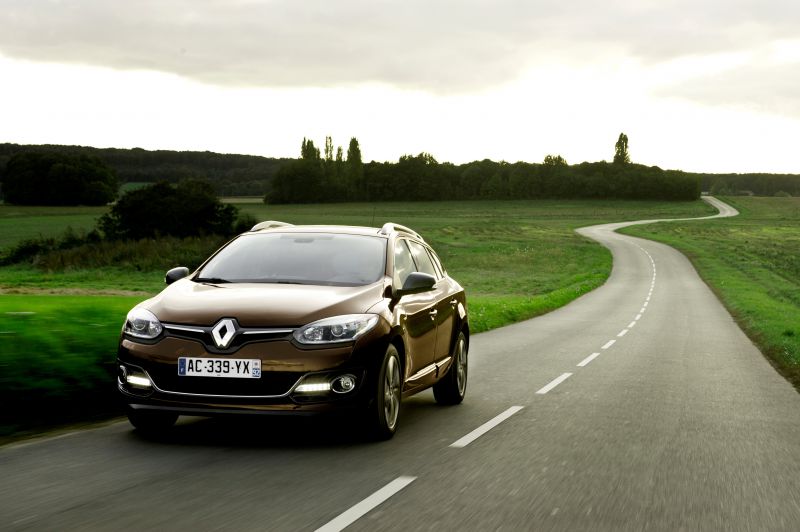
The Renault Megane III Grandtour (Phase III, 2014) 1.2 Energy TCe (132 Hp) Start&Stop represents a compelling offering within the highly competitive European compact station wagon segment. Produced between 2014 and 2015, this particular iteration of the third-generation Megane Grandtour benefited from a mid-cycle refresh, known as Phase III, which brought updated styling and technological refinements. As a model exclusively marketed in Europe and other select international regions, the Megane Grandtour was never officially sold in the United States, yet it exemplifies Renault’s commitment to producing efficient, practical, and well-equipped vehicles tailored to the needs of its primary markets. This version, featuring a turbocharged 1.2-liter gasoline engine, aimed to balance spirited performance with impressive fuel economy, making it a popular choice for families and fleet operators seeking versatility without compromising on running costs.
The Renault Megane III Grandtour (Phase III, 2014) 1.2 Energy TCe (132 Hp) Start&Stop: A European Compact Station Wagon
The Renault Megane, first introduced in 1995, has consistently been a cornerstone of the French automaker’s lineup, particularly in Europe. The third generation, launched in 2008, continued this legacy with a focus on contemporary design, enhanced safety, and a wide array of engine choices. The Phase III update, arriving in 2014, was a strategic refresh designed to keep the Megane competitive against rivals like the Volkswagen Golf Variant, Ford Focus Estate, and Opel Astra Sports Tourer. This facelift primarily updated the front fascia, integrating Renault’s new corporate identity with a larger, more prominent diamond badge and revised lighting signatures. The Grandtour, or station wagon body style, was particularly significant, catering to European consumers who value practicality, cargo space, and a comfortable ride over long distances. With its five doors and seating for five, it was designed as a versatile family vehicle, equally at home on city streets and extended highway journeys.
Engine & Performance
At the heart of this particular Megane Grandtour lies the 1.2 Energy TCe (Turbo Control efficiency) engine, designated with the internal code H5FT. This powerplant is a testament to the industry-wide trend of engine downsizing, where smaller displacement engines, boosted by forced induction, deliver performance comparable to larger naturally aspirated units while significantly improving fuel efficiency and reducing emissions. This inline four-cylinder gasoline engine boasts a displacement of 1197 cubic centimeters (approximately 1.2 liters or 73.05 cubic inches). It features a sophisticated multi-port manifold injection system, coupled with a turbocharger and intercooler, to optimize air-fuel mixture and combustion. This configuration allows the engine to produce a respectable 132 horsepower at 5500 revolutions per minute, translating to an impressive power-per-liter output of 110.3 horsepower per liter. More critically for daily driving, the engine delivers a robust 151.2 pound-feet of torque at a low 2000 rpm, ensuring strong acceleration and flexible in-gear performance.
Power is efficiently transferred to the front wheels via a precise 6-speed manual transmission, offering the driver engaging control over the powertrain. The combination of a lightweight chassis and the responsive turbocharged engine allows the Megane Grandtour to accelerate from 0 to 60 miles per hour in a brisk 9.6 seconds, with a top speed of 118 miles per hour. These figures position it as a capable performer within its class, suitable for both urban commutes and sustained highway cruising. Furthermore, the inclusion of Renault’s Start&Stop system, which automatically shuts off the engine when the vehicle is stationary and restarts it when the driver intends to move, plays a crucial role in enhancing fuel economy and reducing CO2 emissions, especially in congested city traffic. This system contributes to a combined fuel consumption rating of 5.4 liters per 100 kilometers, or an impressive 43.6 US miles per gallon, making it an economically sensible choice. The vehicle also meets the stringent Euro 5 emission standard, with CO2 emissions rated at 124 grams per kilometer, underscoring its environmental consciousness for its era.
Design & Features
The Renault Megane III Grandtour (Phase III, 2014) embodies the practical and aesthetic sensibilities typical of European compact station wagons. Its body type, a 5-door station wagon, offers a harmonious blend of sleek styling and substantial utility. The Phase III facelift brought a more assertive front end, aligning it with Renault’s contemporary design language, while maintaining the flowing lines and balanced proportions that characterized the third-generation Megane. With an overall length of 179.49 inches, a width of 71.02 inches (80.2 inches including mirrors), and a height of 59.96 inches, the Grandtour strikes an excellent balance between interior spaciousness and manageable exterior dimensions for urban environments. The generous 106.42-inch wheelbase contributes significantly to both passenger comfort and stable handling.
Inside, the Megane Grandtour provides seating for five occupants, with a focus on ergonomics and material quality appropriate for its segment. One of its most compelling features is its cargo versatility. The trunk offers a minimum capacity of 18.5 cubic feet (524 liters) with all seats in place, which is highly competitive. When the rear seats are folded down, this expands to a cavernous 56.33 cubic feet (1595 liters), transforming the vehicle into a highly capable hauler for luggage, sports equipment, or larger items. Practicality extends to a maximum roof load of 176.37 pounds and a permitted trailer load with brakes of 3306.93 pounds, further enhancing its utility.
In terms of chassis and safety, the Megane Grandtour is built on a robust platform. It features an independent McPherson strut suspension at the front, known for its balance of comfort and dynamic control, while the rear utilizes a space-efficient torsion beam setup. Braking performance is handled by ventilated discs at the front and solid discs at the rear, complemented by an Anti-lock Braking System (ABS) for enhanced stopping power and stability under challenging conditions. The electric power steering system, a rack and pinion type, provides precise control and light effort at low speeds, aiding maneuverability in tight parking situations. The vehicle also offers a range of tire sizes, from 195/65 R15 to 205/50 R17, allowing for varying levels of grip and ride comfort. While specific advanced driver-assistance systems might have been optional or limited at this price point and era, the fundamental safety architecture and features were designed to meet stringent European safety standards.
Technical Specifications of the Renault Megane III Grandtour (Phase III, 2014) 1.2 Energy TCe (132 Hp) Start&Stop
| Category | Specification |
|---|---|
| Brand | Renault |
| Model | Megane |
| Generation | Megane III Grandtour (Phase III, 2014) |
| Engine Type | 1.2 Energy TCe (132 Hp) Start&Stop |
| Production Start | 2014 year |
| Production End | 2015 year |
| Powertrain Architecture | Internal Combustion Engine |
| Body Type | Station wagon (estate) |
| Seats | 5 |
| Doors | 5 |
| Performance Specs | |
| Fuel consumption (urban) | 6.7 l/100 km (35.1 US mpg) |
| Fuel consumption (extra urban) | 4.6 l/100 km (51.1 US mpg) |
| Fuel consumption (combined) | 5.4 l/100 km (43.6 US mpg) |
| CO2 emissions | 124 g/km |
| Fuel Type | Petrol (Gasoline) |
| Acceleration 0 – 60 mph | 9.6 sec |
| Maximum speed | 190 km/h (118.06 mph) |
| Emission standard | Euro 5 |
| Weight-to-power ratio | 9.7 kg/Hp (102.8 Hp/tonne) |
| Weight-to-torque ratio | 6.3 kg/Nm (159.7 Nm/tonne) |
| Engine Specs | |
| Power | 132 Hp @ 5500 rpm |
| Power per liter | 110.3 Hp/l |
| Torque | 205 Nm @ 2000 rpm (151.2 lb.-ft. @ 2000 rpm) |
| Engine layout | Front, Transverse |
| Engine Model/Code | H5FT |
| Engine displacement | 1197 cm3 (73.05 cu. in.) |
| Number of cylinders | 4 |
| Engine configuration | Inline |
| Cylinder Bore | 72.2 mm (2.84 in.) |
| Piston Stroke | 73.2 mm (2.88 in.) |
| Compression ratio | 9.3:1 |
| Number of valves per cylinder | 4 |
| Fuel injection system | Multi-port manifold injection |
| Engine aspiration | Turbocharger, Intercooler |
| Engine oil capacity | 4.6 l (4.86 US qt) |
| Engine systems | Start & Stop System |
| Space, Volume and Weights | |
| Kerb Weight | 1284 kg (2830.74 lbs.) |
| Max. weight | 1835 kg (4045.48 lbs.) |
| Max load | 551 kg (1214.75 lbs.) |
| Trunk (boot) space – minimum | 524 l (18.5 cu. ft.) |
| Trunk (boot) space – maximum | 1595 l (56.33 cu. ft.) |
| Fuel tank capacity | 60 l (15.85 US gal) |
| Max. roof load | 80 kg (176.37 lbs.) |
| Permitted trailer load with brakes (12%) | 1500 kg (3306.93 lbs.) |
| Permitted trailer load without brakes | 675 kg (1488.12 lbs.) |
| Permitted towbar download | 75 kg (165.35 lbs.) |
| Dimensions | |
| Length | 4559 mm (179.49 in.) |
| Width | 1804 mm (71.02 in.) |
| Width including mirrors | 2037 mm (80.2 in.) |
| Height | 1523 mm (59.96 in.) |
| Wheelbase | 2703 mm (106.42 in.) |
| Front track | 1546 mm (60.87 in.) |
| Rear (Back) track | 1547 mm (60.91 in.) |
| Front overhang | 862 mm (33.94 in.) |
| Rear overhang | 994 mm (39.13 in.) |
| Ride height (ground clearance) | 120 mm (4.72 in.) |
| Minimum turning circle (turning diameter) | 11.05 m (36.25 ft.) |
| Drivetrain, Brakes and Suspension Specs | |
| Drivetrain Architecture | Front-wheel drive, Internal Combustion engine |
| Drive wheel | Front wheel drive |
| Number of gears and type of gearbox | 6 gears, manual transmission |
| Front suspension | Independent type McPherson |
| Rear suspension | Torsion |
| Front brakes | Ventilated discs |
| Rear brakes | Disc |
| Assisting systems | ABS (Anti-lock braking system) |
| Steering type | Steering rack and pinion |
| Power steering | Electric Steering |
| Tires size | 195/65 R15; 205/55 R16; 205/50 R17 |
| Wheel rims size | 15; 16; 17 |
Legacy & Market Impact
The Renault Megane III Grandtour, particularly in its Phase III iteration and with the efficient 1.2 Energy TCe engine, carved out a significant niche in the European automotive landscape. Its reputation was built on a foundation of practicality, comfortable ride quality, and cost-effective operation. In a segment dominated by strong contenders, the Megane Grandtour stood out with its distinct French design flair, offering an alternative to the more conservative aesthetics of some German rivals. Its blend of a spacious interior, large cargo capacity, and a relatively compact footprint made it an ideal choice for European families who often navigate narrower streets and benefit from efficient fuel consumption.
The TCe engine family, exemplified by the 1.2-liter unit in this Megane, played a crucial role in Renault’s strategy to meet increasingly strict emission regulations while still delivering satisfactory performance. This engine became a benchmark for small-displacement turbocharged gasoline engines, demonstrating that power and efficiency could coexist. The Start&Stop system further cemented its credentials as an environmentally conscious and economical vehicle. Its primary competitors included the segment-leading Volkswagen Golf Variant, known for its refined driving dynamics and robust build quality; the Ford Focus Estate, praised for its engaging handling; the Opel Astra Sports Tourer, offering strong value; and the Peugeot 308 SW, another French contender with its own distinctive style. The Megane Grandtour held its own by offering a competitive package that emphasized comfort, practicality, and a distinctive character.
While never crossing the Atlantic to the American market, the Megane III Grandtour’s legacy in Europe is one of a dependable, versatile, and stylish family car. It represented a period when Renault was refining its engine technology and design language, paving the way for future models. Its impact lies in its contribution to the mainstream adoption of downsized, turbocharged engines and its consistent presence as a strong performer in the highly competitive compact station wagon segment. For many European households, the Megane Grandtour was more than just a car; it was a reliable partner for daily life, embodying the practical and innovative spirit of French automotive engineering.