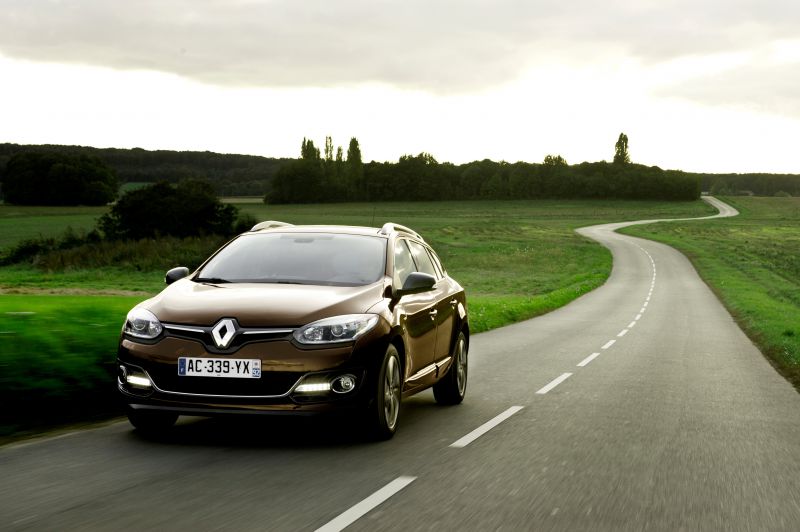
The Renault Megane III Grandtour (Phase III, 2014) 1.2 TCe (132 Hp) EDC Start&Stop represents a significant offering in the European compact family car segment during its production run from 2015 to 2016. As part of the third generation of the popular Renault Megane line, this particular iteration, designated as Phase III, showcased a mid-cycle refresh that brought updated styling cues and technological enhancements. The Grandtour, or estate/station wagon body style, was specifically designed to cater to families and individuals requiring greater cargo capacity and versatility than the standard hatchback, a common demand in European markets. This model, equipped with a modern turbocharged gasoline engine, an efficient dual-clutch automatic transmission, and a Start&Stop system, was engineered to deliver a balance of performance, fuel economy, and practicality, making it a competitive choice against rivals in its class.
The Renault Megane III Grandtour (Phase III, 2014) in its Market
In the highly competitive European C-segment, the Renault Megane has long been a staple, offering a distinct French flair in design and a focus on comfort and practicality. The Megane III Grandtour (Phase III, 2014) 1.2 TCe (132 Hp) EDC Start&Stop was a prime example of Renault’s strategy to provide a well-rounded package for discerning buyers. While the Megane line was not typically sold in the United States, its role in Europe was crucial for Renault, competing directly with established rivals such as the Volkswagen Golf Variant, Ford Focus Estate, Opel Astra Sports Tourer, and Peugeot 308 SW. The Grandtour variant, with its extended roofline and generous cargo area, was particularly popular among families and business users who appreciated its blend of a comfortable ride, efficient powertrains, and substantial utility. The Phase III refresh, introduced in 2014 and entering production for this specific variant in 2015, brought a redesigned front fascia, updated interior materials, and enhanced infotainment options, ensuring the Megane remained fresh and competitive against newer entrants in the market. Its emphasis on a refined driving experience and family-friendly features solidified its position as a practical and appealing choice in its primary markets.
Engine & Performance
At the heart of the Renault Megane III Grandtour (Phase III, 2014) 1.2 TCe (132 Hp) EDC Start&Stop lies a technologically advanced powertrain designed for both spirited driving and remarkable efficiency. The 1.2-liter (1197 cm3 or 73.05 cu. in.) TCe (Turbo Control efficiency) gasoline engine, identified by the H5FT engine code, is an inline four-cylinder unit featuring a turbocharger and intercooler. This forced-induction setup allows the relatively small displacement engine to produce an impressive 132 horsepower at 5500 rpm, translating to a power-per-liter output of 110.3 Hp/l. More significantly for everyday driving, it delivers a robust 205 Nm (151.2 lb.-ft.) of torque available at a low 2000 rpm. This broad torque band ensures responsive acceleration and flexible performance, making the car feel more potent than its displacement might suggest, particularly during urban driving or highway overtaking maneuvers.
Power is efficiently transferred to the front wheels via a 6-speed EDC (Efficient Dual Clutch) automatic transmission. This modern gearbox offers smooth and rapid shifts, contributing to both the car’s performance and its fuel economy. The inclusion of a Start&Stop system further enhances efficiency by automatically shutting off the engine when the vehicle is stationary, such as at traffic lights, and restarting it seamlessly when the driver prepares to move. This system, combined with the optimized engine and transmission, results in impressive fuel consumption figures for a station wagon of its size: a combined rating of 5.6 l/100 km (42 US mpg, 50.4 UK mpg). Urban consumption is rated at 7.4 l/100 km (31.8 US mpg), while extra-urban driving yields an excellent 4.5 l/100 km (52.3 US mpg). These figures underscore the vehicle’s commitment to economical operation, further evidenced by its CO2 emissions of 129 g/km, meeting the Euro 5 emission standard.
In terms of outright performance, the Megane III Grandtour with this powertrain offers a respectable turn of speed. It accelerates from 0 to 60 mph in a calculated 9.6 seconds (0-100 km/h in 10.1 seconds), making it agile enough for daily driving and capable of merging safely onto highways. The maximum speed is 190 km/h (118.06 mph), which is more than adequate for European highway speeds. The engine’s layout is front, transverse, contributing to the front-wheel-drive architecture, which is typical for this segment. With a compression ratio of 9.3:1 and a multi-port manifold fuel injection system, the engine is designed for both reliability and efficient combustion, making it a well-engineered unit for its intended purpose.
Design & Features
The Renault Megane III Grandtour (Phase III, 2014) is characterized by its practical yet stylish station wagon (estate) body type, offering five doors and comfortable seating for five occupants. Its design, refreshed in the Phase III iteration, features Renault’s contemporary styling cues of the era, including a prominent front grille with the brand’s large diamond logo and sleek headlamps that integrate seamlessly into the overall aesthetic. The Grandtour’s extended roofline flows elegantly into a practical tailgate, providing a substantial increase in cargo volume compared to its hatchback sibling.
Dimensions are key to its utility: the vehicle measures 4559 mm (179.49 inches) in length, 1804 mm (71.02 inches) in width (2037 mm or 80.2 inches including mirrors), and 1523 mm (59.96 inches) in height. A generous wheelbase of 2703 mm (106.42 inches) contributes to a stable ride and ample interior space for passengers. The trunk (boot) space is a major highlight, offering a minimum of 524 liters (18.5 cu. ft.) with the rear seats up, expandable to a cavernous 1595 liters (56.33 cu. ft.) when the rear seats are folded down. This impressive cargo capacity makes it an ideal choice for families, road trips, or transporting bulky items.
The interior, while not revolutionary, was well-appointed for its class, featuring ergonomic controls and a focus on driver and passenger comfort. For its time, the Phase III refresh often included updated infotainment systems, potentially with navigation and Bluetooth connectivity, enhancing the driving experience. Safety features were also a priority, with standard equipment including ABS (Anti-lock Braking System) and a suite of airbags. The car’s robust structure and modern braking system, featuring ventilated discs at the front and disc brakes at the rear, ensured confident stopping power. Steering is managed by a rack and pinion system with electric power steering, providing light and responsive handling for urban maneuvers and stable control at higher speeds. The vehicle rides on 205/50 R17 tires mounted on 17-inch wheel rims, striking a balance between ride comfort and handling precision. Suspension consists of an independent McPherson type at the front and a torsion beam at the rear, a common and effective setup for front-wheel-drive compact cars, offering a good compromise between ride quality and dynamic stability.
Technical Specifications for the Renault Megane III Grandtour (Phase III, 2014)
| General Information | |
| Brand | Renault |
| Model | Megane |
| Generation | Megane III Grandtour (Phase III, 2014) |
| Type (Engine) | 1.2 TCe (132 Hp) EDC Start&Stop |
| Start of production | 2015 year |
| End of production | 2016 year |
| Powertrain Architecture | Internal Combustion engine |
| Body type | Station wagon (estate) |
| Seats | 5 |
| Doors | 5 |
| Performance Specifications | |
| Fuel consumption (economy) – urban | 7.4 l/100 km (31.8 US mpg) |
| Fuel consumption (economy) – extra urban | 4.5 l/100 km (52.3 US mpg) |
| Fuel consumption (economy) – combined | 5.6 l/100 km (42 US mpg) |
| CO2 emissions | 129 g/km |
| Fuel Type | Petrol (Gasoline) |
| Acceleration 0 – 60 mph | 9.6 sec |
| Acceleration 0 – 100 km/h | 10.1 sec |
| Maximum speed | 190 km/h (118.06 mph) |
| Emission standard | Euro 5 |
| Weight-to-power ratio | 9.7 kg/Hp, 102.8 Hp/tonne |
| Weight-to-torque ratio | 6.3 kg/Nm, 159.7 Nm/tonne |
| Engine Specifications | |
| Power | 132 Hp @ 5500 rpm |
| Power per liter | 110.3 Hp/l |
| Torque | 205 Nm @ 2000 rpm (151.2 lb.-ft. @ 2000 rpm) |
| Engine layout | Front, Transverse |
| Engine Model/Code | H5FT |
| Engine displacement | 1197 cm3 (1.2 liters / 73.05 cu. in.) |
| Number of cylinders | 4 |
| Engine configuration | Inline |
| Cylinder Bore | 72.2 mm (2.84 in.) |
| Piston Stroke | 73.2 mm (2.88 in.) |
| Compression ratio | 9.3:1 |
| Number of valves per cylinder | 4 |
| Fuel injection system | Multi-port manifold injection |
| Engine aspiration | Turbocharger, Intercooler |
| Engine oil capacity | 4.6 l (4.86 US qt) |
| Engine oil specification | Not specified |
| Engine systems | Start & Stop System |
| Space, Volume and Weights | |
| Kerb Weight | 1284 kg (2830.74 lbs.) |
| Max. weight | 1835 kg (4045.48 lbs.) |
| Max load | 551 kg (1214.75 lbs.) |
| Trunk (boot) space – minimum | 524 l (18.5 cu. ft.) |
| Trunk (boot) space – maximum | 1595 l (56.33 cu. ft.) |
| Fuel tank capacity | 60 l (15.85 US gal) |
| Max. roof load | 80 kg (176.37 lbs.) |
| Permitted trailer load with brakes (12%) | 1500 kg (3306.93 lbs.) |
| Permitted trailer load without brakes | 675 kg (1488.12 lbs.) |
| Permitted towbar download | 75 kg (165.35 lbs.) |
| Dimensions | |
| Length | 4559 mm (179.49 in.) |
| Width | 1804 mm (71.02 in.) |
| Width including mirrors | 2037 mm (80.2 in.) |
| Height | 1523 mm (59.96 in.) |
| Wheelbase | 2703 mm (106.42 in.) |
| Front track | 1546 mm (60.87 in.) |
| Rear (Back) track | 1547 mm (60.91 in.) |
| Front overhang | 862 mm (33.94 in.) |
| Rear overhang | 994 mm (39.13 in.) |
| Ride height (ground clearance) | 120 mm (4.72 in.) |
| Minimum turning circle (turning diameter) | 11.05 m (36.25 ft.) |
| Drivetrain, Brakes and Suspension Specs | |
| Drivetrain Architecture | The Internal combustion engine (ICE) drives the front wheels of the vehicle. |
| Drive wheel | Front wheel drive |
| Number of gears and type of gearbox | 6 gears, automatic transmission EDC |
| Front suspension | Independent type McPherson |
| Rear suspension | Torsion |
| Front brakes | Ventilated discs |
| Rear brakes | Disc |
| Assisting systems | ABS (Anti-lock braking system) |
| Steering type | Steering rack and pinion |
| Power steering | Electric Steering |
| Tires size | 205/50 R17 |
| Wheel rims size | 17 |
Legacy & Market Impact
The Renault Megane III Grandtour, particularly its Phase III iteration with the 1.2 TCe (132 Hp) EDC Start&Stop powertrain, carved out a strong reputation in its primary European markets for being a sensible, well-equipped, and practical family vehicle. While it might not have garnered the same enthusiast following as some performance-oriented models, its impact was significant in providing reliable and economical transportation for a broad demographic. The Megane Grandtour consistently competed with the best in its class, often praised for its comfortable ride quality, which is a hallmark of French automotive engineering, and its generous cargo capacity that rivaled vehicles from higher segments.
In its competitive landscape, the Megane Grandtour stood shoulder-to-shoulder with formidable opponents. Its key competitors included the Volkswagen Golf Variant, which often set the benchmark for refinement and build quality; the Ford Focus Estate, known for its engaging driving dynamics; and the Opel Astra Sports Tourer, another strong contender offering practicality and efficiency. The Megane differentiated itself with its distinctive styling, particularly after the Phase III refresh, which brought a more assertive and modern face to the car. Its blend of a lively yet efficient turbocharged engine, combined with the smooth EDC transmission, offered a compelling package for those seeking a balance between performance and fuel economy without compromising on utility.
Historically, the Megane line has been a cornerstone of Renault’s global sales, and the third generation Grandtour played a vital role in maintaining the brand’s presence in the crucial compact segment. It demonstrated Renault’s commitment to modern engine technology, with the TCe engines being a prime example of downsizing without sacrificing performance. The integration of features like Start&Stop and dual-clutch transmissions showcased Renault’s efforts to meet evolving environmental standards and consumer demands for greater efficiency. The Megane III Grandtour remains a testament to a period where compact station wagons were a highly valued and practical choice for European families, offering a compelling alternative to SUVs before their widespread dominance. Its legacy is one of a dependable, versatile, and economically sound vehicle that served its purpose admirably, contributing to Renault’s enduring reputation as a purveyor of accessible and family-friendly automobiles.