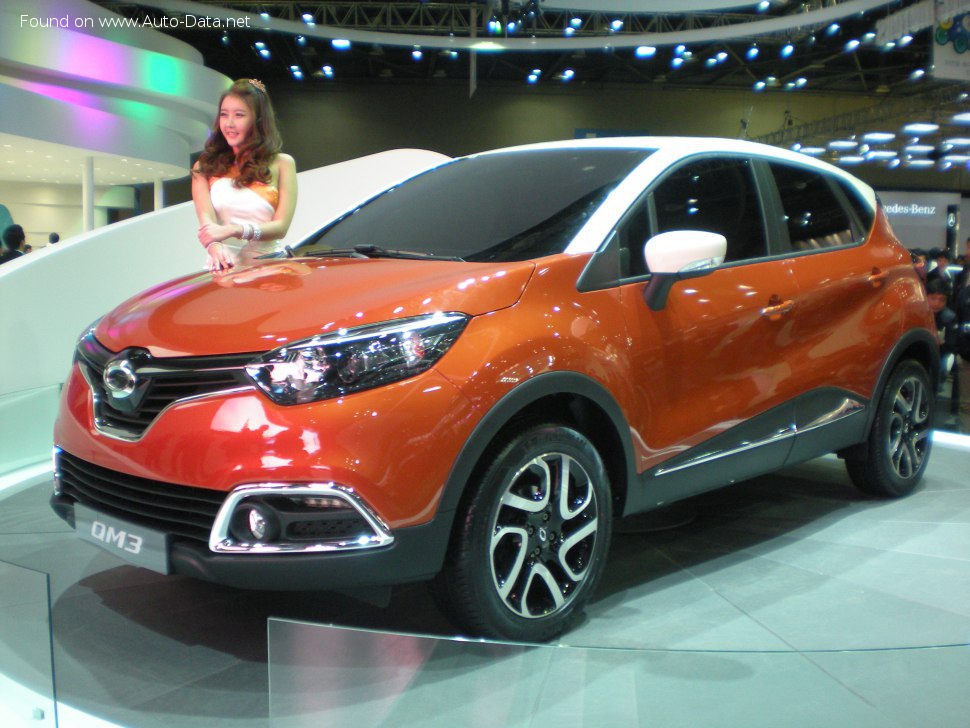
The Renault Samsung QM3 1.5 dCi (90 Hp) Automatic represents a significant offering in the subcompact crossover segment, specifically tailored for the South Korean market. Introduced in 2013, the QM3 is essentially a rebadged first-generation Renault Captur, a highly successful model in Europe known for its distinctive styling, practical urban utility, and efficient powertrains. As a modern vehicle for its era, the QM3 embodies the growing trend towards compact, versatile vehicles that blend the elevated driving position and robust aesthetics of an SUV with the maneuverability and fuel economy of a hatchback. Its launch underscored Renault Samsung’s commitment to providing stylish and efficient options to Korean consumers, leveraging Renault’s global platform expertise. The 1.5 dCi variant, equipped with an automatic transmission, was particularly focused on delivering an optimal balance of performance and exceptional fuel efficiency, making it an attractive choice for city dwellers and those seeking economical long-distance travel.
Powertrain and Performance of the Renault Samsung QM3
At the heart of the Renault Samsung QM3 1.5 dCi (90 Hp) Automatic lies Renault’s venerable K9K 1.5-liter dCi diesel engine, a powerplant renowned globally for its robust design, reliability, and outstanding fuel economy. This inline four-cylinder engine, positioned transversely at the front, produces a respectable 90 horsepower at 4000 rpm, delivering a power-to-liter ratio of 61.6 Hp/l. More crucially for a diesel engine, it generates a substantial 220 Nm (162.26 lb-ft) of torque across a broad and accessible rev range, specifically between 1750 and 2500 rpm. This ample torque at low engine speeds is instrumental in providing responsive acceleration and effortless cruising, particularly beneficial in urban environments where stop-and-go traffic is common.
The engine’s advanced fuel injection system, utilizing common rail technology, combined with a turbocharger and intercooler, ensures optimal combustion efficiency and reduced emissions. With an engine displacement of 1461 cm3 (89.16 cu. in.), the 1.5 dCi unit is a testament to modern diesel engineering, focusing on maximizing output while minimizing fuel consumption. The powertrain architecture is a front-wheel-drive setup, with the internal combustion engine driving the front wheels, a common and efficient configuration for compact crossovers. Mated to this efficient engine is a sophisticated 6-speed automatic transmission, specifically a Dual Clutch Transmission (DCT). This type of gearbox is celebrated for its seamless gear changes and ability to optimize power delivery and fuel economy, providing both the convenience of an automatic and the efficiency often associated with manual transmissions. The combination of the K9K engine and the DCT results in a highly effective and refined driving experience for the Renault Samsung QM3.
Fuel economy figures for the QM3 1.5 dCi are particularly impressive, reflecting its design ethos of efficiency. The vehicle achieves an estimated 38.6 US mpg in urban driving, 44.4 US mpg on the extra-urban cycle, and a combined average of 41.3 US mpg. These figures translate to a low CO2 emission rate of just 107 g/km, positioning the QM3 as an environmentally conscious choice within its segment. The vehicle’s weight-to-power ratio stands at 14.4 kg/Hp (69.2 Hp/tonne), while its weight-to-torque ratio is 5.9 kg/Nm (169.2 Nm/tonne), indicating a well-balanced power-to-weight characteristic for its intended use as a versatile and economical daily driver.
Design and Features of the Renault Samsung QM3
The design of the Renault Samsung QM3 is one of its most compelling attributes, inheriting the distinctive and youthful aesthetic of the Renault Captur. Classified as a crossover, it boasts a practical 5-door, 5-seat body type, making it highly versatile for small families or individuals seeking ample cargo space and passenger comfort. Its dimensions contribute significantly to its urban agility: a length of 162.4 inches (4125 mm), a width of 70.08 inches (1780 mm), and a height of 61.61 inches (1565 mm). The wheelbase measures 102.56 inches (2605 mm), providing a stable ride and contributing to a surprisingly spacious cabin for its exterior footprint.
The exterior styling is characterized by its elevated ground clearance, prominent wheel arches, and often a contrasting two-tone paint scheme, which was a popular customization option for the Captur/QM3. This design language gives it a rugged yet chic appearance, perfectly suited for both city streets and light off-road excursions. Inside, the QM3 focuses on practicality and smart storage solutions. While specific interior features beyond the seating capacity are not detailed in the provided data, the Captur platform was known for its innovative interior design, including removable and washable seat covers and a sliding rear bench seat, though these may vary in the QM3 variant. The elevated driving position offers excellent visibility, a key advantage for navigating congested city traffic.
In terms of chassis and safety, the QM3 is built on a robust platform designed to offer a comfortable yet engaging driving experience. The front suspension employs an independent McPherson type, known for its ability to provide a good balance between ride comfort and handling precision. At the rear, a torsion beam suspension is utilized, a cost-effective and space-efficient solution common in this segment. Braking performance is handled by ventilated discs at the front and traditional drum brakes at the rear, complemented by an Anti-lock Braking System (ABS) for enhanced safety during emergency stops. Steering is managed by a rack and pinion system, offering direct and responsive feedback to the driver. The vehicle rides on 17-inch wheel rims, shod with 205/55 R17 91V tires, which contribute to both its handling dynamics and distinctive visual appeal. The kerb weight of the vehicle is 2866.01 lbs (1300 kg), reflecting its compact yet sturdy construction.
Technical Specifications
| Brand | Renault Samsung |
| Model | QM3 |
| Generation | QM3 |
| Type (Engine) | 1.5 dCi (90 Hp) Automatic |
| Start of Production | 2013 year |
| Powertrain Architecture | Internal Combustion engine |
| Body Type | Crossover |
| Seats | 5 |
| Doors | 5 |
| Fuel Consumption (Urban) | 6.1 l/100 km (38.6 US mpg) |
| Fuel Consumption (Extra Urban) | 5.3 l/100 km (44.4 US mpg) |
| Fuel Consumption (Combined) | 5.7 l/100 km (41.3 US mpg) |
| CO2 Emissions | 107 g/km |
| Fuel Type | Diesel |
| Weight-to-Power Ratio | 14.4 kg/Hp (69.2 Hp/tonne) |
| Weight-to-Torque Ratio | 5.9 kg/Nm (169.2 Nm/tonne) |
| Power | 90 Hp @ 4000 rpm |
| Power per Liter | 61.6 Hp/l |
| Torque | 220 Nm (162.26 lb.-ft.) @ 1750-2500 rpm |
| Engine Layout | Front, Transverse |
| Engine Model/Code | K9K |
| Engine Displacement | 1461 cm3 (89.16 cu. in.) |
| Number of Cylinders | 4 |
| Engine Configuration | Inline |
| Fuel Injection System | Diesel Commonrail |
| Engine Aspiration | Turbocharger, Intercooler |
| Engine Oil Capacity | 4.5 l (4.76 US qt) |
| Kerb Weight | 1300 kg (2866.01 lbs.) |
| Length | 4125 mm (162.4 in.) |
| Width | 1780 mm (70.08 in.) |
| Height | 1565 mm (61.61 in.) |
| Wheelbase | 2605 mm (102.56 in.) |
| Front Track | 1530 mm (60.24 in.) |
| Rear (Back) Track | 1515 mm (59.65 in.) |
| Drivetrain Architecture | Internal combustion engine drives front wheels |
| Drive Wheel | Front wheel drive |
| Number of Gears and Type of Gearbox | 6 gears, automatic transmission DCT |
| Front Suspension | Independent type McPherson |
| Rear Suspension | Torsion |
| Front Brakes | Ventilated discs |
| Rear Brakes | Drum |
| Assisting Systems | ABS (Anti-lock braking system) |
| Steering Type | Steering rack and pinion |
| Tires Size | 205/55 R17 91V |
| Wheel Rims Size | 17 |