The Renault Samsung QM6, specifically in its 2.0 GDe (144 Hp) CVT variant, represents a significant offering in the competitive mid-size SUV segment within the South Korean market. Launched in 2016, this vehicle is the first generation of the QM6, a model developed under the strategic alliance between Renault and Samsung Motors. While not directly sold in the United States, the QM6 is essentially the South Korean market version of the second-generation Renault Koleos, a global SUV that sees extensive sales across Europe, Asia, and other regions. Its introduction marked Renault Samsung’s commitment to providing a stylish, practical, and efficient utility vehicle tailored to the preferences of Korean consumers, emphasizing both urban drivability and long-distance comfort. Designed to compete against established players in its class, the QM6 aims to deliver a blend of modern design, a refined powertrain, and a comprehensive suite of features, making it a compelling choice for families and individuals seeking a versatile and capable SUV. The Renault Samsung QM6 2.0 GDe (144 Hp) CVT is engineered to balance performance with fuel economy, a crucial consideration in its target markets.
Powertrain and Dynamics of the Renault Samsung QM6 2.0 GDe (144 Hp) CVT
At the heart of the Renault Samsung QM6 2.0 GDe (144 Hp) CVT lies a robust and efficient 2.0-liter naturally aspirated gasoline direct injection (GDe) engine, designated by the M5R engine code. This inline four-cylinder unit is mounted transversely at the front, a common configuration for front-wheel-drive SUVs, which optimizes packaging and interior space. With an engine displacement of 1997 cubic centimeters (121.86 cubic inches), it delivers a respectable 144 horsepower at 6000 rpm, providing ample power for daily commuting and highway cruising. Torque output stands at 147.51 lb.-ft. (200 Nm) at 4400 rpm, ensuring responsive acceleration and sufficient pulling power, particularly in urban environments. The direct injection fuel system enhances combustion efficiency, contributing to both power delivery and fuel economy, while its naturally aspirated nature provides a linear and predictable power band.
Power is channeled to the front wheels through an automatic continuously variable transmission (CVT). This type of gearbox is renowned for its smooth, stepless acceleration, which eliminates traditional gear shifts, resulting in a seamless driving experience. The CVT is also instrumental in optimizing fuel efficiency by keeping the engine operating in its most efficient rpm range under varying driving conditions. This is reflected in the QM6’s fuel consumption figures: an estimated 25.3 US mpg (9.3 l/100 km) in urban settings, an impressive 30.9 US mpg (7.6 l/100 km) on the extra-urban cycle, and a combined average of 26.4 US mpg (8.9 l/100 km). These figures, coupled with CO2 emissions of 145 g/km, position the QM6 as a reasonably economical choice in its segment, especially for its primary markets where fuel costs are a significant factor for consumers.
The chassis and suspension setup of the Renault Samsung QM6 are designed to provide a comfortable yet composed ride. It features an independent McPherson strut system at the front, known for its balance of ride comfort and handling precision. The rear utilizes an independent multi-link suspension, which further enhances ride quality and stability, particularly when traversing uneven surfaces or carrying passengers and cargo. This sophisticated rear suspension setup is a hallmark of modern SUVs aiming for a refined driving experience. Stopping power is provided by ventilated disc brakes on both the front and rear axles, ensuring consistent and effective braking performance. An Anti-lock Braking System (ABS) is standard, enhancing safety by preventing wheel lock-up during hard braking. The steering is a rack and pinion type, offering direct and predictable control, which is crucial for maneuvering a mid-size SUV in various driving conditions, from congested city streets to open highways. With a curb weight of 3362.05 lbs. (1525 kg), the QM6 has a weight-to-power ratio of 10.6 kg/Hp and a weight-to-torque ratio of 7.6 kg/Nm, indicating a balanced performance profile for its class.
Design and Key Features of the Renault Samsung QM6
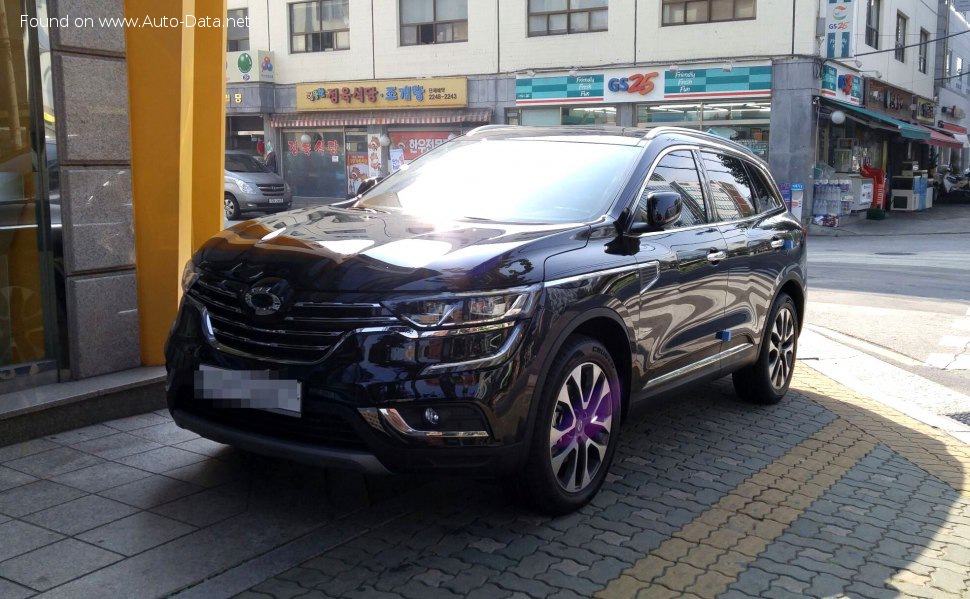
The Renault Samsung QM6 embodies a contemporary SUV design aesthetic that aligns with global automotive trends, reflecting its connection to the Renault Koleos. As a five-door, five-seat SUV, it prioritizes both passenger comfort and cargo versatility. Its exterior styling is characterized by clean lines, a muscular stance, and distinctive lighting signatures that give it a strong road presence. The vehicle’s dimensions are substantial, measuring 184.06 inches (4675 mm) in length, 72.64 inches (1845 mm) in width, and 67.32 inches (1710 mm) in height. These proportions contribute to a spacious interior, making it well-suited for families. The generous wheelbase of 106.5 inches (2705 mm) is a key factor in maximizing cabin space and ensuring a stable ride, while the front track of 62.8 inches (1595 mm) and rear track of 62.6 inches (1590 mm) further enhance its planted feel on the road.
Inside, the QM6 is designed with practicality and ergonomics in mind. The five-seat configuration offers comfortable seating for all occupants, with ample headroom and legroom, reflecting its status as a family-friendly SUV. While specific interior features beyond the seating capacity are not detailed in the provided data, a 2016 model in this segment would typically include amenities such as a modern infotainment system, climate control, and various storage compartments to enhance convenience. Safety is a paramount consideration, and beyond the standard ABS, the QM6 would likely incorporate a suite of passive and active safety features common for SUVs of its era and market, such as multiple airbags, electronic stability control, and potentially advanced driver-assistance systems depending on the trim level.
The QM6’s aesthetic appeal is further enhanced by its wheel and tire options. It offers choices of 17-inch or 18-inch wheel rims, paired with tire sizes of 225/65 R17 102H or 225/60 R18 100H, respectively. These tire specifications not only contribute to the vehicle’s visual appeal but also play a critical role in its handling dynamics, grip, and ride comfort. The larger wheel options typically offer a more assertive look and potentially sharper handling, while the standard sizes provide a good balance of comfort and efficiency. Overall, the Renault Samsung QM6 presents a compelling package for consumers in its target markets, blending sophisticated design with practical functionality and a focus on a comfortable driving experience.
Technical Specifications: Renault Samsung QM6 2.0 GDe (144 Hp) CVT
| Brand | Renault Samsung |
| Model | QM6 |
| Generation | QM6 |
| Type (Engine) | 2.0 GDe (144 Hp) CVT |
| Start of production | 2016 year |
| Powertrain Architecture | Internal Combustion engine |
| Body type | SUV |
| Seats | 5 |
| Doors | 5 |
| Fuel consumption (economy) – urban | 9.3 l/100 km (25.3 US mpg) |
| Fuel consumption (economy) – extra urban | 7.6 l/100 km (30.9 US mpg) |
| Fuel consumption (economy) – combined | 8.9 l/100 km (26.4 US mpg) |
| CO2 emissions | 145 g/km |
| Fuel Type | Petrol (Gasoline) |
| Weight-to-power ratio | 10.6 kg/Hp (94.4 Hp/tonne) |
| Weight-to-torque ratio | 7.6 kg/Nm (131.1 Nm/tonne) |
| Power | 144 Hp @ 6000 rpm |
| Power per liter | 72.1 Hp/l |
| Torque | 200 Nm @ 4400 rpm (147.51 lb.-ft. @ 4400 rpm) |
| Engine layout | Front, Transverse |
| Engine Model/Code | M5R |
| Engine displacement | 1997 cm3 (121.86 cu. in.) |
| Number of cylinders | 4 |
| Engine configuration | Inline |
| Fuel injection system | Direct injection |
| Engine aspiration | Naturally aspirated engine |
| Engine oil capacity | 4.3 l (4.54 US qt) |
| Kerb Weight | 1525 kg (3362.05 lbs.) |
| Length | 4675 mm (184.06 in.) |
| Width | 1845 mm (72.64 in.) |
| Height | 1710 mm (67.32 in.) |
| Wheelbase | 2705 mm (106.5 in.) |
| Front track | 1595 mm (62.8 in.) |
| Rear (Back) track | 1590 mm (62.6 in.) |
| Drivetrain Architecture | The Internal combustion engine (ICE) drives the front wheels of the vehicle. |
| Drive wheel | Front wheel drive |
| Number of gears and type of gearbox | automatic transmission CVT |
| Front suspension | Independent type McPherson |
| Rear suspension | Independent multi-link suspension |
| Front brakes | Ventilated discs |
| Rear brakes | Ventilated discs |
| Assisting systems | ABS (Anti-lock braking system) |
| Steering type | Steering rack and pinion |
| Tires size | 225/65 R17 102H; 225/60 R18 100H |
| Wheel rims size | 17; 18 |