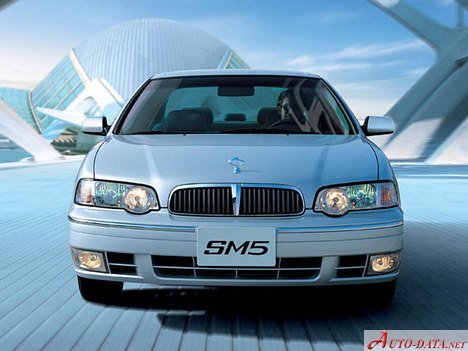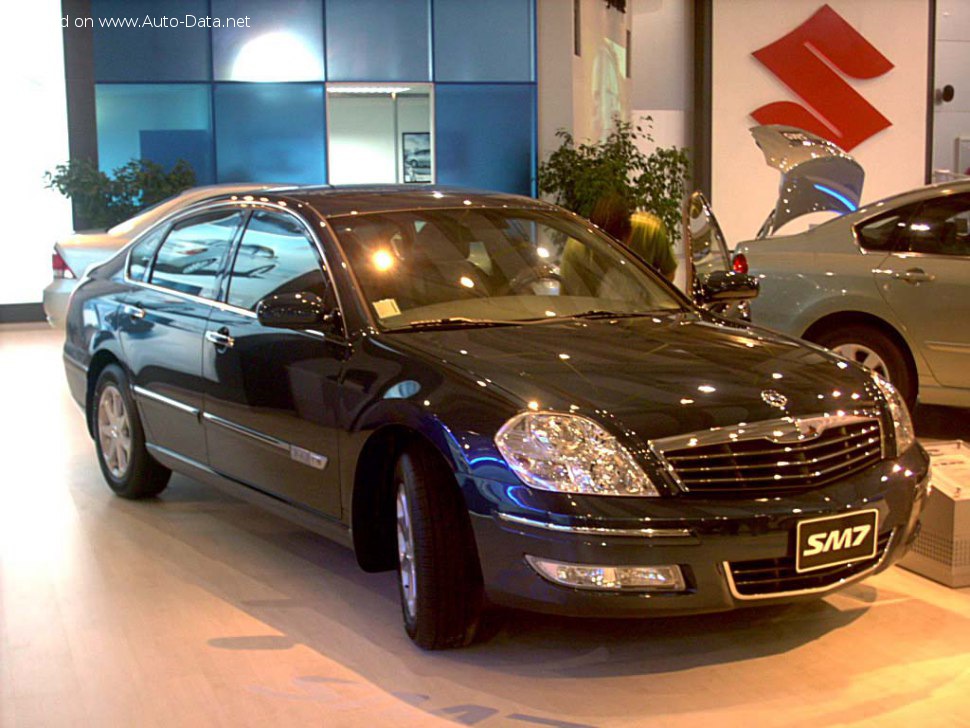
The Renault Samsung SM7 I (EX2) represents a significant chapter in the history of South Korean automotive manufacturing, embodying a blend of French design philosophy, Japanese engineering prowess, and local market sensibilities. Launched in 2004, this first-generation SM7, internally designated EX2, was positioned as a flagship executive sedan, aiming to capture a discerning segment of the South Korean market. As a product of the Renault Samsung Motors joint venture, it leveraged the global expertise of its parent companies, primarily drawing its underpinnings from the Nissan Teana/Maxima platform, a common strategy for the brand to ensure robust engineering and proven reliability. Throughout its production run from 2004 to 2008, the SM7 I (EX2) aimed to deliver a premium driving experience, emphasizing comfort, refinement, and a sophisticated aesthetic tailored for the Asian market, where large sedans often signify status and luxury. This particular variant, the 2.3 i V6 24V (170 Hp), was a cornerstone of its lineup, offering a compelling balance of performance and fuel efficiency for its class.
Engine and Performance of the Renault Samsung SM7 I (EX2)
At the heart of the Renault Samsung SM7 I (EX2) 2.3 i V6 24V (170 Hp) lies a powerplant celebrated for its smoothness and reliability: the Nissan VQ23DE engine. This VQ-series engine, a derivative of Nissan’s acclaimed VQ family, is a naturally aspirated 2.3-liter (2349 cm³ or 143.34 cu. in.) V6 unit, configured with 24 valves, translating to four valves per cylinder for enhanced breathing and efficiency. With a cylinder bore of 3.35 inches (85 mm) and a piston stroke of 2.72 inches (69 mm), combined with a compression ratio of 9.8:1, this engine was engineered to deliver a balanced output suitable for a premium sedan. It generates a respectable 170 horsepower at 6000 rpm, providing ample power for both city commuting and highway cruising. Torque figures stand at 225 Newton-meters, which translates to approximately 165.95 pound-feet, peaking at 4400 rpm. This broad torque band ensures responsive acceleration and confident overtaking maneuvers, contributing to a refined driving experience.
The engine’s front, transverse layout, coupled with a multi-port manifold injection system, optimized both packaging and fuel delivery. Power is transmitted to the front wheels via a conventional and robust 4-speed automatic transmission, a common choice for its era, prioritizing smooth shifts and durability over outright performance. This drivetrain architecture, where the internal combustion engine (ICE) drives the front wheels, provided predictable handling characteristics and efficiency. The vehicle’s kerb weight of 3428.19 pounds (1555 kg) results in a weight-to-power ratio of 9.1 kg/Hp (109.3 Hp/tonne) and a weight-to-torque ratio of 6.9 kg/Nm (144.7 Nm/tonne). These metrics highlight a design philosophy focused on comfortable and effortless propulsion rather than aggressive sportiness. The VQ23DE engine is known for its longevity and relatively low maintenance, further enhancing the SM7’s appeal in markets where durability is highly valued. Its naturally aspirated design ensures a linear power delivery, a characteristic often preferred in luxury-oriented vehicles for its predictability and quiet operation, distinguishing it from the more complex turbocharged engines that would become prevalent in later years.
Design and Features of the Renault Samsung SM7 I (EX2)
The design of the Renault Samsung SM7 I (EX2) embodies the classic proportions of an executive sedan, prioritizing a stately presence and interior spaciousness. Its four-door, five-seat configuration provides comfortable accommodation for passengers, reflecting its role as a premium family or business vehicle. With a length of 194.69 inches (4945 mm), a width of 70.47 inches (1790 mm), and a height of 58.07 inches (1475 mm), the SM7 I (EX2) commanded a significant footprint on the road. The generous wheelbase of 109.25 inches (2775 mm) was instrumental in providing a smooth ride and ample legroom for rear occupants, a critical aspect for its target market. The front track measured 60.63 inches (1540 mm) and the rear track 60.83 inches (1545 mm), contributing to the vehicle’s stable stance and handling dynamics.
Inside, the SM7 I (EX2) offered a refined cabin environment. While specific interior features are not detailed in the raw data, for a sedan of its class and era (2004-2008), one would expect a comprehensive suite of amenities focused on comfort and convenience. These would typically include automatic climate control, power-adjustable seating, a premium audio system, and high-quality upholstery materials. Practicality was also a key consideration, evidenced by a substantial trunk (boot) space of 15.89 cubic feet (450 liters), capable of accommodating luggage for multiple occupants. The fuel tank capacity of 18.49 US gallons (70 liters) ensured a decent cruising range, reducing the frequency of fuel stops, an important factor for long-distance travel.
In terms of chassis and safety, the SM7 I (EX2) was equipped with a robust setup. Both the front and rear suspensions utilized a Spring Strut system, designed to balance ride comfort with competent handling. Braking duties were handled by ventilated discs at the front and solid discs at the rear, a common and effective configuration for sedans of this weight and performance. An Anti-lock Braking System (ABS) was a standard assisting system, enhancing safety by preventing wheel lock-up during hard braking, allowing the driver to maintain steering control. The steering system featured a rack and pinion setup, offering direct and predictable control. The vehicle rode on 205/65 R16 tires mounted on 16-inch wheel rims, providing a good compromise between ride comfort and road grip. Overall, the design and features of the Renault Samsung SM7 I (EX2) were meticulously crafted to deliver a comfortable, safe, and prestigious ownership experience within its segment, reflecting the evolving expectations of the South Korean automotive consumer during the mid-2000s.
Technical Specifications: Renault Samsung SM7 I (EX2) 2.3 i V6 24V (170 Hp)
| Brand | Renault Samsung |
| Model | SM7 |
| Generation | SM7 I (EX2) |
| Type (Engine) | 2.3 i V6 24V (170 Hp) |
| Start of production | 2004 year |
| End of production | 2008 year |
| Powertrain Architecture | Internal Combustion engine |
| Body type | Sedan |
| Seats | 5 |
| Doors | 4 |
| Fuel Type | Petrol (Gasoline) |
| Weight-to-power ratio | 9.1 kg/Hp, 109.3 Hp/tonne |
| Weight-to-torque ratio | 6.9 kg/Nm, 144.7 Nm/tonne |
| Power | 170 Hp @ 6000 rpm |
| Power per liter | 72.4 Hp/l |
| Torque | 225 Nm @ 4400 rpm (165.95 lb.-ft. @ 4400 rpm) |
| Engine layout | Front, Transverse |
| Engine Model/Code | VQ23DE |
| Engine displacement | 2349 cm³ (143.34 cu. in.) |
| Number of cylinders | 6 |
| Engine configuration | V-engine |
| Cylinder Bore | 85 mm (3.35 in.) |
| Piston Stroke | 69 mm (2.72 in.) |
| Compression ratio | 9.8:1 |
| Number of valves per cylinder | 4 |
| Fuel injection system | Multi-port manifold injection |
| Engine aspiration | Naturally aspirated engine |
| Engine oil capacity | 4 l (4.23 US qt | 3.52 UK qt) |
| Kerb Weight | 1555 kg (3428.19 lbs.) |
| Trunk (boot) space – minimum | 450 l (15.89 cu. ft.) |
| Fuel tank capacity | 70 l (18.49 US gal | 15.4 UK gal) |
| Length | 4945 mm (194.69 in.) |
| Width | 1790 mm (70.47 in.) |
| Height | 1475 mm (58.07 in.) |
| Wheelbase | 2775 mm (109.25 in.) |
| Front track | 1540 mm (60.63 in.) |
| Rear (Back) track | 1545 mm (60.83 in.) |
| Drivetrain Architecture | The Internal combustion engine (ICE) drives the front wheels of the vehicle. |
| Drive wheel | Front wheel drive |
| Number of gears and type of gearbox | 4 gears, automatic transmission |
| Front suspension | Spring Strut |
| Rear suspension | Spring Strut |
| Front brakes | Ventilated discs |
| Rear brakes | Disc |
| Assisting systems | ABS (Anti-lock braking system) |
| Steering type | Steering rack and pinion |
| Tires size | 205/65 R16 |
| Wheel rims size | 16 |