
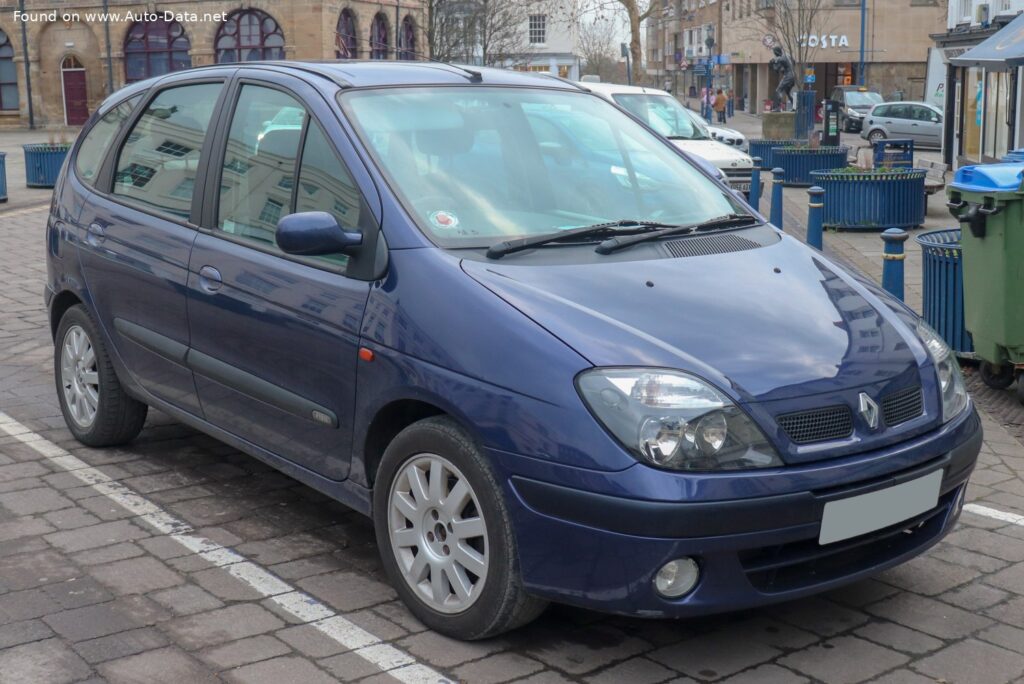
The Renault Scenic I (Phase II) 2.0 i 16V IDE (140 Hp) represents a significant evolution in the compact minivan segment. Introduced in 2000, this iteration of the Scenic, a vehicle not widely sold in the United States, built upon the success of the original Scenic launched in 1996. The Scenic was a pioneering vehicle, often credited with popularizing the modern compact multi-purpose vehicle (MPV) – or minivan – in Europe. The Phase II updates brought refinements to the styling, interior, and mechanical components, solidifying its position as a practical and family-oriented vehicle in the European market. This model focused on providing a spacious and versatile interior within a relatively compact footprint, appealing to families and individuals seeking a flexible transportation solution.
Renault Scenic I (Phase II): A European Compact MPV
The Renault Scenic I (Phase II) occupied a crucial space in Renault’s lineup, offering an alternative to traditional hatchbacks and larger, more expensive MPVs. It was designed to cater to the growing demand for vehicles that could comfortably accommodate passengers and cargo while remaining easy to maneuver in urban environments. The Phase II model, specifically the 2.0 i 16V IDE variant, aimed to balance performance with fuel efficiency, making it a popular choice for everyday driving. While not available in the US market, the Scenic’s influence on MPV design is undeniable, and it paved the way for similar vehicles offered by other manufacturers globally.
Engine & Performance
The heart of the Scenic I (Phase II) 2.0 i 16V IDE is a naturally aspirated 2.0-liter inline-four cylinder engine, designated the F4R. This engine produces 140 horsepower at 5500 rpm and 188 Nm (138.66 lb.-ft.) of torque at 3750 rpm. The engine features multi-port fuel injection and a double overhead camshaft (DOHC) valvetrain, contributing to its responsive performance. Power delivery is smooth and linear, making it well-suited for everyday driving conditions. The engine’s power-to-weight ratio of 9.2 kg/Hp and torque-to-weight ratio of 6.9 kg/Nm provide adequate acceleration and responsiveness. The vehicle achieves a 0-100 km/h (0-62 mph) time of 10.2 seconds, and a 0-60 mph time of approximately 9.7 seconds. Its top speed is rated at 196 km/h (121.79 mph). Fuel economy is rated at 10.8 l/100 km (21.8 US mpg) in urban driving and 6.4 l/100 km (36.8 US mpg) on the extra-urban cycle.
Design & Features
The Renault Scenic I (Phase II) is a five-door minivan with a practical and functional design. Its compact dimensions – 4168 mm (164.09 in) in length, 1719 mm (67.68 in) in width, and 1609 mm (63.35 in) in height – make it relatively easy to maneuver and park. The interior is designed with versatility in mind, offering seating for five passengers. A key feature of the Scenic is its modular interior, with seats that can be folded, removed, or reconfigured to maximize cargo space. Trunk space ranges from a minimum of 410 liters (14.48 cu. ft.) to a maximum of 1800 liters (63.57 cu. ft.) with the rear seats folded down. Safety features for the time included ABS (Anti-lock Braking System) and a robust body structure. The Phase II updates included minor cosmetic changes to the exterior, such as revised headlights and bumpers, and improvements to the interior trim and materials. The vehicle utilizes a front-wheel-drive layout, coupled with a hydraulic power steering system and a five-speed manual transmission.
Technical Specifications
| Brand | Renault |
| Model | Scenic |
| Generation | Scenic I (Phase II) |
| Type (Engine) | 2.0 i 16V IDE (140 Hp) |
| Start of production | 2000 |
| End of production | 2000 |
| Powertrain Architecture | Internal Combustion engine |
| Body type | Minivan |
| Seats | 5 |
| Doors | 5 |
| Fuel consumption (urban) | 10.8 l/100 km (21.8 US mpg) |
| Fuel consumption (extra urban) | 6.4 l/100 km (36.8 US mpg) |
| Fuel Type | Petrol (Gasoline) |
| Acceleration 0 – 100 km/h | 10.2 sec |
| Acceleration 0 – 62 mph | 10.2 sec |
| Acceleration 0 – 60 mph | 9.7 sec |
| Maximum speed | 196 km/h (121.79 mph) |
| Weight-to-power ratio | 9.2 kg/Hp |
| Weight-to-torque ratio | 6.9 kg/Nm |
| Power | 140 Hp @ 5500 rpm |
| Torque | 188 Nm @ 3750 rpm (138.66 lb.-ft. @ 3750 rpm) |
| Engine layout | Front, Transverse |
| Engine Model/Code | F4R |
| Engine displacement | 1998 cm3 (121.93 cu. in.) |
| Number of cylinders | 4 |
| Engine configuration | Inline |
| Cylinder Bore | 82.7 mm (3.26 in.) |
| Piston Stroke | 93 mm (3.66 in.) |
| Compression ratio | 9.8:1 |
| Number of valves per cylinder | 4 |
| Fuel injection system | Multi-port manifold injection |
| Engine aspiration | Naturally aspirated |
| Valvetrain | DOHC |
| Engine oil capacity | 5.3 l (5.6 US qt | 4.66 UK qt) |
| Coolant capacity | 7 l (7.4 US qt | 6.16 UK qt) |
| Kerb Weight | 1290 kg (2843.96 lbs.) |
| Max. weight | 1815 kg (4001.39 lbs.) |
| Max load | 525 kg (1157.43 lbs.) |
| Trunk (boot) space – minimum | 410 l (14.48 cu. ft.) |
| Trunk (boot) space – maximum | 1800 l (63.57 cu. ft.) |
| Fuel tank capacity | 60 l (15.85 US gal | 13.2 UK gal) |
| Length | 4168 mm (164.09 in.) |
| Width | 1719 mm (67.68 in.) |
| Height | 1609 mm (63.35 in.) |
| Wheelbase | 2580 mm (101.57 in.) |
| Front track | 1446 mm (56.93 in.) |
| Rear track | 1458 mm (57.4 in.) |
| Drivetrain Architecture | Front wheel drive |
| Number of gears | 5 |
| Gearbox type | Manual transmission |
| Front suspension | Spring Strut |
| Rear suspension | Torsion |
| Front brakes | Disc |
| Rear brakes | Disc |
| Assisting systems | ABS (Anti-lock braking system) |
| Steering type | Steering rack and pinion |
| Power steering | Hydraulic |
| Tires size | 195/60 R15 |
| Wheel rims size | 15 |
