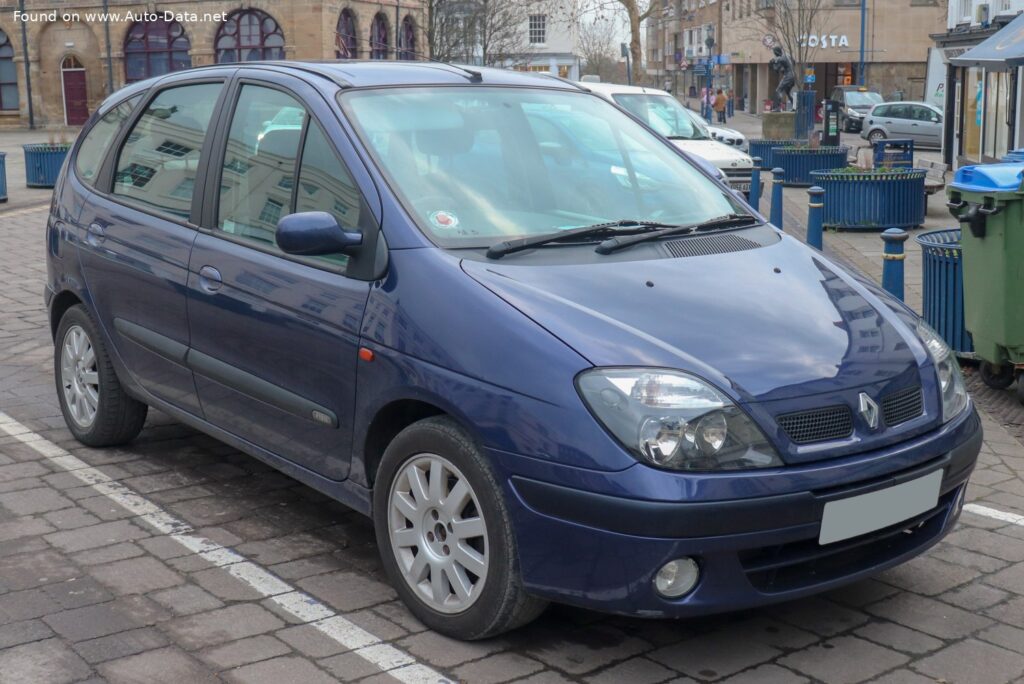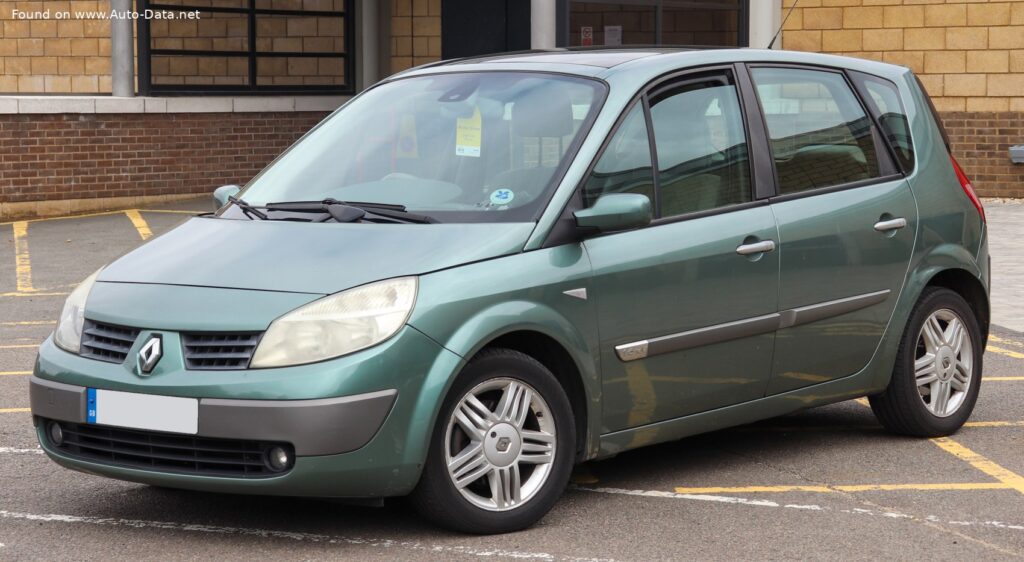
The Renault Scenic II (Phase I) 2.0 i 16V T, produced between 2004 and 2006, represents a significant evolution in the compact minivan segment. As a key model in Renault’s lineup, the Scenic II was designed to appeal to families seeking a practical, versatile, and comfortable vehicle. While not initially sold in the United States, the Scenic series, and particularly the second generation, became a dominant force in the European market, known for its innovative features and spacious interior. This version, equipped with a 2.0-liter turbocharged engine producing 163 horsepower, offered a balance of performance and fuel efficiency for its time.
Renault Scenic II (Phase I) 2.0 i 16V T: An Overview
The Scenic II built upon the success of the original Scenic, addressing criticisms and introducing improvements in design, safety, and technology. Positioned as a five-seater minivan (or multi-purpose vehicle – MPV – as it was commonly known in Europe), it competed with vehicles like the Citroën Xsara Picasso, Opel/Vauxhall Zafira, and Ford Focus C-Max. The Phase I designation refers to the initial production run, with subsequent phases introducing styling and equipment updates. The 2.0 i 16V T variant specifically targeted drivers who desired more power and responsiveness than the base engine options.
Engine & Performance
At the heart of the Scenic II 2.0 i 16V T lies Renault’s F4R engine, a 1998cc (121.93 cubic inches) inline four-cylinder powerplant. This engine is notable for its use of a turbocharger and intercooler, boosting output to 163 horsepower at 5000 rpm and 270 Nm (199.14 lb-ft) of torque at 3250 rpm. The turbocharging significantly enhances both acceleration and mid-range performance. Power per liter is a respectable 81.6 hp/l. This engine was paired with a six-speed manual transmission, allowing for precise control and efficient power delivery. Performance figures include a 0-100 km/h (0-62 mph) acceleration time of 9.6 seconds and a 0-60 mph time of 9.1 seconds, with a maximum speed of 206 km/h (128 mph). The weight-to-power ratio of 8.7 kg/Hp and weight-to-torque ratio of 5.3 kg/Nm contribute to a responsive driving experience.
Design & Features
The Renault Scenic II Phase I adopted a more refined and modern aesthetic compared to its predecessor. Its minivan body style prioritized interior space and practicality. The vehicle features five doors and comfortably accommodates five passengers. Key design elements included a distinctive front grille, sculpted headlights, and a relatively high roofline maximizing headroom. Inside, the Scenic II was lauded for its modular interior, offering flexible seating arrangements and ample storage space. The trunk offered 430 liters (15.19 cubic feet) of space with the rear seats up, expanding to a substantial 1840 liters (64.98 cubic feet) when folded down. Safety features for the time included ABS (Anti-lock Braking System) and a robust body structure. Other notable features included a 60-liter (15.85 US gallons) fuel tank, a maximum roof load capacity of 80 kg (176.37 lbs), and towing capabilities of up to 1300 kg (2866.01 lbs) with brakes.
Technical Specifications
| Brand | Renault |
| Model | Scenic |
| Generation | Scenic II (Phase I) |
| Type (Engine) | 2.0 i 16V T (163 Hp) |
| Start of production | 2004 |
| End of production | 2006 |
| Powertrain Architecture | Internal Combustion engine |
| Body type | Minivan |
| Seats | 5 |
| Doors | 5 |
| Fuel consumption (urban) | 11.2 l/100 km (21 US mpg, 25.2 UK mpg, 8.9 km/l) |
| Fuel consumption (extra urban) | 6.3 l/100 km (37.3 US mpg, 44.8 UK mpg, 15.9 km/l) |
| Fuel consumption (combined) | 8.1 l/100 km (29 US mpg, 34.9 UK mpg, 12.3 km/l) |
| CO2 emissions | 194 g/km |
| Fuel Type | Petrol (Gasoline) |
| Acceleration 0 – 100 km/h | 9.6 sec |
| Acceleration 0 – 62 mph | 9.6 sec |
| Acceleration 0 – 60 mph | 9.1 sec |
| Maximum speed | 206 km/h (128 mph) |
| Emission standard | Euro 3 D4 |
| Weight-to-power ratio | 8.7 kg/Hp |
| Weight-to-torque ratio | 5.3 kg/Nm |
| Power | 163 Hp @ 5000 rpm |
| Torque | 270 Nm @ 3250 rpm (199.14 lb.-ft. @ 3250 rpm) |
| Engine layout | Front, Transverse |
| Engine Model/Code | F4R |
| Engine displacement | 1998 cm3 (121.93 cu. in.) |
| Number of cylinders | 4 |
| Engine configuration | Inline |
| Cylinder Bore | 82.7 mm (3.26 in.) |
| Piston Stroke | 93 mm (3.66 in.) |
| Compression ratio | 10:1 |
| Number of valves per cylinder | 4 |
| Fuel injection system | Multi-port manifold injection |
| Engine aspiration | Turbocharger, Intercooler |
| Valvetrain | DOHC |
| Engine oil capacity | 5.4 l (5.71 US qt | 4.75 UK qt) |
| Coolant | 6.5 l (6.87 US qt | 5.72 UK qt) |
| Kerb Weight | 1425 kg (3141.59 lbs.) |
| Max. weight | 1980 kg (4365.15 lbs.) |
| Max load | 555 kg (1223.57 lbs.) |
| Trunk (boot) space – minimum | 430 l (15.19 cu. ft.) |
| Trunk (boot) space – maximum | 1840 l (64.98 cu. ft.) |
| Fuel tank capacity | 60 l (15.85 US gal | 13.2 UK gal) |
| Max. roof load | 80 kg (176.37 lbs.) |
| Permitted trailer load with brakes (12%) | 1300 kg (2866.01 lbs.) |
| Permitted trailer load without brakes | 650 kg (1433 lbs.) |
| Permitted towbar download | 75 kg (165.35 lbs.) |
| Length | 4259 mm (167.68 in.) |
| Width | 1810 mm (71.26 in.) |
| Width including mirrors | 2087 mm (82.17 in.) |
| Height | 1620 mm (63.78 in.) |
| Wheelbase | 2685 mm (105.71 in.) |
| Front track | 1514 mm (59.61 in.) |
| Rear (Back) track | 1514 mm (59.61 in.) |
| Front overhang | 851 mm (33.5 in.) |
| Rear overhang | 723 mm (28.46 in.) |
| Ride height (ground clearance) | 130 mm (5.12 in.) |
| Minimum turning circle (turning diameter) | 10.7 m (35.1 ft.) |
| Drivetrain Architecture | Front wheel drive |
| Number of gears and type of gearbox | 6 gears, manual transmission |
| Front suspension | Independent type McPherson |
| Rear suspension | Elastic beam |
| Front brakes | Ventilated discs, 300 mm |
| Rear brakes | Disc, 270 mm |
| Assisting systems | ABS (Anti-lock braking system) |
| Steering type | Steering rack and pinion |
| Tires size | 205/60 R16 |
| Wheel rims size | 16 |
The Renault Scenic II (Phase I) 2.0 i 16V T remains a popular choice in the used car market, particularly in Europe, due to its practicality, comfort, and relatively efficient turbocharged engine. It represents a significant step forward in the development of the modern compact minivan.