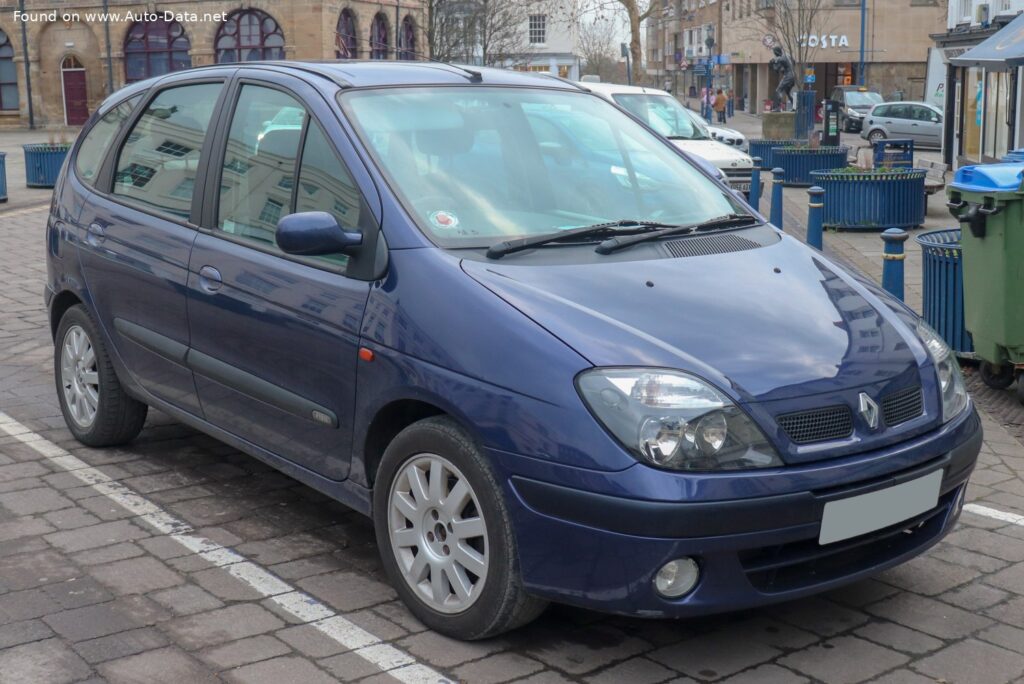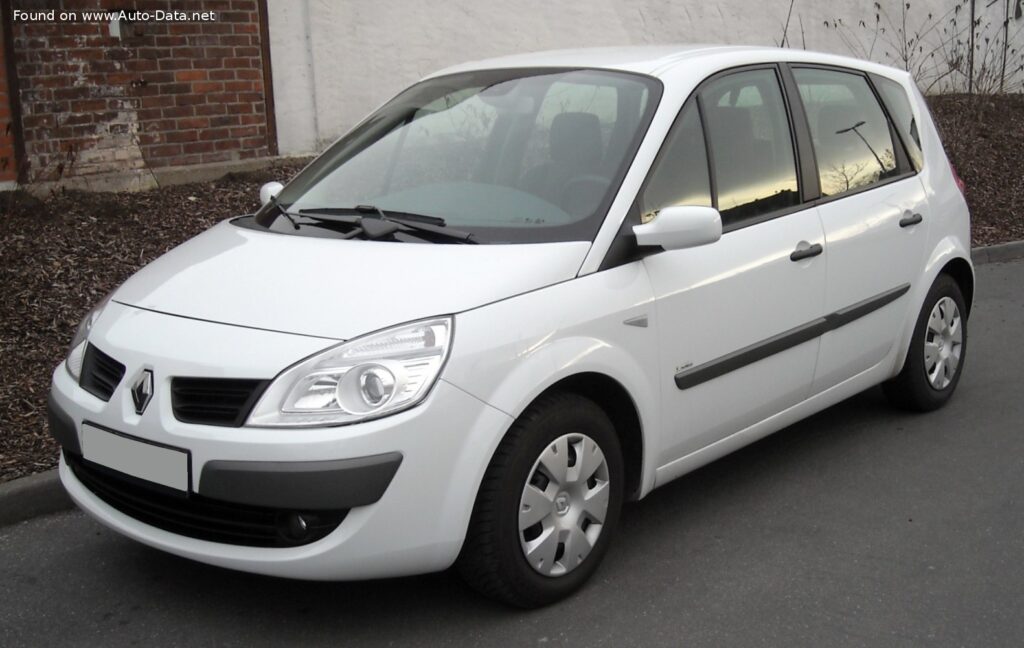
The Renault Scenic II (Phase II) 2.0 i 16V Automatic, produced between 2006 and 2008, represents a significant evolution of Renault’s popular compact minivan. Positioned as a family vehicle, the Scenic II aimed to provide practicality, comfort, and a degree of style within the European market. While not officially sold in the United States, the Scenic series, and particularly the second generation, was a key player in establishing the modern compact MPV (Multi-Purpose Vehicle) segment in Europe. This version, equipped with a 2.0-liter gasoline engine and an automatic transmission, offered a balance between performance and convenience for buyers seeking a versatile vehicle.
Renault Scenic II (Phase II): An Overview
The Scenic II, launched in 2003, was a substantial upgrade over its predecessor, offering increased space, improved build quality, and a more refined driving experience. The Phase II update, introduced in 2006, brought cosmetic revisions, enhanced safety features, and refinements to the engine lineup. The 2.0 i 16V model, producing 135 horsepower, was a popular choice for those prioritizing smooth power delivery and ease of use, particularly when paired with the four-speed automatic transmission. The Scenic II competed with vehicles like the Citroën Xsara Picasso, Opel/Vauxhall Zafira, and Ford Focus C-Max, all vying for the attention of European families.
Engine & Performance
The heart of the Scenic II 2.0 i 16V is a naturally aspirated, 1998cc (121.93 cubic inches) inline-four cylinder gasoline engine. This F4R engine, a common powerplant in Renault vehicles of the era, delivers 135 horsepower at 5500 rpm and 191 Nm (140.87 lb-ft) of torque at 3750 rpm. While not a performance-oriented engine, it provides adequate power for everyday driving and highway cruising. The four-speed automatic transmission offers smooth gear changes, contributing to a comfortable driving experience. Acceleration from 0 to 100 km/h (0-62 mph) takes 11.5 seconds, and the vehicle has a top speed of 190 km/h (118.06 mph). Fuel economy is rated at 8.6 l/100 km (27.4 US mpg) combined, with 11.9 l/100 km (19.8 US mpg) in urban conditions and 6.7 l/100 km (35.1 US mpg) on the open road. The engine’s power-to-weight ratio is 95.7 hp per tonne, and the torque-to-weight ratio is 135.5 Nm per tonne.
Design & Features
The Renault Scenic II Phase II is a five-door minivan designed to maximize interior space and practicality. Its compact dimensions – 4263 mm (167.83 in) in length, 1805 mm (71.06 in) in width, and 1620 mm (63.78 in) in height) – make it relatively easy to maneuver in urban environments. The interior is designed with family needs in mind, offering comfortable seating for five passengers. A key feature is the versatile seating arrangement, with individual rear seats that can be folded flat or removed entirely, creating a large and flexible cargo area. Trunk space ranges from a minimum of 406 liters (14.34 cu ft) to a maximum of 1840 liters (64.98 cu ft) with the rear seats folded. Safety features for the Phase II model included ABS (Anti-lock Braking System) as standard, and improvements were made to the body structure to enhance crash protection. Other features included electric power steering, a standard audio system, and air conditioning. The Phase II also received minor styling updates, including revised front and rear bumpers and updated interior trim.
Technical Specifications
| Brand | Renault |
| Model | Scenic |
| Generation | Scenic II (Phase II) |
| Type (Engine) | 2.0 i 16V (135 Hp) Automatic |
| Start of production | 2006 |
| End of production | 2008 |
| Powertrain Architecture | Internal Combustion engine |
| Body type | Minivan |
| Seats | 5 |
| Doors | 5 |
| Fuel consumption (urban) | 11.9 l/100 km (19.8 US mpg) |
| Fuel consumption (extra urban) | 6.7 l/100 km (35.1 US mpg) |
| Fuel consumption (combined) | 8.6 l/100 km (27.4 US mpg) |
| CO2 emissions | 205 g/km |
| Fuel Type | Petrol (Gasoline) |
| Acceleration 0 – 100 km/h | 11.5 sec |
| Acceleration 0 – 62 mph | 11.5 sec |
| Acceleration 0 – 60 mph | 10.9 sec |
| Maximum speed | 190 km/h (118.06 mph) |
| Emission standard | Euro 4 |
| Weight-to-power ratio | 10.4 kg/Hp |
| Weight-to-torque ratio | 7.4 kg/Nm |
| Power | 135 Hp @ 5500 rpm |
| Torque | 191 Nm @ 3750 rpm (140.87 lb.-ft. @ 3750 rpm) |
| Engine layout | Front, Transverse |
| Engine Model/Code | F4R |
| Engine displacement | 1998 cm3 (121.93 cu. in.) |
| Number of cylinders | 4 |
| Engine configuration | Inline |
| Cylinder Bore | 82.7 mm (3.26 in.) |
| Piston Stroke | 93 mm (3.66 in.) |
| Number of valves per cylinder | 4 |
| Fuel injection system | Multi-port manifold injection |
| Engine aspiration | Naturally aspirated |
| Engine oil capacity | 5.4 l (5.71 US qt | 4.75 UK qt) |
| Coolant | 6.5 l (6.87 US qt | 5.72 UK qt) |
| Kerb Weight | 1410 kg (3108.52 lbs.) |
| Max. weight | 1985 kg (4376.18 lbs.) |
| Max load | 575 kg (1267.66 lbs.) |
| Trunk (boot) space – minimum | 406 l (14.34 cu. ft.) |
| Trunk (boot) space – maximum | 1840 l (64.98 cu. ft.) |
| Fuel tank capacity | 60 l (15.85 US gal | 13.2 UK gal) |
| Max. roof load | 80 kg (176.37 lbs.) |
| Permitted trailer load with brakes (12%) | 1250 kg (2755.78 lbs.) |
| Permitted trailer load without brakes | 650 kg (1433 lbs.) |
| Permitted towbar download | 75 kg (165.35 lbs.) |
| Length | 4263 mm (167.83 in.) |
| Width | 1805 mm (71.06 in.) |
| Width including mirrors | 2087 mm (82.17 in.) |
| Height | 1620 mm (63.78 in.) |
| Wheelbase | 2685 mm (105.71 in.) |
| Front track | 1514 mm (59.61 in.) |
| Rear track | 1514 mm (59.61 in.) |
| Ride height (ground clearance) | 130 mm (5.12 in.) |
| Minimum turning circle | 10.7 m (35.1 ft.) |
| Drivetrain | Front wheel drive |
| Number of gears and type of gearbox | 4 gears, automatic transmission |
| Front suspension | Independent type McPherson |
| Rear suspension | Elastic beam |
| Front brakes | Ventilated discs, 300 mm |
| Rear brakes | Disc, 270 mm |
| Steering type | Steering rack and pinion |
| Power steering | Electric |
| Tires size | 205/60 R16 |
| Wheel rims size | 16 |