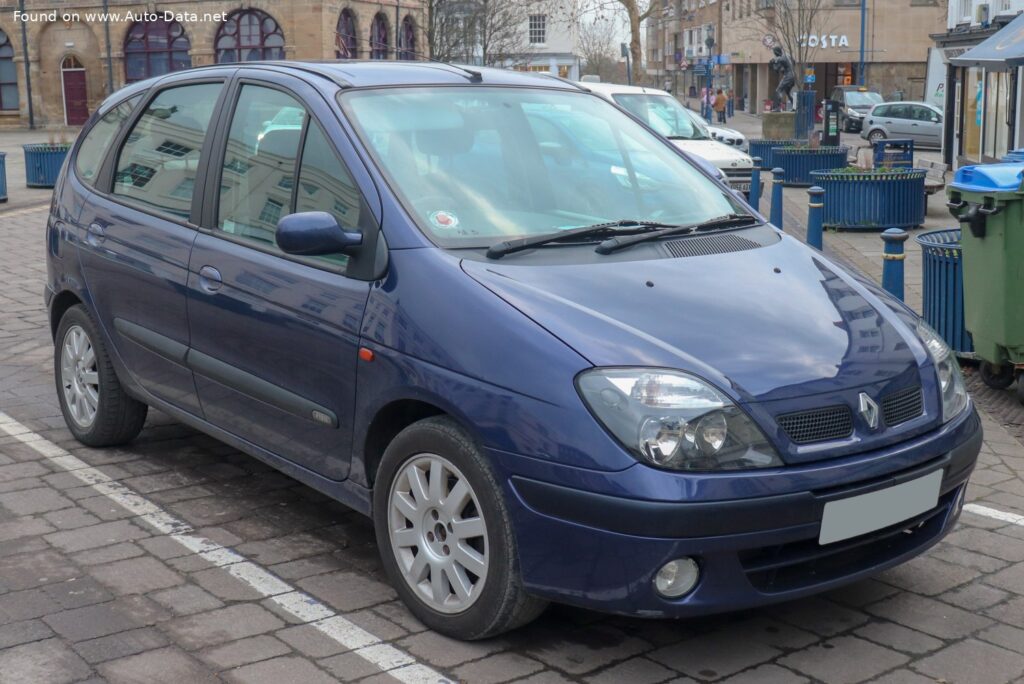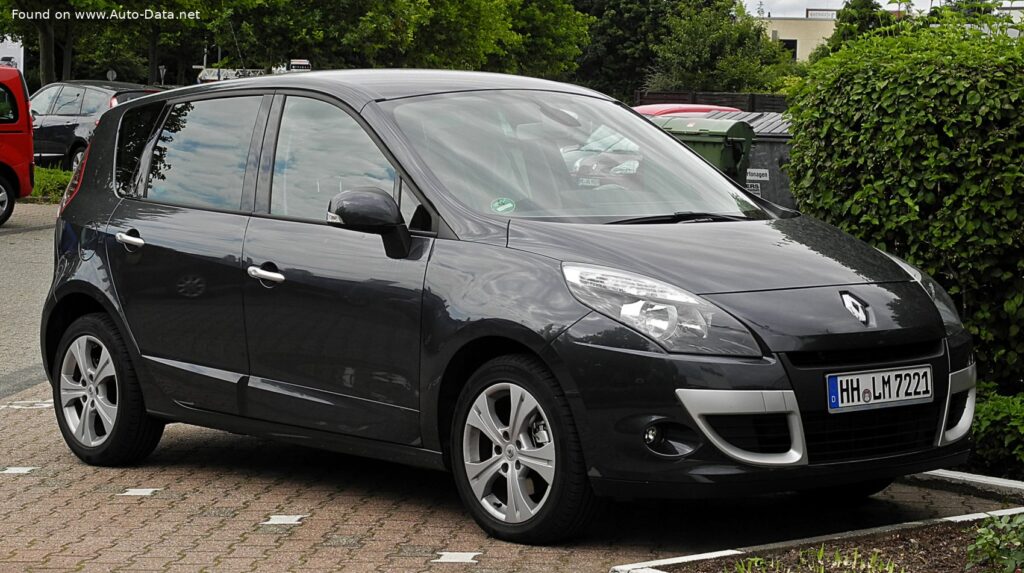
The Renault Scenic III (Phase I) 1.4 TCe (130 Hp) is a compact minivan produced by the French automaker Renault from 2009 to 2011. Representing the third generation of the Scenic model, it aimed to build upon the success of its predecessors by offering a practical and family-oriented vehicle with improved styling and technology. While not officially sold in the United States, the Scenic has been a popular choice in Europe as a versatile and spacious alternative to traditional hatchbacks and small SUVs. The Phase I designation refers to the initial iteration of the third-generation Scenic, with subsequent phases introducing further refinements and updates.
Renault Scenic III (Phase I) 1.4 TCe: Overview
The Scenic III, and specifically the 1.4 TCe variant, was designed to appeal to families seeking a comfortable and functional vehicle for everyday use. It offered a five-seat configuration and a flexible interior layout, prioritizing passenger space and cargo capacity. The 1.4 TCe engine provided a balance between performance and fuel efficiency, making it a suitable option for both urban commuting and longer journeys. The vehicle competed with other European compact minivans such as the Citroën C4 Picasso and the Opel/Vauxhall Zafira.
Engine & Performance
The Renault Scenic III 1.4 TCe is powered by a 1.4-liter, inline-four cylinder turbocharged gasoline engine, designated the H4J. This engine produces 130 horsepower at 5500 rpm and 190 Nm (140.14 lb.-ft.) of torque at 2250 rpm. The turbocharger and intercooler contribute to improved engine responsiveness and power delivery. Power per liter is rated at 93.2 hp/l. The engine is transversely mounted at the front of the vehicle and drives the front wheels. The 1.4 TCe engine was known for its relatively good fuel economy for its class, achieving a combined fuel consumption of 7.1 l/100 km (33.1 US mpg, 39.8 UK mpg). Acceleration from 0 to 100 km/h (0-62 mph) takes 10.5 seconds, with a top speed of 195 km/h (121.17 mph). The vehicle features a six-speed manual transmission.
Design & Features
The Scenic III Phase I showcased a more modern and refined exterior design compared to its predecessor. It featured a distinctive front end with a large Renault logo and sculpted headlights. The body style is a five-door minivan, offering easy access for passengers and cargo. Inside, the cabin was designed with practicality and comfort in mind. Key features included a spacious interior, comfortable seating, and a flexible cargo area. The trunk offers 437 liters (15.43 cu. ft.) of space with the rear seats up, expanding to 1894 liters (66.89 cu. ft.) when the seats are folded down. Safety features, typical for the era, included ABS (Anti-lock Braking System) and driver/passenger airbags. The vehicle’s kerb weight is 1320 kg (2910.1 lbs), with a maximum permissible weight of 1837 kg (4049.89 lbs). The suspension utilizes an independent McPherson strut setup at the front and an elastic beam arrangement at the rear, providing a balance between ride comfort and handling.
Technical Specifications
| Brand | Renault |
| Model | Scenic |
| Generation | Scenic III (Phase I) |
| Type (Engine) | 1.4 TCe (130 Hp) |
| Start of production | 2009 |
| End of production | 2011 |
| Powertrain Architecture | Internal Combustion engine |
| Body type | Minivan |
| Seats | 5 |
| Doors | 5 |
| Fuel consumption (urban) | 9.4 l/100 km (25 US mpg, 30.1 UK mpg) |
| Fuel consumption (extra urban) | 5.8 l/100 km (40.6 US mpg, 48.7 UK mpg) |
| Fuel consumption (combined) | 7.1 l/100 km (33.1 US mpg, 39.8 UK mpg) |
| CO2 emissions | 168 g/km |
| Fuel Type | Petrol (Gasoline) |
| Acceleration 0 – 100 km/h | 10.5 sec |
| Acceleration 0 – 62 mph | 10.5 sec |
| Acceleration 0 – 60 mph | 10 sec |
| Maximum speed | 195 km/h (121.17 mph) |
| Emission standard | Euro 4 |
| Weight-to-power ratio | 10.2 kg/Hp |
| Weight-to-torque ratio | 6.9 kg/Nm |
| Power | 130 Hp @ 5500 rpm |
| Torque | 190 Nm @ 2250 rpm (140.14 lb.-ft. @ 2250 rpm) |
| Engine layout | Front, Transverse |
| Engine Model/Code | H4J |
| Engine displacement | 1395 cm3 (85.13 cu. in.) |
| Number of cylinders | 4 |
| Engine configuration | Inline |
| Cylinder Bore | 78 mm (3.07 in.) |
| Piston Stroke | 73.1 mm (2.88 in.) |
| Compression ratio | 9.1:1 |
| Number of valves per cylinder | 4 |
| Fuel injection system | Multi-port manifold injection |
| Engine aspiration | Turbocharger, Intercooler |
| Valvetrain | DOHC |
| Engine oil capacity | 4.5 l (4.76 US qt | 3.96 UK qt) |
| Coolant | 6.5 l (6.87 US qt | 5.72 UK qt) |
| Kerb Weight | 1320 kg (2910.1 lbs.) |
| Max. weight | 1837 kg (4049.89 lbs.) |
| Max load | 517 kg (1139.79 lbs.) |
| Trunk (boot) space – minimum | 437 l (15.43 cu. ft.) |
| Trunk (boot) space – maximum | 1894 l (66.89 cu. ft.) |
| Fuel tank capacity | 60 l (15.85 US gal | 13.2 UK gal) |
| Max. roof load | 80 kg (176.37 lbs.) |
| Permitted trailer load with brakes (12%) | 1300 kg (2866.01 lbs.) |
| Permitted trailer load without brakes | 695 kg (1532.21 lbs.) |
| Permitted towbar download | 75 kg (165.35 lbs.) |
| Length | 4343 mm (170.98 in.) |
| Width | 1845 mm (72.64 in.) |
| Width including mirrors | 2077 mm (81.77 in.) |
| Height | 1624 mm (63.94 in.) |
| Wheelbase | 2702 mm (106.38 in.) |
| Front track | 1546 mm (60.87 in.) |
| Rear (Back) track | 1547 mm (60.91 in.) |
| Front overhang | 888 mm (34.96 in.) |
| Rear overhang | 753 mm (29.65 in.) |
| Ride height (ground clearance) | 120 mm (4.72 in.) |
| Minimum turning circle (turning diameter) | 11.05 m (36.25 ft.) |
| Drive wheel | Front wheel drive |
| Number of gears and type of gearbox | 6 gears, manual transmission |
| Front suspension | Independent type McPherson |
| Rear suspension | Elastic beam |
| Front brakes | Ventilated discs, 296 mm |
| Rear brakes | Disc, 260 mm |
| Steering type | Steering rack and pinion |
| Power steering | Electric Steering |
| Tires size | 205/60 R16; 205/55 R17 |
| Wheel rims size | 16; 17 |
The Renault Scenic III (Phase I) 1.4 TCe offered a compelling package for families seeking a practical, comfortable, and relatively fuel-efficient minivan. While not available in the US market, it remains a significant model in Renault’s history and a popular choice in Europe.