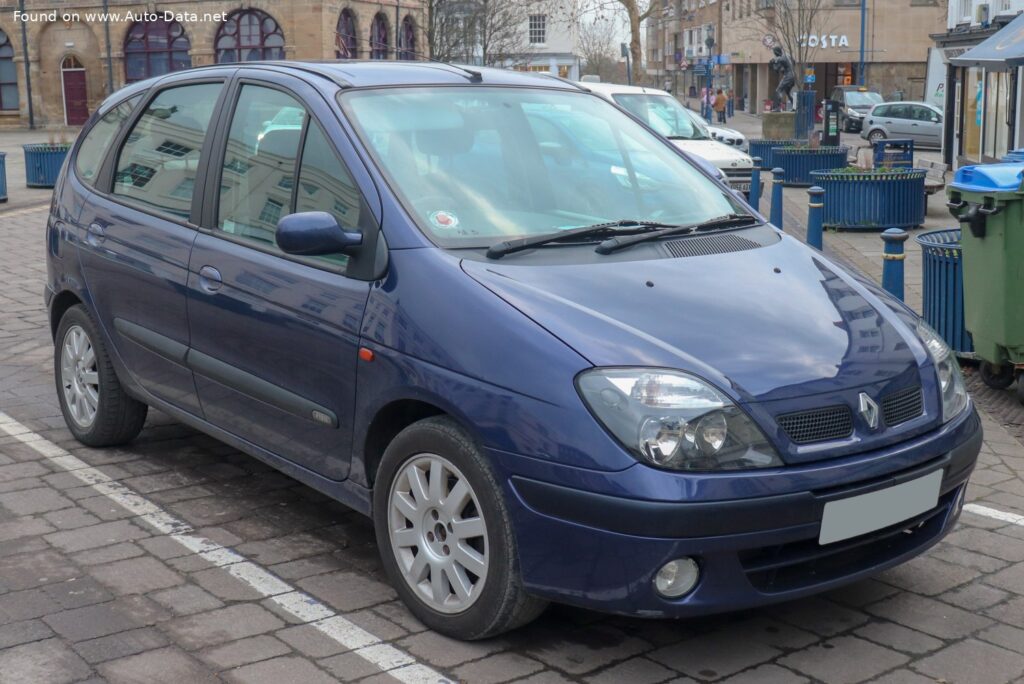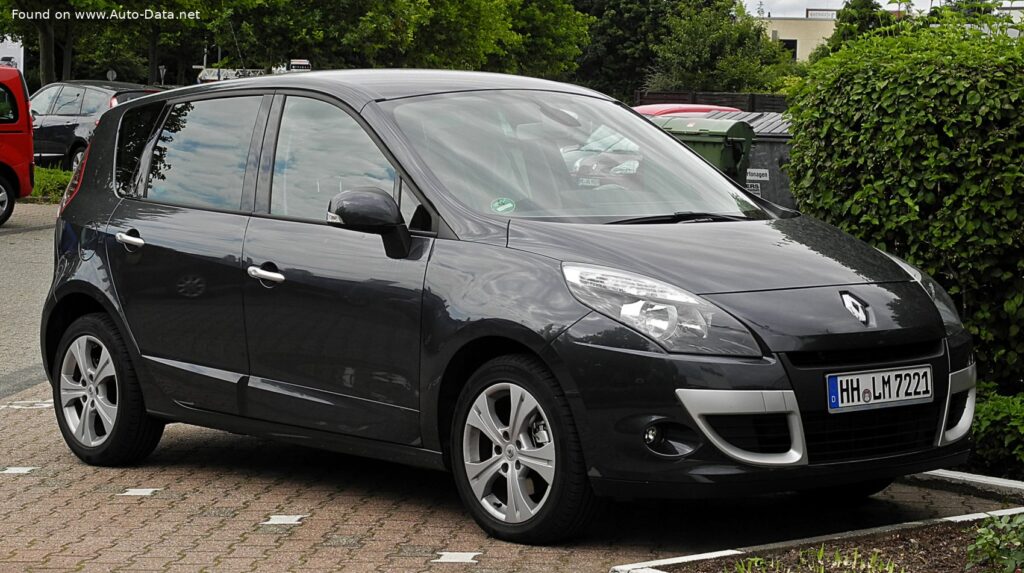
The Renault Scenic III (Phase I) 1.6 16V, produced between 2009 and 2011, represents the third generation of Renault’s popular compact minivan. Positioned as a family vehicle, the Scenic III aimed to improve upon its predecessors with enhanced practicality, comfort, and a more modern design. While not officially sold in the United States, the Scenic has been a significant player in the European market, competing with vehicles like the Volkswagen Touran and Citroën C4 Picasso. The Phase I models, like the 1.6 16V variant, established the core features and styling that would define the Scenic III range.
Renault Scenic III (Phase I): Overview and Market Position
The Scenic, originally launched in 1996, pioneered the modern compact minivan segment. The third generation, introduced in 2009, continued this legacy by offering a versatile and spacious interior within a relatively compact footprint. The Scenic III was designed to appeal to families seeking a practical and comfortable vehicle for everyday use. The 1.6 16V engine option provided a balance between fuel efficiency and adequate performance for typical driving conditions. In Europe, the Scenic was praised for its innovative storage solutions, panoramic sunroof (often optional), and overall user-friendliness. It was a common sight on European roads, serving as a popular choice for school runs, family holidays, and daily commutes.
Engine & Performance
The Renault Scenic III (Phase I) 1.6 16V is powered by a 1.6-liter inline-four cylinder gasoline engine, designated the K4M engine code. This naturally aspirated engine produces 110 horsepower (Hp) at 6000 rpm and 151 Newton-meters (111.37 lb.-ft.) of torque at 4250 rpm. The engine features multi-port fuel injection and a compression ratio optimized for efficiency and drivability. Power is delivered to the front wheels via a six-speed manual transmission. Acceleration from 0 to 100 km/h (0-62 mph) takes 11.7 seconds, while 0 to 60 mph is achieved in approximately 11.1 seconds. The vehicle has a maximum speed of 185 km/h (114.95 mph). The engine’s power-to-weight ratio is 12 kg/Hp, and the torque-to-weight ratio is 8.7 kg/Nm. Fuel economy is rated at 7.4 liters per 100 kilometers (31.8 US mpg) combined, with 9.9 l/100km (23.8 US mpg) in urban settings and 5.9 l/100km (39.9 US mpg) on the open road. The engine meets Euro 5 emission standards, reflecting Renault’s commitment to reducing environmental impact.
Design & Features
The Renault Scenic III (Phase I) is a five-door minivan with seating for five passengers. Its exterior design is characterized by a flowing silhouette, sculpted lines, and a relatively upright stance. The Phase I models feature a distinctive front fascia with a prominent Renault logo and integrated headlights. Inside, the Scenic III offers a spacious and versatile cabin. The rear seats can be folded down or removed completely, providing a maximum cargo capacity of 1837 liters (64.87 cu. ft.) with all seats folded. Standard features typically included air conditioning, power windows, central locking, and an audio system. Safety features, crucial for family vehicles, included ABS (Anti-lock Braking System) and driver/passenger airbags. The Scenic III also offered a range of optional features, such as a panoramic sunroof, parking sensors, and a navigation system. The interior was designed with practicality in mind, featuring numerous storage compartments and cubbies throughout the cabin.
Technical Specifications
| Brand | Renault |
| Model | Scenic |
| Generation | Scenic III (Phase I) |
| Type (Engine) | 1.6 16V (110 Hp) |
| Start of production | 2009 |
| End of production | 2011 |
| Powertrain Architecture | Internal Combustion engine |
| Body type | Minivan |
| Seats | 5 |
| Doors | 5 |
| Fuel consumption (urban) | 9.9 l/100 km (23.8 US mpg) |
| Fuel consumption (extra urban) | 5.9 l/100 km (39.9 US mpg) |
| Fuel consumption (combined) | 7.4 l/100 km (31.8 US mpg) |
| CO2 emissions | 174 g/km |
| Fuel Type | Petrol (Gasoline) |
| Acceleration 0 – 100 km/h | 11.7 sec |
| Acceleration 0 – 62 mph | 11.7 sec |
| Acceleration 0 – 60 mph | 11.1 sec |
| Maximum speed | 185 km/h (114.95 mph) |
| Emission standard | Euro 5 |
| Weight-to-power ratio | 12 kg/Hp |
| Weight-to-torque ratio | 8.7 kg/Nm |
| Power | 110 Hp @ 6000 rpm |
| Torque | 151 Nm @ 4250 rpm (111.37 lb.-ft. @ 4250 rpm) |
| Engine layout | Front, Transverse |
| Engine Model/Code | K4M |
| Engine displacement | 1598 cm3 (97.52 cu. in.) |
| Number of cylinders | 4 |
| Engine configuration | Inline |
| Cylinder Bore | 79.5 mm (3.13 in.) |
| Piston Stroke | 80.5 mm (3.17 in.) |
| Number of valves per cylinder | 4 |
| Fuel injection system | Multi-port manifold injection |
| Engine aspiration | Naturally aspirated engine |
| Engine oil capacity | 5 l (5.28 US qt | 4.4 UK qt) |
| Coolant | 5.3 l (5.6 US qt | 4.66 UK qt) |
| Kerb Weight | 1320 kg (2910.1 lbs.) |
| Max. weight | 1877 kg (4138.08 lbs.) |
| Max load | 557 kg (1227.97 lbs.) |
| Trunk (boot) space – minimum | 437-522 l (15.43 – 18.43 cu. ft.) |
| Trunk (boot) space – maximum | 1837 l (64.87 cu. ft.) |
| Fuel tank capacity | 60 l (15.85 US gal | 13.2 UK gal) |
| Max. roof load | 80 kg (176.37 lbs.) |
| Permitted trailer load with brakes (12%) | 1300 kg (2866.01 lbs.) |
| Permitted trailer load without brakes | 695 kg (1532.21 lbs.) |
| Permitted towbar download | 75 kg (165.35 lbs.) |
| Length | 4343 mm (170.98 in.) |
| Width | 1845 mm (72.64 in.) |
| Width including mirrors | 2077 mm (81.77 in.) |
| Height | 1624 mm (63.94 in.) |
| Wheelbase | 2702 mm (106.38 in.) |
| Front track | 1546 mm (60.87 in.) |
| Rear (Back) track | 1547 mm (60.91 in.) |
| Front overhang | 888 mm (34.96 in.) |
| Rear overhang | 753 mm (29.65 in.) |
| Ride height (ground clearance) | 120 mm (4.72 in.) |
| Minimum turning circle (turning diameter) | 11.05 m (36.25 ft.) |
| Drivetrain Architecture | Front wheel drive |
| Number of gears and type of gearbox | 6 gears, manual transmission |
| Front suspension | Independent type McPherson |
| Rear suspension | Elastic beam |
| Front brakes | Ventilated discs, 296 mm |
| Rear brakes | Disc, 260 mm |
| Assisting systems | ABS (Anti-lock braking system) |
| Steering type | Steering rack and pinion |
| Power steering | Electric Steering |
| Tires size | 205/ 60 R16 |
| Wheel rims size | 16 |
The Renault Scenic III (Phase I) 1.6 16V offered a compelling package for families in Europe, combining practicality, comfort, and reasonable running costs. While never officially available in the US market, it represents a significant example of European compact minivan design and engineering.