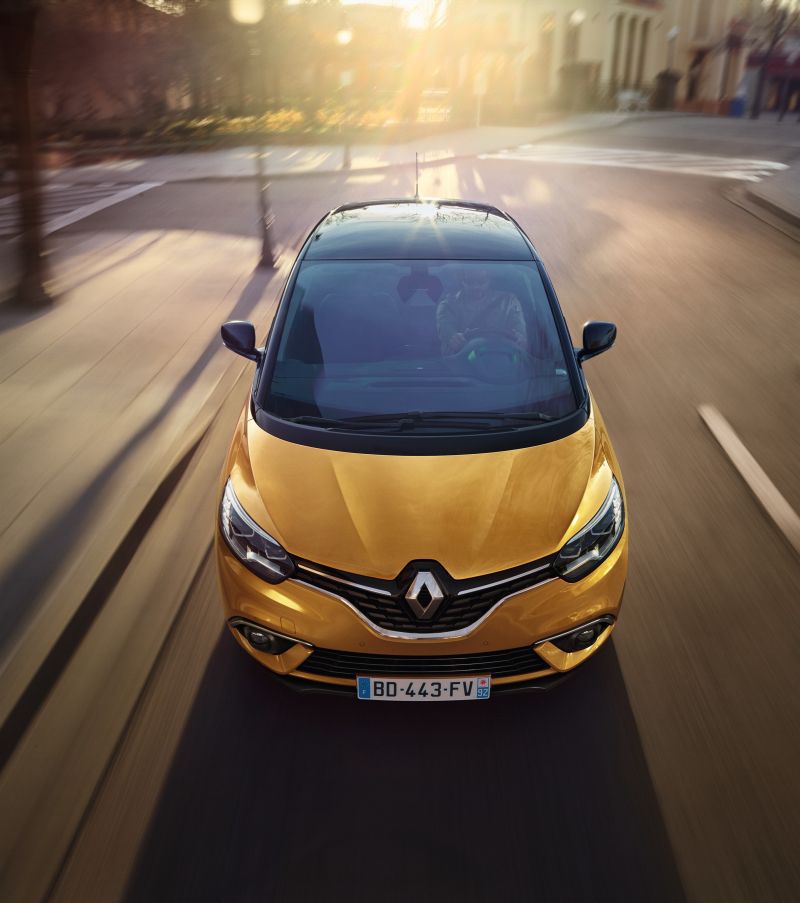
The Renault Scenic IV (Phase I) 1.6 Energy dCi (160 Hp) EDC is a compact minivan produced by the French manufacturer Renault from 2016 to 2018. Representing the fourth generation of the Scenic model, it aimed to blend practicality with a more refined driving experience and contemporary styling. This iteration of the Scenic was positioned as a family vehicle, competing with other European MPVs like the Citroën C4 Picasso and Volkswagen Touran, though its market presence in the United States was limited to grey market imports.
Development & History
The Scenic IV marked a significant departure from its predecessors, moving away from the traditional multi-purpose vehicle (MPV) silhouette towards a more crossover-inspired design. It was built on the Common Module Family (CMF) platform, specifically the CMF-C/D variant, jointly developed by Renault and Nissan. This platform underpinned several other Renault and Nissan models, allowing for economies of scale and shared componentry. The CMF platform aimed to improve structural rigidity, reduce weight, and enhance overall driving dynamics. The Scenic IV represented a move upmarket for the model, with a greater emphasis on interior quality and technology compared to earlier generations. It succeeded the Scenic III and was later superseded by a revised version of the Scenic IV with updated styling and technology.
Powertrain & Performance
The 1.6 Energy dCi variant of the Scenic IV was powered by a 1.6-liter inline-four cylinder turbocharged diesel engine, designated the R9M. This engine produced 160 horsepower at 4,000 rpm and 280.27 lb-ft of torque at 1,750 rpm. The engine featured common rail direct injection and an intercooled turbocharger to optimize performance and fuel efficiency. Power was delivered to the front wheels via a six-speed Efficient Dual Clutch (EDC) automatic transmission. This transmission offered smooth and quick gear changes, contributing to a more engaging driving experience. The combination of the diesel engine and EDC transmission resulted in a 0-60 mph acceleration time of approximately 10.2 seconds and a top speed of 124.27 mph. Fuel economy was rated at 52.3 US mpg combined, with 47 US mpg in urban driving and 54.7 US mpg on the extra-urban cycle. CO2 emissions were rated at 118 g/km, meeting Euro 6b emission standards.
Chassis & Handling
The Scenic IV utilized an independent McPherson strut suspension setup at the front, providing a balance between ride comfort and handling precision. The rear suspension employed a semi-independent coil spring arrangement. This configuration aimed to minimize body roll and provide a stable platform for everyday driving. The steering system was an electric power-assisted rack and pinion system, offering light and responsive steering feel. Braking duties were handled by ventilated discs at the front and solid discs at the rear, equipped with an Anti-lock Braking System (ABS) to enhance safety. The vehicle’s weight distribution and suspension tuning prioritized comfort and ease of driving over outright sporty handling. The front track measured 1602 mm, while the rear track was 1596 mm, contributing to stability.
Design & Interior
The exterior design of the Scenic IV represented a significant evolution from previous generations. It featured a more sculpted and dynamic appearance, with a prominent front grille, sleek headlights, and a sloping roofline. The vehicle’s profile was characterized by its large windows and relatively short rear overhang. The interior of the Scenic IV was designed with a focus on practicality and comfort. The dashboard featured a minimalist design with a prominent touchscreen infotainment system. Materials used in the cabin included a mix of soft-touch plastics and fabric upholstery. The Scenic IV offered seating for five passengers and a generous 20.2 cubic feet of trunk space, expandable with the rear seats folded down. Standard safety features included ABS, electronic stability control, and multiple airbags. Higher trim levels offered additional features such as automatic emergency braking, lane departure warning, and adaptive cruise control.
Variants & Special Editions
The Scenic IV was offered in a range of trim levels, each with varying levels of equipment and features. These typically included base, mid-range, and high-end variants, offering different combinations of interior materials, infotainment systems, and driver-assistance technologies. While not specifically a performance-oriented model, the 1.6 Energy dCi engine represented a higher-performance option within the Scenic IV lineup. Limited edition models were occasionally released, featuring unique styling elements or additional equipment. These special editions were often produced in limited numbers and catered to specific customer preferences.
Technical Specifications
| Data Type | Value |
| Brand | Renault |
| Model | Scenic |
| Generation | Scenic IV (Phase I) |
| Type (Engine) | 1.6 Energy dCi (160 Hp) EDC |
| Start of production | 2016 |
| End of production | 2018 |
| Fuel consumption (urban) | 5 l/100 km (47 US mpg) |
| Fuel consumption (extra urban) | 4.3 l/100 km (54.7 US mpg) |
| Fuel consumption (combined) | 4.5 l/100 km (52.3 US mpg) |
| CO2 emissions | 118 g/km |
| Fuel Type | Diesel |
| Acceleration 0 – 100 km/h | 10.7 sec |
| Acceleration 0 – 62 mph | 10.7 sec |
| Acceleration 0 – 60 mph | 10.2 sec |
| Maximum speed | 200 km/h (124.27 mph) |
| Emission standard | Euro 6 b |
| Weight-to-power ratio | 9.6 kg/Hp |
| Power | 160 Hp @ 4000 rpm |
| Torque | 380 Nm @ 1750 rpm (280.27 lb.-ft. @ 1750 rpm) |
| Engine layout | Front, Transverse |
| Engine Model/Code | R9M |
| Engine displacement | 1600 cm3 (97.64 cu. in.) |
| Number of cylinders | 4 |
| Engine configuration | Inline |
| Cylinder Bore | 80 mm (3.15 in.) |
| Piston Stroke | 79.5 mm (3.13 in.) |
| Kerb Weight | 1539 kg (3392.91 lbs.) |
| Max. weight | 2133 kg (4702.46 lbs.) |
| Trunk (boot) space – minimum | 572 l (20.2 cu. ft.) |
| Fuel tank capacity | 52 l (13.74 US gal) |
| Length | 4406 mm (173.46 in.) |
| Width | 1866 mm (73.46 in.) |
| Height | 1653 mm (65.08 in.) |
| Wheelbase | 2734 mm (107.64 in.) |
| Number of gears | 6 |
| Gearbox type | Automatic transmission EDC |
Legacy & Reception
The Renault Scenic IV (Phase I) 1.6 Energy dCi (160 Hp) EDC was generally well-received by automotive critics for its comfortable ride, spacious interior, and fuel-efficient engine. The CMF platform contributed to improved structural rigidity and handling compared to previous generations. However, some reviewers noted that the interior design, while modern, lacked the premium feel of some competitors. The EDC transmission was praised for its smoothness and responsiveness, but some found it to be less engaging than a traditional manual gearbox. The Scenic IV’s position as a practical and versatile family vehicle solidified its reputation in the European market, though its limited availability in North America restricted its overall impact. The model represented a significant step forward for the Scenic nameplate, blending practicality with a more contemporary design and improved driving dynamics.