
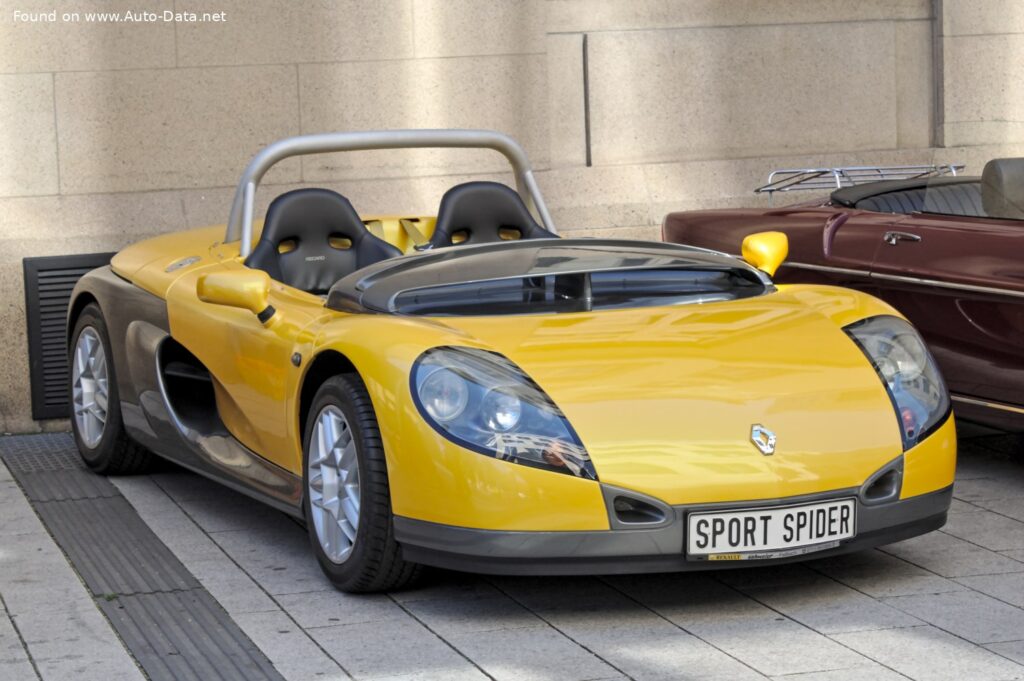
The Renault Sport Spider 2.0 i 16V (150 Hp) stands as a testament to pure, unadulterated driving pleasure, a unique offering from Renault Sport that graced the European market from 1995 to 1999. This generation of the Sport Spider was not merely another roadster; it was a radical, back-to-basics machine designed with a singular focus on driver engagement and track-day capability, yet entirely street legal. Conceived during an era when many manufacturers were adding creature comforts, Renault Sport defiantly stripped them away, creating a minimalist, lightweight, two-seater cabriolet that prioritized mechanical grip, responsive handling, and direct feedback. Its distinctive design, often characterized by its exposed aluminum chassis and composite body panels, immediately set it apart from its contemporaries. While never officially sold in the United States, its influence and philosophy resonate with American enthusiasts who appreciate stripped-down performance cars, drawing parallels to cult classics that prioritize driving dynamics over luxury. The Sport Spider was a bold statement, showcasing Renault’s engineering prowess and commitment to motorsport heritage, offering an experience that was both visceral and unforgettable for those who sought the thrill of a race car adapted for the open road.
The Renault Sport Spider 2.0 i 16V (150 Hp): A Pure Driving Machine
The philosophy behind the Renault Sport Spider 2.0 i 16V (150 Hp) was clear: deliver an unparalleled driving experience by minimizing weight and maximizing driver connection. This approach resulted in a car that felt inherently nimble and responsive, a stark contrast to the increasingly complex and comfort-oriented vehicles of its time. The Sport Spider carved out a niche for itself, appealing to enthusiasts who valued raw performance and mechanical purity above all else. Its short production run from 1995 to 1999, coupled with its niche market appeal, cemented its status as a collector’s item and a significant chapter in Renault Sport’s storied history. It represented a daring venture for a mainstream manufacturer, proving that a dedicated, no-compromise sports car could emerge from a brand known for its practical family vehicles. The car’s uncompromising design and performance characteristics ensured that every journey, whether on a winding country road or a dedicated race circuit, was an event in itself, a true celebration of the art of driving.
Engine and Performance
At the heart of the Renault Sport Spider 2.0 i 16V (150 Hp) lay a naturally aspirated 2.0-liter (1998 cm³) inline-four engine, specifically the AF0H05 code, renowned for its responsiveness and spirited character. This 16-valve powerplant, featuring a Double Overhead Cam (DOHC) valvetrain and multi-port manifold injection, was meticulously tuned to produce 150 horsepower at a peaky 6000 rpm. This power output translates to an impressive 75.1 horsepower per liter, highlighting its efficiency and performance potential for its era. Torque figures stood at a robust 136.45 lb.-ft. (185 Nm) delivered at 4500 rpm, providing ample mid-range pull that was crucial for brisk acceleration and engaging driving dynamics. The engine’s layout was a critical aspect of the Sport Spider’s design philosophy: a mid-transverse configuration, which significantly contributed to the car’s balanced weight distribution and exceptional handling characteristics. This, combined with its rear-wheel-drive architecture, ensured a classic sports car feel, allowing for precise control and exhilarating power delivery to the pavement.
Performance metrics for the Sport Spider were impressive, especially considering its modest power output. The car could rocket from 0 to 60 mph in a mere 6.6 seconds (0-100 km/h in 6.9 seconds), a testament to its exceptional power-to-weight ratio. With a curb weight of just 2050.3 lbs (930 kg), the weight-to-power ratio was an outstanding 6.2 kg/Hp (161.3 Hp/tonne), making it incredibly agile and quick off the line. The top speed was rated at 133.59 mph (215 km/h), more than sufficient for its intended purpose as a focused driver’s car rather than a high-speed cruiser. Power was channeled through a precise and engaging 5-speed manual transmission, offering direct mechanical feedback and encouraging drivers to fully exploit the engine’s rev range. Fuel economy, while not the primary concern for such a vehicle, was respectable for a performance car of its time: an estimated 23.8 US mpg in urban conditions and an impressive 36.8 US mpg on the extra-urban cycle, thanks in part to its lightweight construction and efficient powertrain. The combination of a free-revving engine, a slick manual gearbox, and a featherlight chassis created a driving experience that was both thrilling and deeply rewarding, solidifying its reputation as a true enthusiast’s machine.
Design, Chassis, and Features
The design of the Renault Sport Spider was revolutionary and unapologetically functional, embodying a “form follows function” ethos. As a two-door, two-seat cabriolet, its open-top configuration emphasized the connection between driver, road, and environment. The car’s most striking visual element was its exposed aluminum chassis, visible beneath the composite body panels, which not only served as a structural backbone but also contributed to its distinctive aesthetic. This lightweight construction was paramount to the Sport Spider’s performance, resulting in a remarkably low curb weight of 2050.3 lbs (930 kg) and a maximum permissible weight of 2491.22 lbs (1130 kg), allowing for a maximum load of 440.92 lbs (200 kg). Its compact dimensions – a length of 149.41 inches (3795 mm), a width of 72.05 inches (1830 mm), and a height of 49.21 inches (1250 mm) – further underscored its agile, go-kart-like character. The relatively long wheelbase of 92.13 inches (2340 mm) for its size, coupled with wide front and rear tracks (60.43 in / 1535 mm and 60.63 in / 1540 mm, respectively), provided a stable platform for high-speed cornering and exceptional grip.
Underneath its minimalist exterior, the Sport Spider featured a sophisticated chassis engineered for precision and control. The suspension system utilized double wishbones at the front, a setup typically found in higher-performance vehicles, ensuring excellent wheel control and consistent tire contact with the road. This advanced suspension, combined with a direct rack and pinion steering system, delivered incredibly sharp turn-in and communicative feedback, allowing the driver to feel every nuance of the road surface. Braking performance was equally impressive, with large 300 mm ventilated discs fitted both front and rear, providing powerful and fade-resistant stopping capabilities crucial for spirited driving. The car rode on 16-inch wheels shod with 225/55 R16 tires, offering a generous contact patch for grip and stability. In terms of practicality, the Sport Spider was true to its minimalist nature, offering a modest trunk space of 2.75 cu. ft. (78 liters) – enough for a weekend bag, perhaps, but certainly not for a grocery run. Its 13.21 US gallon (50 liter) fuel tank provided a reasonable range for its performance category. The Sport Spider’s design was not about luxury or convenience; it was about the fundamental joy of driving, making it a revered classic for enthusiasts who prioritize an unadulterated, raw automotive experience.
Technical Specifications
| Brand | Renault |
| Model | Sport Spider |
| Generation | Sport Spider |
| Type (Engine) | 2.0 i 16V (150 Hp) |
| Start of production | 1995 year |
| End of production | 1999 year |
| Powertrain Architecture | Internal Combustion engine |
| Body type | Cabriolet |
| Seats | 2 |
| Doors | 2 |
| Fuel consumption (economy) – urban | 9.9 l/100 km (23.8 US mpg) |
| Fuel consumption (economy) – extra urban | 6.4 l/100 km (36.8 US mpg) |
| Fuel Type | Petrol (Gasoline) |
| Acceleration 0 – 60 mph | 6.6 sec |
| Acceleration 0 – 100 km/h | 6.9 sec |
| Maximum speed | 215 km/h (133.59 mph) |
| Weight-to-power ratio | 6.2 kg/Hp (161.3 Hp/tonne) |
| Weight-to-torque ratio | 5 kg/Nm (198.9 Nm/tonne) |
| Power | 150 Hp @ 6000 rpm |
| Power per liter | 75.1 Hp/l |
| Torque | 185 Nm @ 4500 rpm (136.45 lb.-ft. @ 4500 rpm) |
| Engine layout | Middle, Transverse |
| Engine Model/Code | AF0H05 |
| Engine displacement | 1998 cm³ (121.93 cu. in.) |
| Number of cylinders | 4 |
| Engine configuration | Inline |
| Cylinder Bore | 82.7 mm (3.26 in.) |
| Piston Stroke | 93 mm (3.66 in.) |
| Compression ratio | 9.8:1 |
| Number of valves per cylinder | 4 |
| Fuel injection system | Multi-port manifold injection |
| Engine aspiration | Naturally aspirated engine |
| Valvetrain | DOHC |
| Engine oil capacity | 6.25 l (6.6 US qt) |
| Coolant | 8 l (8.45 US qt) |
| Kerb Weight | 930 kg (2050.3 lbs) |
| Max. weight | 1130 kg (2491.22 lbs) |
| Max load | 200 kg (440.92 lbs) |
| Trunk (boot) space – minimum | 78 l (2.75 cu. ft.) |
| Fuel tank capacity | 50 l (13.21 US gal) |
| Length | 3795 mm (149.41 in.) |
| Width | 1830 mm (72.05 in.) |
| Height | 1250 mm (49.21 in.) |
| Wheelbase | 2340 mm (92.13 in.) |
| Front track | 1535 mm (60.43 in.) |
| Rear (Back) track | 1540 mm (60.63 in.) |
| Minimum turning circle (turning diameter) | 9.8 m (32.15 ft.) |
| Drivetrain Architecture | The Internal combustion engine (ICE) drives the rear wheels of the vehicle. |
| Drive wheel | Rear wheel drive |
| Number of gears and type of gearbox | 5 gears, manual transmission |
| Front suspension | Double wishbone |
| Front brakes | Ventilated discs, 300 mm |
| Rear brakes | Ventilated discs, 300 mm |
| Steering type | Steering rack and pinion |
| Tires size | 225/55 R16 |
| Wheel rims size | 16 |
