
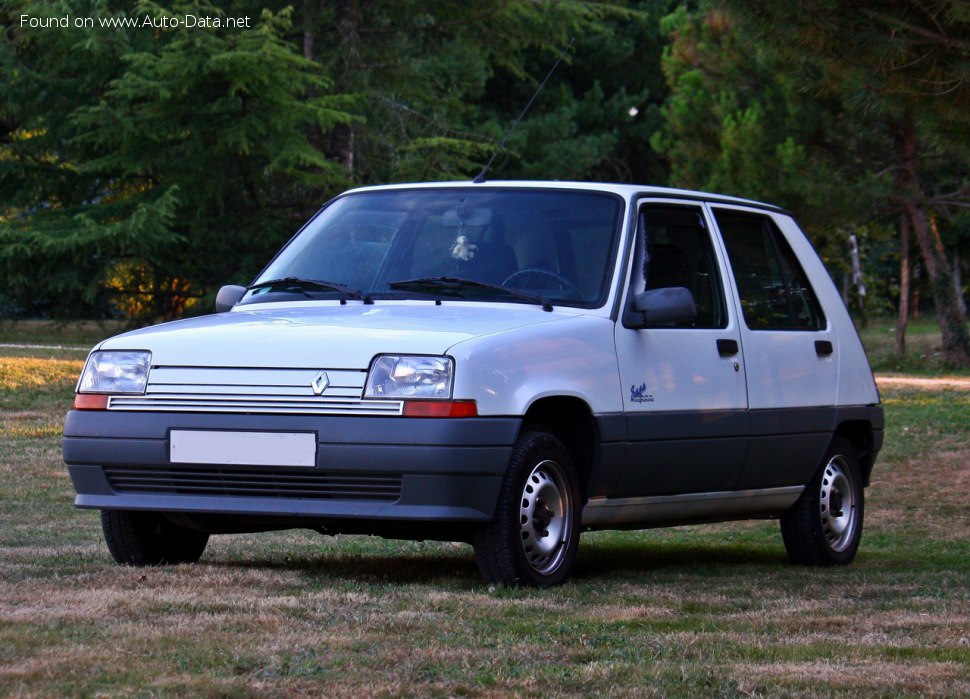
The Renault Super 5, known internally as the B/C40 series, represented a pivotal moment for the French automaker, succeeding the iconic original Renault 5, a car that had revolutionized the European supermini segment. Launched in 1984, the Super 5 carried the daunting task of evolving a beloved classic while retaining its core appeal of compact efficiency and urban practicality. The specific variant, the Renault Super 5 (B/C40) 1.1 (B/C/S40,B/C40H) (45 Hp), produced between 1986 and 1989, epitomized the model’s entry-level offerings, providing an economical and reliable transportation solution for millions across Europe and other international markets where it was sold. While never officially imported to the United States, the Super 5’s design philosophy and engineering ethos significantly influenced global automotive trends, particularly in the realm of small, fuel-efficient hatchbacks. Its robust construction and straightforward mechanicals made it a popular choice for first-time car buyers, small families, and urban commuters, cementing its place as a significant vehicle in Renault’s storied history.
The Evolution and Market Positioning of the Renault Super 5 (B/C40)
The Super 5 was more than just a facelift; it was a comprehensive redesign that maintained the spirit of its predecessor while introducing contemporary styling and engineering advancements. Penned by Marcello Gandini, renowned for his work with Lamborghini, the Super 5 adopted a more modern, aerodynamic silhouette compared to the boxier original. This design not only improved aesthetics but also contributed to better fuel efficiency and reduced wind noise, crucial factors for a car positioned in the highly competitive European supermini market. The B/C40 designation referred to the three-door (B40) and five-door (C40) hatchback versions, offering versatility to suit different customer needs. The 1.1-liter variant, specifically the Renault Super 5 (B/C40) 1.1 (B/C/S40,B/C40H) (45 Hp), was designed as a workhorse, prioritizing low running costs and ease of maintenance over outright performance. It competed fiercely with other European compacts like the Fiat Uno, Peugeot 205, and Ford Fiesta, all vying for dominance in a segment characterized by practicality, affordability, and nimble handling in congested city environments.
During its production run from 1986 to 1989, this particular 1.1-liter model served as a cornerstone of the Super 5 lineup, embodying the accessible nature of the car. Its appeal lay in its ability to offer comfortable seating for five adults and a respectable cargo capacity within a compact footprint, making it an ideal choice for the burgeoning European middle class seeking economical personal mobility. The Super 5 also became known for its driving dynamics, which, for a car of its class and era, were considered quite engaging, offering a good balance between ride comfort and responsive handling. This balance was particularly appreciated in urban settings, where tight turns and parking maneuvers were daily occurrences. The Super 5’s legacy extended beyond its sales figures; it became a cultural icon in many European countries, representing an era of practical, no-nonsense motoring that was both affordable and reliable.
Engine and Performance: The 1.1-Liter Powertrain
At the heart of the Renault Super 5 (B/C40) 1.1 (B/C/S40,B/C40H) (45 Hp) was a robust and well-proven internal combustion engine, specifically the C1E model code. This naturally aspirated, four-cylinder gasoline (petrol) engine was a testament to Renault’s expertise in developing reliable and economical powertrains for its compact vehicles. With a power output of 45 horsepower, the engine was tuned for efficiency and durability, rather than high-speed performance. While 45 Hp might seem modest by today’s standards, it was entirely adequate for the Super 5’s intended purpose as an urban and suburban commuter. The engine delivered its power smoothly, making the car easy to drive in stop-and-go traffic and capable of maintaining reasonable speeds on secondary roads.
The naturally aspirated design meant a simpler engine architecture, translating to lower manufacturing costs and easier maintenance. This simplicity also contributed to the engine’s reputation for longevity and reliability, attributes highly valued by owners in the 1980s. The fuel type was standard gasoline, widely available across Europe. The engine oil capacity of 3.5 liters (3.7 US quarts) and a coolant capacity of 5.5 liters (5.81 US quarts) indicate a compact but well-engineered cooling and lubrication system designed for efficient operation. These capacities were typical for small engines of the era, ensuring proper thermal management and lubrication under various driving conditions. The fuel tank capacity of 43 liters (11.36 US gallons) provided a decent range, further enhancing the car’s practicality for daily use and occasional longer journeys, allowing owners to travel significant distances between fill-ups, a crucial aspect for budget-conscious drivers. The overall powertrain architecture, centered around this dependable internal combustion engine, underscored the Super 5’s mission as an accessible and economical mode of transport, prioritizing function and efficiency above all else.
Design and Features: Practicality Meets 1980s Style
The design of the Renault Super 5 (B/C40) marked a significant departure from its predecessor, yet retained a recognizable silhouette. As a five-door hatchback, it offered a blend of compact dimensions with practical utility, a hallmark of the supermini class. The five-door configuration, in particular, enhanced accessibility for rear passengers and made loading cargo considerably easier compared to its three-door counterpart. The body type, a classic hatchback, was extremely popular in Europe due to its versatility, allowing for an expandable cargo area by folding down the rear seats, thereby transforming the car from a passenger carrier to a small utility vehicle.
Inside, the Super 5 was designed with practicality and user-friendliness in mind. The five-seat configuration provided ample space for a small family or a group of friends, though rear legroom, as with most cars in this segment, was somewhat limited for taller adults. The interior aesthetics were typical of 1980s European design – functional, durable, and straightforward. Dashboards were typically made of hard-wearing plastics, and controls were ergonomically placed for ease of use. Features common for the era included manual window winders, a basic heating and ventilation system, and often a simple AM/FM radio. Power steering, while available on higher trims, was not standard on the entry-level 1.1-liter model, requiring a bit more effort at low speeds but contributing to a more direct steering feel. Safety features, while not as advanced as modern vehicles, included standard seatbelts and a relatively robust body structure for its class. The Super 5’s design was not about luxury or cutting-edge technology, but rather about delivering reliable, affordable, and practical transportation, reflecting the needs and expectations of its primary market during its production years.
Technical Specifications: Renault Super 5 (B/C40) 1.1 (B/C/S40,B/C40H) (45 Hp)
| Brand | Renault |
| Model | Super 5 |
| Generation | Super 5 (B/C40) |
| Engine Type | 1.1 (B/C/S40,B/C40H) (45 Hp) |
| Start of Production | 1986 year |
| End of Production | 1989 year |
| Powertrain Architecture | Internal Combustion engine |
| Body Type | Hatchback |
| Seats | 5 |
| Doors | 5 |
| Fuel Type | Petrol (Gasoline) |
| Power | 45 Hp |
| Engine Model/Code | C1E |
| Engine Aspiration | Naturally aspirated engine |
| Engine Oil Capacity | 3.5 l (3.7 US qt) |
| Coolant Capacity | 5.5 l (5.81 US qt) |
| Fuel Tank Capacity | 43 l (11.36 US gal) |
