
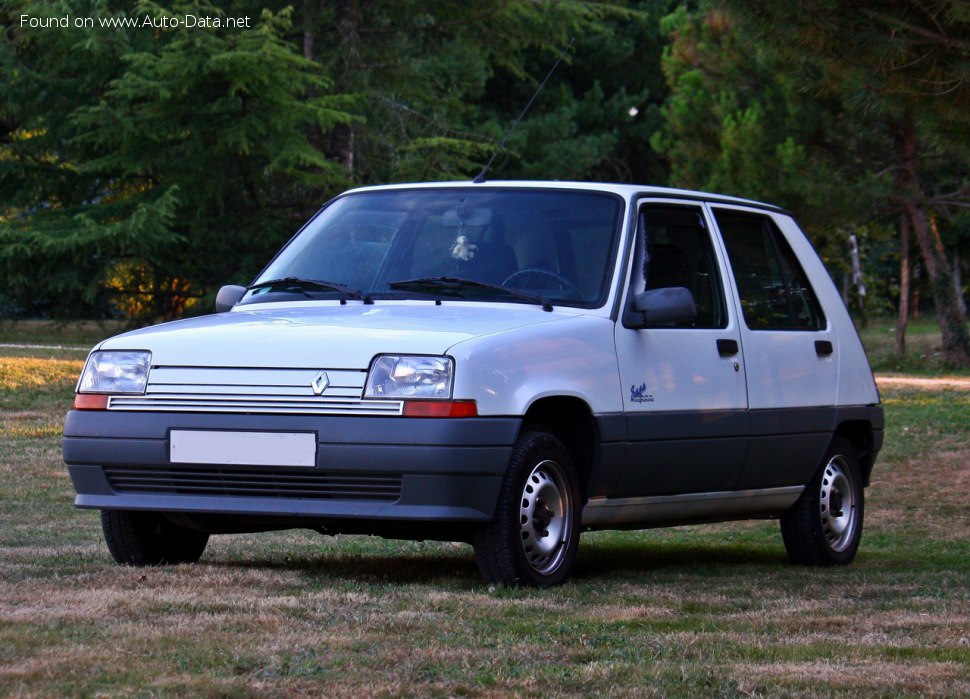
The Renault Super 5 (B/C40) 1.4 Turbo (C405) (116 Hp) represents a significant chapter in the history of European compact performance vehicles. Produced between 1985 and 1990, this particular variant of the second-generation Renault 5, often affectionately known as the “Supercinq” in its home market, carved out a formidable reputation as a quintessential ‘hot hatch.’ While never officially sold in the United States, its legacy resonated deeply across Europe, where it competed fiercely in a burgeoning segment defined by lightweight, agile, and surprisingly potent small cars. The Super 5 built upon the immense success of its predecessor, the original Renault 5, which had been a staple of European urban transport since the early 1970s. The B/C40 generation brought a more modern, aerodynamic design and improved mechanicals, but it was the 1.4 Turbo (C405) model that truly captured the imagination of enthusiasts, offering exhilarating performance in an accessible package. This vehicle was a testament to Renault’s engineering prowess, demonstrating how a small, economical hatchback could be transformed into a spirited road machine with the strategic application of forced induction.
Engine and Performance of the Renault Super 5 (B/C40) 1.4 Turbo (C405)
At the heart of the performance-oriented Renault Super 5 (B/C40) 1.4 Turbo (C405) was its spirited C1J Turbo engine. This 1.4-liter (1397 cc) internal combustion engine was a marvel of its time, delivering a robust 116 horsepower. For a vehicle of its compact dimensions and relatively light curb weight, this power output translated into a lively and engaging driving experience that few competitors could match. The key to its impressive performance was the turbocharger, a technology that was rapidly gaining traction in the 1980s for its ability to extract significant power from smaller displacement engines without a substantial increase in fuel consumption under normal driving conditions. The turbocharger compressed the intake air, allowing more oxygen into the combustion chamber, which in turn enabled more fuel to be burned, resulting in a dramatic increase in power.
The characteristic of 1980s turbo engines, particularly in smaller displacement units, was often a noticeable ‘turbo lag’ – a delay between pressing the accelerator and the turbocharger spooling up to deliver its full boost. While some might consider this a drawback, it often contributed to the Super 5 Turbo’s raw and exciting character. Once the turbo spooled up, the power delivery could be quite sudden and thrilling, propelling the lightweight hatchback with surprising urgency. This made the Renault Super 5 (B/C40) 1.4 Turbo (C405) a favorite among drivers who appreciated a more visceral and involved driving experience. The engine ran on petrol (gasoline), and its design prioritized a balance of performance and the practicalities of a daily driver. Maintenance aspects included an engine oil capacity of 3.01 US quarts and a coolant capacity of 5.81 US quarts, figures typical for compact European engines of the era, underscoring the importance of regular fluid checks for optimal performance and longevity.
Design and Features
Body and Aesthetics
The Renault Super 5 (B/C40) 1.4 Turbo (C405) was a five-door hatchback, a body style that perfectly blended practicality with a sporty aesthetic. Its design was a significant departure from the more angular lines of the original Renault 5, adopting a smoother, more aerodynamic profile that was characteristic of 1980s automotive design trends. The Super 5 boasted a cohesive and modern look, with integrated bumpers and flush-fitting glass contributing to a lower drag coefficient. For the Turbo variant, Renault often added subtle but effective visual cues to denote its performance pedigree. While specific details like body kits or unique wheel designs are not explicitly listed in the provided data, it was common for hot hatchbacks of this era to feature wider wheel arches, distinctive alloy wheels, and perhaps a subtle rear spoiler to enhance both aesthetics and aerodynamics. These elements not only contributed to a more aggressive stance but also hinted at the power lurking beneath the hood, distinguishing the Turbo from its more pedestrian siblings.
Interior and Practicality
Inside, the Renault Super 5 (B/C40) offered a practical and functional cabin designed to accommodate five occupants comfortably for its class. The five-door configuration greatly enhanced accessibility to the rear seats and cargo area, making it a versatile option for small families or individuals needing utility. While the interior might appear spartan by modern standards, it was well-equipped for its time, focusing on ergonomics and ease of use. The dashboard layout was straightforward, with clear instrumentation providing essential information to the driver. Seating was typically supportive, designed to hold occupants in place during spirited driving, especially in the Turbo models. The compact exterior dimensions of the Super 5 made it an ideal vehicle for navigating narrow European city streets and parking in tight spaces, a crucial factor in its widespread popularity across the continent. Despite its compact footprint, the hatchback design ensured a reasonable amount of cargo space, which could be expanded by folding down the rear seats, further enhancing its practicality for everyday use.
Safety and Innovations of its Era
In the mid-1980s, automotive safety standards were evolving, and the Renault Super 5 (B/C40) incorporated features that were considered advanced for a compact car of its time. While lacking many of the passive and active safety systems found in modern vehicles, the Super 5 benefited from a more robust body structure compared to its predecessor, with improvements in crumple zones and occupant protection. Innovations for the era would have included features like front disc brakes (likely standard on the Turbo model for enhanced stopping power), improved suspension geometry for better handling, and potentially more advanced lighting systems. The focus was on providing a stable and predictable driving platform, especially crucial for a performance model like the 1.4 Turbo. The car’s overall design, from its chassis to its engine management, reflected Renault’s commitment to delivering a well-engineered and enjoyable driving experience, balancing performance with the practical considerations of a mainstream compact car.
Technical Specifications
| Brand | Renault |
| Model | Super 5 |
| Generation | Super 5 (B/C40) |
| Type (Engine) | 1.4 Turbo (C405) (116 Hp) |
| Start of production | 1985 year |
| End of production | 1990 year |
| Powertrain Architecture | Internal Combustion engine |
| Body type | Hatchback |
| Seats | 5 |
| Doors | 5 |
| Fuel Type | Petrol (Gasoline) |
| Power | 116 Hp |
| Engine Model/Code | C1J Turbo |
| Engine aspiration | Turbocharger |
| Engine oil capacity | 3.01 US qt |
| Coolant | 5.81 US qt |
| Fuel tank capacity | 11.36 US gal |
