
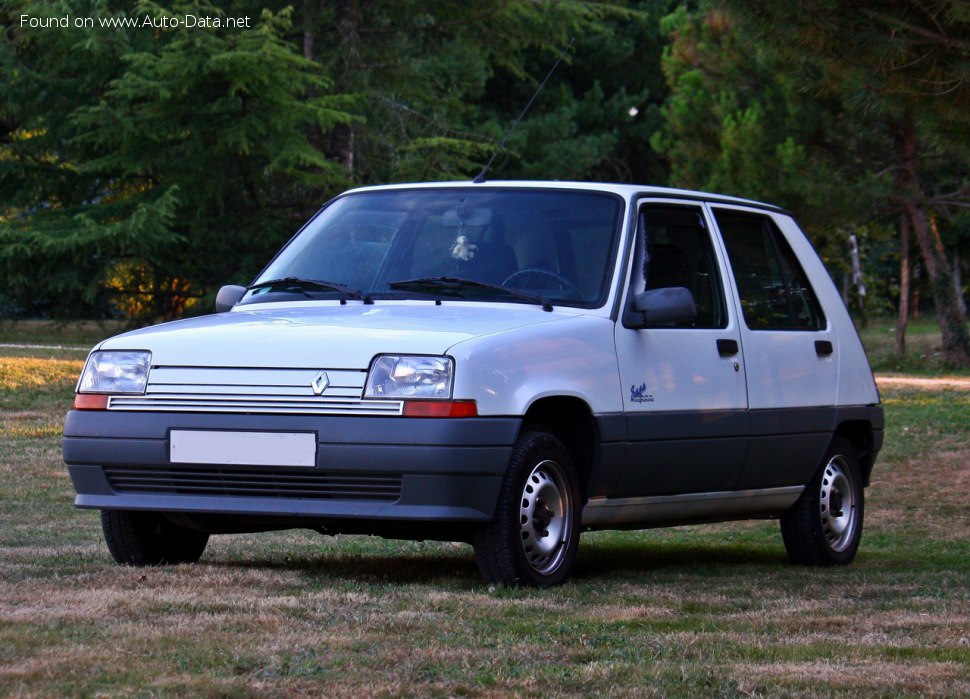
The Renault Super 5, known internally by its generation code B/C40, represents a pivotal chapter in the history of the French automotive manufacturer, succeeding the original and highly successful Renault 5. Launched in 1984, the Super 5 quickly cemented its position as a dominant force in the highly competitive European supermini segment, a market it was exclusively designed for and never officially sold in the United States. Among its diverse powertrain offerings, the Renault Super 5 (B/C40) 1.7 i (C409) (94 Hp), produced between 1986 and 1991, stood out as a particularly spirited and technically advanced variant. This iteration combined a robust fuel-injected engine with the Super 5’s renowned practical hatchback body, offering a compelling blend of performance and everyday usability that appealed to a broad spectrum of European buyers seeking a compact yet capable vehicle.
Engine and Performance of the Renault Super 5 (B/C40) 1.7 i (C409) (94 Hp)
At the heart of the Super 5 (B/C40) 1.7 i (C409) lay Renault’s F3N engine, a 1.7-liter (1721 cm3 or 105.02 cubic inches) inline four-cylinder powerplant. This engine featured a single overhead camshaft (SOHC) valvetrain with two valves per cylinder, a common and reliable configuration for the era. What distinguished this particular variant was its adoption of a multi-port manifold fuel injection system, a more sophisticated approach than the carbureted setups found in many of its contemporaries. This fuel injection system contributed significantly to the engine’s efficiency, responsiveness, and consistent power delivery, making it a more refined choice for drivers.
The F3N engine in the 1.7 i (C409) trim was engineered to produce a respectable 94 horsepower at 5250 revolutions per minute, translating to a power output of 54.6 horsepower per liter. This figure was quite strong for a supermini in the late 1980s, enabling the Super 5 to offer genuinely brisk performance. Torque output was equally impressive for its class, peaking at 143 Newton-meters (105.47 lb.-ft.), ensuring ample pulling power across the rev range. The engine’s layout was front, transverse, driving the front wheels through a precise 5-speed manual transmission, a standard and preferred setup for compact cars prioritizing packaging efficiency and dynamic handling.
In terms of acceleration, the Renault Super 5 (B/C40) 1.7 i (C409) (94 Hp) was a lively performer. It could sprint from 0 to 60 miles per hour in a calculated 8.8 seconds, a figure that would allow it to comfortably keep pace with, and often outshine, many larger and more expensive vehicles of the period. Its maximum speed was rated at 114.95 miles per hour (185 km/h), highlighting its capability for sustained highway cruising, a key requirement for European driving conditions. The naturally aspirated nature of the engine meant a linear power delivery, providing a predictable and engaging driving experience, characteristic of Renault’s focus on driver enjoyment even in its smaller models. The engine oil capacity was 5.2 liters (5.49 US quarts), while the coolant system held 5.5 liters (5.81 US quarts), indicating standard maintenance requirements for the time.
Design and Features of the Renault Super 5 Hatchback
The Renault Super 5 (B/C40) inherited much of the original Renault 5’s charm but evolved it with a more modern, rounded aesthetic, often described as a “bubble” design. The 1.7 i (C409) variant, like others in the generation, came in a practical 5-door hatchback body style, a configuration that maximized interior space and versatility for a compact vehicle. With seating for five occupants, the Super 5 was designed to be a highly functional urban commuter and a capable small family car, offering easy access to both front and rear seats, and a flexible cargo area thanks to the hatchback design.
From a chassis perspective, the Super 5 (B/C40) was engineered for a balance of comfort and dynamic handling. The front suspension utilized a spring strut system, a common and effective design for providing good wheel control and ride quality. At the rear, a torsion bar suspension was employed, a compact and space-efficient solution that allowed for a flatter load floor and contributed to the car’s agile handling characteristics. Steering was managed by a rack and pinion system, offering direct and responsive feedback to the driver, enhancing the Super 5’s reputation for being enjoyable to drive. The car was fitted with 195/55 R13 tires mounted on 13-inch wheel rims, a specification that provided a good compromise between grip, ride comfort, and affordability for replacement.
Braking performance was handled by a combination of ventilated discs at the front and solid discs at the rear. The use of ventilated discs up front was a notable feature for a car in this segment during the late 1980s, offering improved heat dissipation and thus more consistent braking performance under demanding conditions compared to solid discs. The overall design philosophy of the Super 5 prioritized practicality, ease of use, and a cheerful disposition, making it a popular choice across Europe. Its compact dimensions made it ideal for navigating crowded city streets, while its comfortable interior and capable engine made longer journeys feasible. The fuel tank capacity of 43 liters (11.36 US gallons) provided a decent range, further enhancing its appeal as an all-rounder.
Technical Specifications
| Brand | Renault |
| Model | Super 5 |
| Generation | Super 5 (B/C40) |
| Type (Engine) | 1.7 i (C409) (94 Hp) |
| Start of production | 1986 year |
| End of production | 1991 year |
| Powertrain Architecture | Internal Combustion engine |
| Body type | Hatchback |
| Seats | 5 |
| Doors | 5 |
| Fuel Type | Petrol (Gasoline) |
| Acceleration 0 – 100 km/h | 9.3 sec |
| Acceleration 0 – 62 mph | 9.3 sec |
| Acceleration 0 – 60 mph (Calculated) | 8.8 sec |
| Maximum speed | 185 km/h (114.95 mph) |
| Power | 94 Hp @ 5250 rpm. |
| Power per liter | 54.6 Hp/l |
| Torque | 143 Nm (105.47 lb.-ft.) |
| Engine layout | Front, Transverse |
| Engine Model/Code | F3N |
| Engine displacement | 1721 cm3 (105.02 cu. in.) |
| Number of cylinders | 4 |
| Engine configuration | Inline |
| Number of valves per cylinder | 2 |
| Fuel injection system | Multi-port manifold injection |
| Engine aspiration | Naturally aspirated engine |
| Valvetrain | SOHC |
| Engine oil capacity | 5.2 l (5.49 US qt) |
| Coolant | 5.5 l (5.81 US qt) |
| Fuel tank capacity | 43 l (11.36 US gal) |
| Drivetrain Architecture | The Internal combustion engine (ICE) drives the front wheels of the vehicle. |
| Drive wheel | Front wheel drive |
| Number of gears and type of gearbox | 5 gears, manual transmission |
| Front suspension | Spring Strut |
| Rear suspension | Torsion |
| Front brakes | Ventilated discs |
| Rear brakes | Disc |
| Steering type | Steering rack and pinion |
| Tires size | 195/55 R13 |
| Wheel rims size | 13 |
