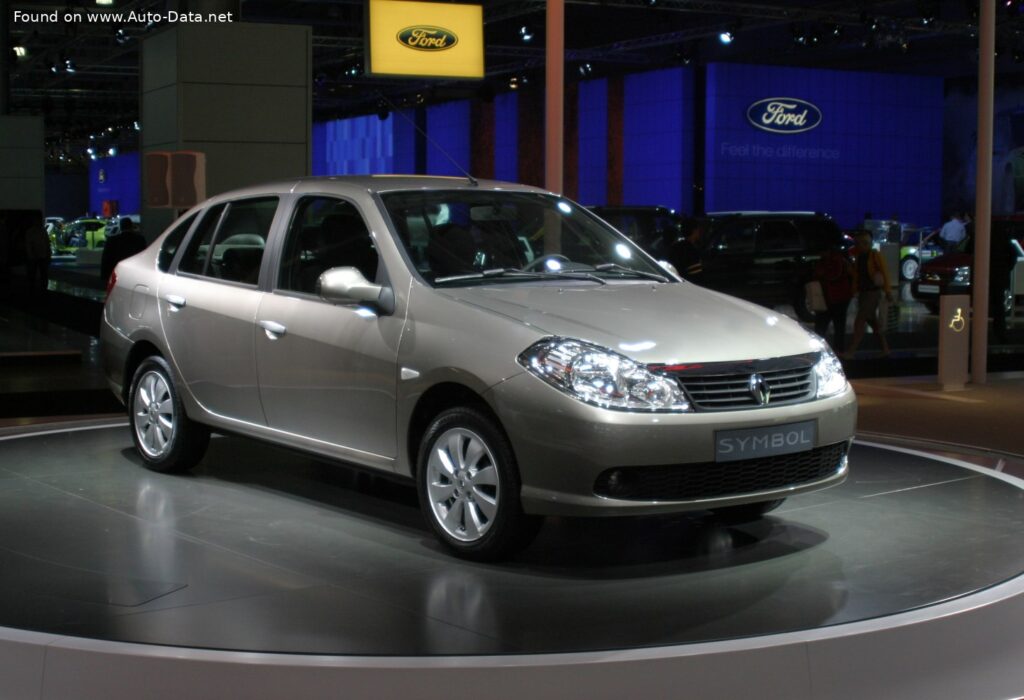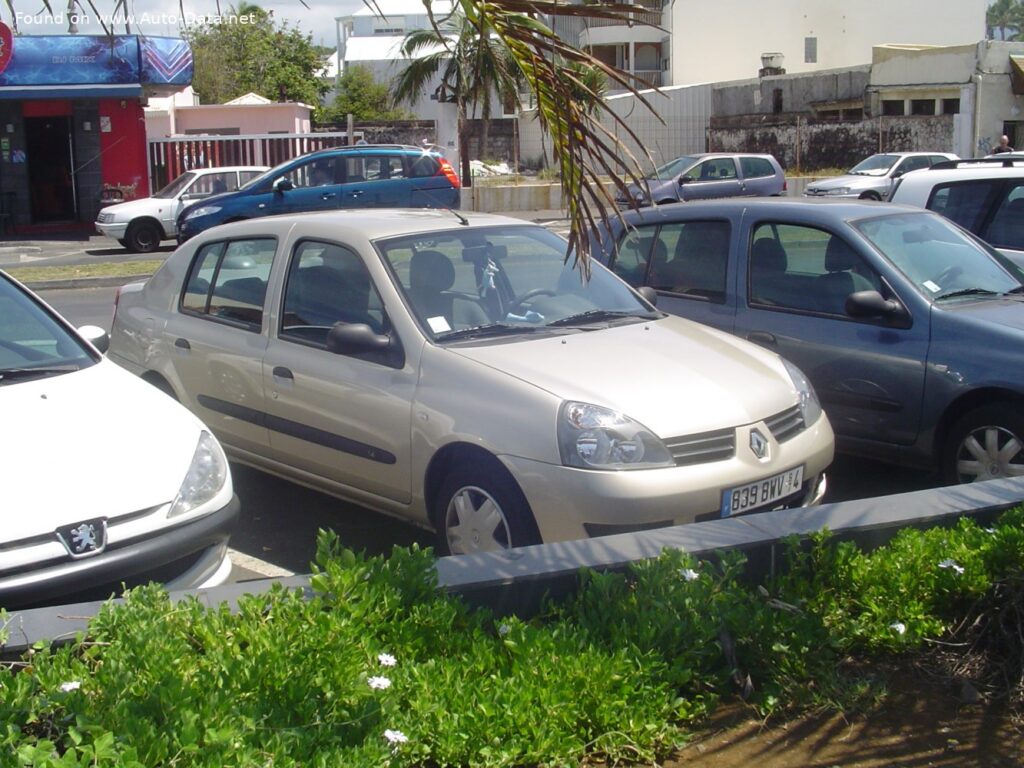
The Renault Symbol I (facelift 2002) 1.4 (75 Hp) Automatic represents a significant offering from the French automaker, Renault, specifically tailored for markets where a conventional sedan body style derived from a subcompact platform held considerable appeal. While not a familiar sight in North America, the Symbol, also known in some regions as the Thalia or Clio Symbol, carved out a strong niche in Eastern Europe, Latin America, the Middle East, and parts of Asia. This particular iteration, produced from 2002 to 2008, showcases Renault’s strategy of adapting its successful Clio platform into a more spacious and affordable sedan, focusing on practicality, robust construction, and economic operation. It was positioned as a sensible choice for families and individuals seeking a reliable, low-maintenance vehicle with a generous trunk capacity, often serving as a primary family car in its target regions rather than a secondary vehicle.
Engine and Performance: The Renault Symbol I (facelift 2002) 1.4 (75 Hp) Automatic Powertrain
At the heart of the Renault Symbol I (facelift 2002) 1.4 (75 Hp) Automatic lies a dependable 1.4-liter (1390 cm3 or 84.82 cubic inches) inline-four gasoline engine, internally designated as the K7J 700. This naturally aspirated unit features a Single Overhead Cam (OHC) valvetrain with two valves per cylinder, a configuration chosen for its simplicity, reliability, and ease of maintenance. Fuel delivery is managed by a multi-port manifold injection system, ensuring efficient combustion and reasonable fuel economy for its time. The engine produces a modest but adequate 75 horsepower at 5800 rpm, which, coupled with 84.08 lb.-ft. (114 Nm) of torque peaking at 4250 rpm, provides sufficient motivation for urban commuting and highway cruising.
Power is transmitted to the front wheels via a 4-speed automatic transmission, a common offering in the early 2000s that prioritized smooth, unburdened driving over peak performance. This powertrain architecture contributes to the vehicle’s approachable driving dynamics, making it user-friendly in various traffic conditions. Performance figures for this variant include an acceleration time from 0 to 60 mph in a calculated 11.9 seconds, or 0-62 mph (0-100 km/h) in 12.5 seconds. The top speed is rated at 105.63 mph (170 km/h). While these figures don’t suggest a performance-oriented vehicle, they are entirely competitive within its segment and align with its practical brief.
Fuel efficiency was a key consideration for the Symbol’s target markets. The 1.4-liter engine, paired with the automatic transmission, delivers respectable economy. In city driving, it achieves approximately 24.2 US mpg (9.7 l/100 km), while extra-urban driving significantly improves to about 41.3 US mpg (5.7 l/100 km). These figures underscore its suitability as an economical daily driver. The engine’s oil capacity stands at 3.28 US quarts (3.1 liters), and the cooling system holds 5.81 US quarts (5.5 liters) of coolant, indicating standard maintenance requirements for a vehicle of this class. With a curb weight of 2072.35 lbs (940 kg), the Symbol boasts a weight-to-power ratio of 12.5 kg/Hp, or 79.8 Hp per tonne, and a weight-to-torque ratio of 8.2 kg/Nm, or 121.3 Nm per tonne. These ratios reflect its lightweight construction relative to its power output, contributing to its overall efficiency and handling characteristics.
Design and Features of the Renault Symbol I (facelift 2002)
The Renault Symbol I (facelift 2002) is a classic 4-door, 5-seat sedan, a body style that resonated strongly with consumers in its primary markets. Its design language, while sharing lineage with the Clio hatchback, features a distinct rear section that integrates a conventional trunk, distinguishing it from its hatchback sibling. The facelift introduced in 2002 brought subtle refinements to the exterior and interior, refreshing its appearance and keeping it competitive. While specific facelift changes are not detailed in the data, such updates typically involved revised front and rear fascias, updated lighting, new wheel designs, and minor interior trim enhancements to modernize the vehicle’s appeal.
Dimensionally, the Symbol is a compact vehicle, measuring 164.21 inches (4171 mm) in length, 64.53 inches (1639 mm) in width, and 56.57 inches (1437 mm) in height. Its wheelbase of 97.32 inches (2472 mm) provides a stable platform and contributes to a surprisingly spacious interior for its class. The front track measures 55.35 inches (1406 mm), and the rear track is 54.53 inches (1385 mm), offering a balanced stance. Despite its compact footprint, one of the Symbol’s most compelling features is its generous trunk space, offering a minimum of 18.01 cubic feet (510 liters). This large cargo capacity was a significant selling point, making it highly practical for families, especially in regions where carrying ample luggage was a common requirement.
Underneath, the Symbol employs a straightforward and robust chassis design. It features coil spring suspension at both the front and rear, a common and effective setup for balancing ride comfort with handling stability, particularly important for varying road conditions found in its target markets. Braking is handled by ventilated discs at the front, providing effective stopping power, complemented by drum brakes at the rear, a cost-effective and reliable solution for a vehicle of this weight and performance. The steering system is a hydraulic rack and pinion setup, offering direct feedback and ease of maneuverability, enhanced by power steering for reduced effort in parking and low-speed driving. The vehicle rides on 14-inch wheels fitted with 175/65 R14 tires, a common size that balances ride comfort, grip, and tire replacement cost. The fuel tank capacity of 13.21 US gallons (50 liters) ensures a decent range between fill-ups, further enhancing its appeal as a practical long-distance commuter or family vehicle.
The Symbol’s design philosophy clearly prioritized utility, durability, and affordability. Its interior, while perhaps not featuring the most luxurious materials, was designed to be functional and hard-wearing, capable of withstanding the rigors of daily use. Safety features, typical for its era and segment, would have included basic passive safety elements, with the emphasis on structural integrity and standard restraint systems. The overall package positioned the Symbol as an honest, no-frills sedan that delivered on its promise of reliable transportation and ample space for its price point, making it a highly successful model in the markets it served.
Technical Specifications
| Brand | Renault |
| Model | Symbol |
| Generation | Symbol I (facelift 2002) |
| Type (Engine) | 1.4 (75 Hp) Automatic |
| Start of production | 2002 year |
| End of production | 2008 year |
| Powertrain Architecture | Internal Combustion engine |
| Body type | Sedan |
| Seats | 5 |
| Doors | 4 |
| Fuel consumption (economy) – urban | 24.2 US mpg (9.7 l/100 km) |
| Fuel consumption (economy) – extra urban | 41.3 US mpg (5.7 l/100 km) |
| Fuel Type | Petrol (Gasoline) |
| Acceleration 0 – 60 mph | 11.9 sec |
| Acceleration 0 – 100 km/h | 12.5 sec |
| Maximum speed | 105.63 mph (170 km/h) |
| Weight-to-power ratio | 12.5 kg/Hp (79.8 Hp/tonne) |
| Weight-to-torque ratio | 8.2 kg/Nm (121.3 Nm/tonne) |
| Power | 75 Hp @ 5800 rpm |
| Power per liter | 54 Hp/l |
| Torque | 84.08 lb.-ft. @ 4250 rpm (114 Nm @ 4250 rpm) |
| Engine layout | Front, Transverse |
| Engine Model/Code | K7J 700 |
| Engine displacement | 1.4 l (1390 cm3 / 84.82 cu. in.) |
| Number of cylinders | 4 |
| Engine configuration | Inline |
| Cylinder Bore | 3.13 in. (79.5 mm) |
| Piston Stroke | 2.76 in. (70 mm) |
| Compression ratio | 9.5:1 |
| Number of valves per cylinder | 2 |
| Fuel injection system | Multi-port manifold injection |
| Engine aspiration | Naturally aspirated engine |
| Valvetrain | OHC |
| Engine oil capacity | 3.28 US qt (3.1 l) |
| Coolant capacity | 5.81 US qt (5.5 l) |
| Kerb Weight | 2072.35 lbs (940 kg) |
| Max. weight | 3141.59 lbs (1425 kg) |
| Max load | 1069.24 lbs (485 kg) |
| Trunk (boot) space – minimum | 18.01 cu. ft. (510 l) |
| Fuel tank capacity | 13.21 US gal (50 l) |
| Length | 164.21 in. (4171 mm) |
| Width | 64.53 in. (1639 mm) |
| Height | 56.57 in. (1437 mm) |
| Wheelbase | 97.32 in. (2472 mm) |
| Front track | 55.35 in. (1406 mm) |
| Rear (Back) track | 54.53 in. (1385 mm) |
| Drivetrain Architecture | The Internal combustion engine (ICE) drives the front wheels of the vehicle. |
| Drive wheel | Front wheel drive |
| Number of gears and type of gearbox | 4 gears, automatic transmission |
| Front suspension | Coil spring |
| Rear suspension | Coil spring |
| Front brakes | Ventilated discs |
| Rear brakes | Drum |
| Steering type | Steering rack and pinion |
| Power steering | Hydraulic Steering |
| Tires size | 175/65 R14 |
| Wheel rims size | 14 |