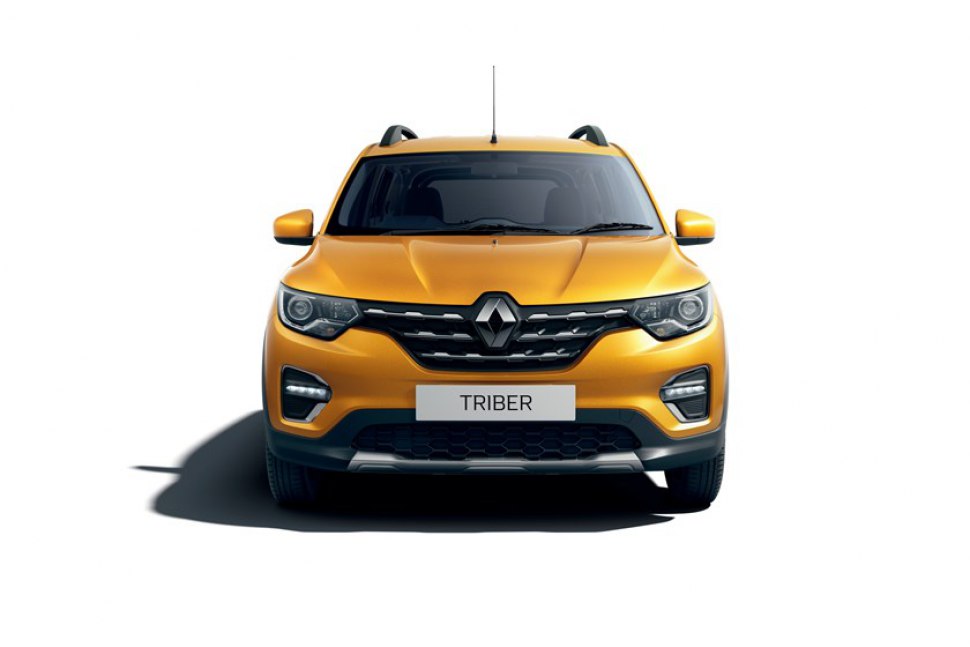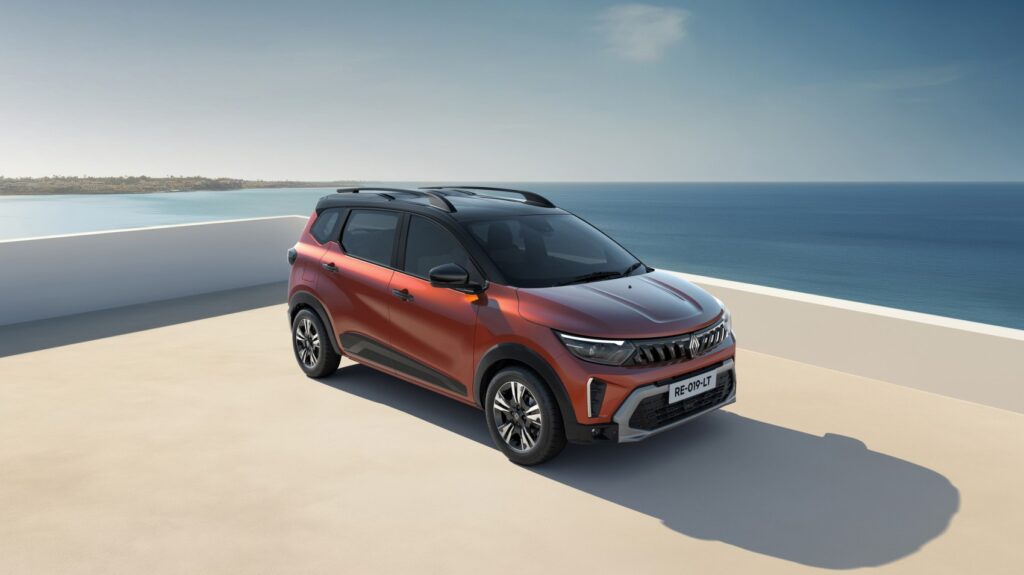
The Renault Triber (facelift 2025) 1.0 is a compact Multi-Purpose Vehicle (MPV) designed and manufactured by Renault. Introduced in July 2025, this iteration represents a refresh of the original Triber, initially launched in India in 2019. While not officially sold in the United States, the Triber is a significant model in emerging markets, particularly in India, South Africa, and parts of South America, where affordable and versatile family vehicles are in high demand. The Triber aims to provide seating for up to seven passengers in a sub-4 meter (13.1 ft) package, making it a practical and space-efficient option for growing families. The 2025 facelift brings updated styling, enhanced features, and refinements to the powertrain, maintaining its position as a value-oriented MPV.
Renault Triber (Facelift 2025): Overview
The Triber occupies a unique niche in the automotive market. It’s designed to appeal to buyers seeking a vehicle that can comfortably accommodate a large family without the expense and size of a larger SUV or minivan. The facelifted 2025 model builds upon the strengths of the original, focusing on improving aesthetics, safety, and overall driving experience. It’s positioned as an entry-level MPV, competing with other budget-friendly people carriers in its target markets. The Triber’s design prioritizes maximizing interior space within a compact footprint, making it well-suited for navigating congested urban environments.
Engine & Performance
The 2025 Renault Triber 1.0 is powered by a 999 cc inline three-cylinder petrol engine. This naturally aspirated engine produces 72 horsepower at 6250 rpm and 96 Nm (70.81 lb-ft) of torque at 3500 rpm. While not a performance-oriented vehicle, the engine provides adequate power for everyday driving conditions and is tuned for fuel efficiency. The engine features a multi-port fuel injection system and Dual VVT (Variable Valve Timing) technology to optimize performance and reduce emissions. Power is delivered to the front wheels via a five-speed manual transmission. The Triber’s weight-to-power ratio is 21.4 kg/Hp (46.8 Hp/tonne), and its weight-to-torque ratio is 16 kg/Nm (62.4 Nm/tonne). The engine’s relatively small displacement and three-cylinder configuration contribute to its fuel economy, making it an attractive option for budget-conscious buyers.
Design & Features
The Renault Triber (facelift 2025) maintains the distinctive styling of the original model, with a focus on a robust and modern appearance. The MPV features a tallboy design, maximizing headroom for passengers. The front fascia has been updated with a redesigned grille, new headlights, and a revised bumper. The side profile remains largely unchanged, while the rear end receives subtle updates to the taillights and bumper. The interior of the Triber is designed to be practical and functional, with a focus on maximizing space. The flexible seating configuration allows for up to seven passengers, with the third row being best suited for children or shorter adults. The dashboard features a simple and intuitive layout, with essential controls within easy reach. Depending on the trim level, features may include air conditioning, power windows, a touchscreen infotainment system, and basic safety equipment like ABS (Anti-lock Braking System). The Triber’s trunk space ranges from a minimum of 84 liters (2.97 cu. ft.) with all seats in use to a maximum of 625 liters (22.07 cu. ft.) with the third-row seats folded down.
Technical Specifications
| Brand | Renault |
| Model | Triber |
| Generation | Triber (facelift 2025) |
| Type (Engine) | 1.0 (72 Hp) |
| Start of production | July, 2025 |
| Powertrain Architecture | Internal Combustion engine |
| Body type | MPV |
| Seats | 5-7 |
| Doors | 5 |
| Fuel Type | Petrol (Gasoline) |
| Weight-to-power ratio | 21.4 kg/Hp, 46.8 Hp/tonne |
| Weight-to-torque ratio | 16 kg/Nm, 62.4 Nm/tonne |
| Power | 72 Hp @ 6250 rpm |
| Power per litre | 72.1 Hp/l |
| Torque | 96 Nm @ 3500 rpm, 70.81 lb.-ft. @ 3500 rpm |
| Engine layout | Front, Transverse |
| Engine displacement | 999 cm3, 60.96 cu. in. |
| Number of cylinders | 3 |
| Engine configuration | Inline |
| Number of valves per cylinder | 4 |
| Fuel injection system | Multi-port manifold injection |
| Engine aspiration | Naturally aspirated engine |
| Valvetrain | Dual VVT |
| Kerb Weight | 1538-1540 kg, 3390.71 – 3395.12 lbs |
| Trunk (boot) space – minimum | 84 l, 2.97 cu. ft. |
| Trunk (boot) space – maximum | 625 l, 22.07 cu. ft. |
| Fuel tank capacity | 40 l, 10.57 US gal | 8.8 UK gal |
| Max. roof load | 50 kg, 110.23 lbs |
| Length | 3985 mm, 156.89 in |
| Width | 1734 mm, 68.27 in |
| Width including mirrors | 1935 mm, 76.18 in |
| Height | 1643 mm, 64.69 in |
| Wheelbase | 2636 mm, 103.78 in |
| Front track | 1527-1547 mm, 60.12 – 60.91 in |
| Rear (Back) track | 1525-1545 mm, 60.04 – 60.83 in |
| Front overhang | 655 mm, 25.79 in |
| Rear overhang | 694 mm, 27.32 in |
| Ride height (ground clearance) | 182 mm, 7.17 in |
| Drivetrain Architecture | The Internal combustion engine (ICE) drives the front wheels of the vehicle. |
| Drive wheel | Front wheel drive |
| Number of gears and type of gearbox | 5 gears, manual transmission |
| Front suspension | Independent, type McPherson with coil spring and anti-roll bar |
| Rear suspension | Torsion |
| Front brakes | Disc |
| Rear brakes | Drum |
| Assisting systems | ABS (Anti-lock braking system) |
| Steering type | Steering rack and pinion |
| Power steering | Electric Steering |
| Tires size | 165/80 R14; 185/65 R15 |
| Wheel rims size | 14; 15 |
The Renault Triber (facelift 2025) 1.0 represents a compelling option for buyers in emerging markets seeking an affordable, versatile, and spacious MPV. While not available in the US market, its design and features cater to the specific needs of families in regions where maximizing space and value are paramount.