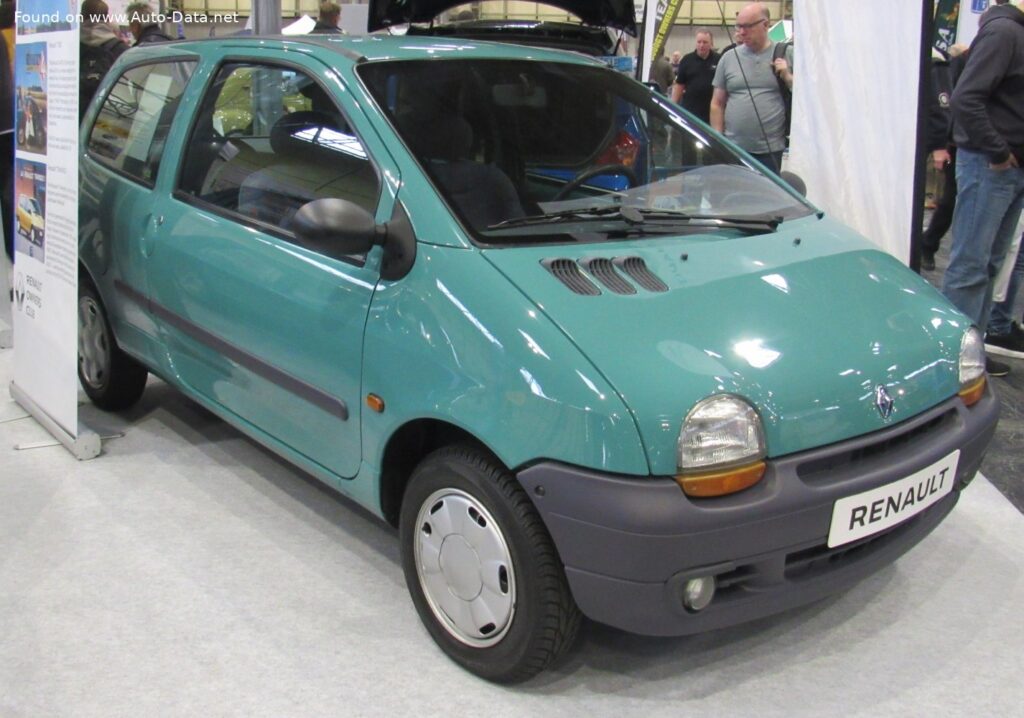
The Renault Twingo I 1.2, produced between 1996 and 2000, represents a significant entry in the European city car segment. Designed as a small, affordable, and practical hatchback, the Twingo quickly gained popularity for its nimble handling and efficient engine. While never officially sold in the United States, the Twingo I was a key model for Renault, demonstrating their ability to create a compelling and modern vehicle for the urban environment. It served as a direct competitor to vehicles like the Fiat Cinquecento and Peugeot 106, offering a blend of style, functionality, and economy.
Renault Twingo I 1.2: A City Car Pioneer
The first generation Twingo (Twingo I) was a departure from Renault’s traditional designs, embracing a more rounded and contemporary aesthetic. Its emphasis on interior space and ease of maneuverability made it particularly well-suited for congested city streets. The 1.2-liter engine variant, producing 58 horsepower, became a mainstay of the Twingo lineup, balancing performance with fuel efficiency. The Twingo’s design philosophy prioritized practicality and affordability, making it a popular choice for first-time car buyers and those seeking a convenient urban runabout.
Engine & Performance
The Renault Twingo I 1.2 is powered by a 1.149-liter (70.12 cubic inches) inline four-cylinder gasoline engine, designated the D7F. This naturally aspirated engine produces a maximum power output of 58 horsepower at 5250 rpm and 93 Nm (68.59 lb.-ft.) of torque at 2500 rpm. While not a performance-oriented vehicle, the engine provides adequate power for urban driving and short highway trips. The power-to-weight ratio of 14.7 kg/Hp allows for a reasonable, if not brisk, acceleration. The Twingo I 1.2 achieves a 0 to 100 km/h (0 to 62 mph) time of 13.4 seconds, and a 0 to 60 mph time of 12.7 seconds. Its top speed is rated at 151 km/h (93.83 mph). Fuel economy is a strong point, with urban consumption rated at 7.5 l/100 km (31.4 US mpg), and extra-urban consumption at 5.1 l/100 km (46.1 US mpg). The engine utilizes a multi-port manifold fuel injection system and an overhead camshaft (OHC) valvetrain with two valves per cylinder.
Design & Features
The Renault Twingo I is a three-door hatchback with seating for four passengers. Its compact dimensions – 3433 mm (135.16 in) in length, 1630 mm (64.17 in) in width, and 1423 mm (56.02 in) in height – contribute to its maneuverability in tight spaces. The Twingo’s interior is designed to maximize space efficiency, offering a surprisingly roomy cabin for its size. The rear seats can be folded down to increase cargo capacity from a minimum of 168 liters (5.93 cu. ft.) to a maximum of 1096 liters (38.7 cu. ft.). Safety features for the era included an Anti-lock Braking System (ABS) as an option, and a robust body structure. The steering is rack and pinion with hydraulic assistance, providing a responsive and comfortable driving experience. The vehicle rides on 155/70 R13 tires mounted on 13-inch wheel rims. The Twingo’s design was considered modern for its time, with a rounded silhouette and a cheerful aesthetic that appealed to a broad range of buyers.
Technical Specifications
| Brand | Renault |
| Model | Twingo |
| Generation | Twingo I |
| Type (Engine) | 1.2 (58 Hp) |
| Start of production | 1996 |
| End of production | 2000 |
| Powertrain Architecture | Internal Combustion engine |
| Body type | Hatchback |
| Seats | 4 |
| Doors | 3 |
| Fuel consumption (urban) | 7.5 l/100 km (31.4 US mpg) |
| Fuel consumption (extra urban) | 5.1 l/100 km (46.1 US mpg) |
| Fuel Type | Petrol (Gasoline) |
| Acceleration 0 – 100 km/h | 13.4 sec |
| Acceleration 0 – 62 mph | 13.4 sec |
| Acceleration 0 – 60 mph | 12.7 sec |
| Maximum speed | 151 km/h (93.83 mph) |
| Weight-to-power ratio | 14.7 kg/Hp |
| Weight-to-torque ratio | 9.2 kg/Nm |
| Power | 58 Hp @ 5250 rpm |
| Torque | 93 Nm @ 2500 rpm (68.59 lb.-ft. @ 2500 rpm) |
| Engine layout | Front, Transverse |
| Engine Model/Code | D7F |
| Engine displacement | 1149 cm3 (70.12 cu. in.) |
| Number of cylinders | 4 |
| Engine configuration | Inline |
| Cylinder Bore | 69 mm (2.72 in.) |
| Piston Stroke | 76.8 mm (3.02 in.) |
| Compression ratio | 9.6:1 |
| Number of valves per cylinder | 2 |
| Fuel injection system | Multi-port manifold injection |
| Engine aspiration | Naturally aspirated |
| Valvetrain | OHC |
| Engine oil capacity | 4 l (4.23 US qt | 3.52 UK qt) |
| Coolant capacity | 5 l (5.28 US qt | 4.4 UK qt) |
| Kerb Weight | 855 kg (1884.95 lbs.) |
| Max. weight | 1230 kg (2711.69 lbs.) |
| Max load | 375 kg (826.73 lbs.) |
| Trunk (boot) space – minimum | 168 l (5.93 cu. ft.) |
| Trunk (boot) space – maximum | 1096 l (38.7 cu. ft.) |
| Fuel tank capacity | 40 l (10.57 US gal | 8.8 UK gal) |
| Length | 3433 mm (135.16 in.) |
| Width | 1630 mm (64.17 in.) |
| Height | 1423 mm (56.02 in.) |
| Wheelbase | 2340 mm (92.13 in.) |
| Front track | 1416 mm (55.75 in.) |
| Rear track | 1374 mm (54.09 in.) |
| Drivetrain Architecture | Front wheel drive |
| Number of gears | 5 gears, manual transmission |
| Front suspension | Wishbone |
| Rear suspension | Coil spring |
| Front brakes | Disc |
| Rear brakes | Drum |
| Assisting systems | ABS (Anti-lock braking system) |
| Steering type | Steering rack and pinion |
| Power steering | Hydraulic |
| Tires size | 155/70 R13 |
| Wheel rims size | 13 |
The Renault Twingo I 1.2, while not a high-performance vehicle, offered a compelling package of affordability, practicality, and efficiency. Its impact on the European city car market was significant, establishing a benchmark for small, maneuverable, and fuel-efficient vehicles. Although not sold in the US, it represents a noteworthy example of European automotive engineering focused on addressing the needs of urban drivers.