
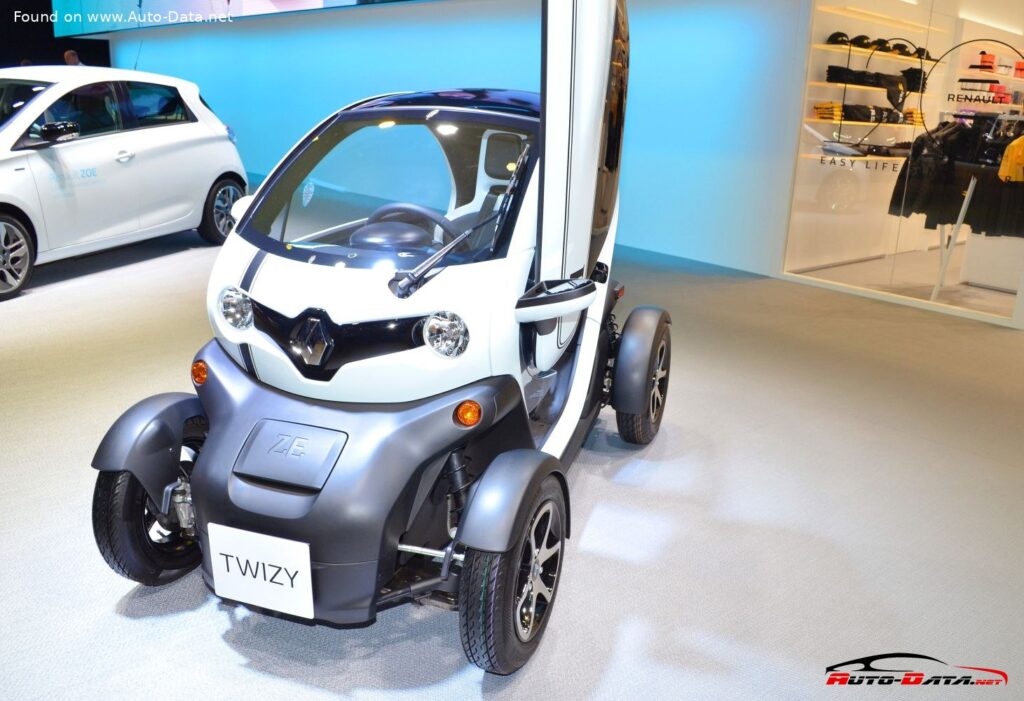
The Renault Twizy ZE is a two-seater urban microcar developed by French manufacturer Renault. Introduced in 2012, the Twizy occupies a unique niche as a quadricycle, bridging the gap between a traditional car and a scooter. While not officially sold in the United States, the Twizy gained significant traction in Europe as a novel solution for short-distance commuting and urban mobility, particularly appealing to those seeking an environmentally friendly and cost-effective alternative to conventional vehicles. Its distinctive design and fully electric powertrain set it apart, making it a recognizable symbol of Renault’s early foray into electric vehicle technology.
Renault Twizy ZE: A Unique Urban Mobility Solution
The Twizy ZE (Zero Emission) represents Renault’s commitment to electric mobility. It was conceived as a response to the growing demand for sustainable transportation options in congested urban environments. Unlike many early electric vehicles that aimed to replicate the experience of a traditional gasoline car, the Twizy embraced a different philosophy. Its open-air cabin, motorcycle-inspired controls, and compact dimensions were specifically designed for navigating narrow city streets and minimizing its environmental footprint. The “ZE” designation highlights its fully electric nature, contributing to zero tailpipe emissions and reduced noise pollution.
Engine & Performance
The Renault Twizy ZE is powered by a single electric motor producing 17 horsepower (Hp). This motor delivers 57 Nm (42.04 lb.-ft.) of torque available from 0 to 2100 rpm, providing surprisingly brisk acceleration for its size and intended use. The powertrain is a fully electric BEV (Battery Electric Vehicle) configuration. The motor is transversely mounted on the rear axle, driving the rear wheels. The Twizy utilizes a single-speed automatic transmission, simplifying operation and focusing on ease of use. While not designed for high-speed travel, the Twizy achieves a maximum speed of 80 km/h (49.71 mph), sufficient for urban and suburban environments. The 6.1 kWh lithium-ion battery provides an all-electric range of 100 km (62.14 miles) under typical driving conditions.
Design & Features
The Twizy’s design is undeniably unconventional. Classified as a quadricycle, it features an open-air cabin with butterfly doors, offering a unique entry and exit experience. The two seats are arranged in a tandem configuration, similar to a motorcycle. While offering minimal weather protection, the optional doors and windshield provide some shielding from the elements. The vehicle’s compact dimensions – measuring 2338 mm (92.05 in.) in length and 1237 mm (48.7 in.) in width – allow for easy maneuverability and parking in tight urban spaces. Safety features include front and rear ventilated disc brakes, and a McPherson suspension system both front and rear. The relatively low curb weight of 474 kg (1044.99 lbs.) contributes to its agility and efficiency. A small trunk space of 31 liters (1.09 cu. ft.) provides limited storage capacity.
Technical Specifications
| Brand | Renault |
| Model | Twizy |
| Generation | Twizy ZE |
| Type (Engine) | 6.1 kWh (17 Hp) |
| Start of production | 2012 |
| Powertrain Architecture | BEV (Electric Vehicle) |
| Body type | Quadricycle |
| Seats | 2 |
| Doors | 2 |
| Fuel Type | Electricity |
| Maximum speed | 80 km/h (49.71 mph) |
| Gross battery capacity | 6.1 kWh |
| Battery technology | Lithium-ion (Li-Ion) |
| Battery weight | 98 kg (216.05 lbs.) |
| Battery location | Below the floor |
| All-electric range | 100 km (62.14 mi) |
| Max speed (electric) | 80 km/h (49.71 mph) |
| Electric motor power | 17 Hp |
| Electric motor Torque | 57 Nm @ 0-2100 rpm (42.04 lb.-ft. @ 0-2100 rpm) |
| Electric motor model/code | 3CG |
| Electric motor location | Rear axle, Transverse |
| Kerb Weight | 474 kg (1044.99 lbs.) |
| Max. weight | 690 kg (1521.19 lbs.) |
| Max load | 216 kg (476.2 lbs.) |
| Trunk (boot) space – minimum | 31 l (1.09 cu. ft.) |
| Length | 2338 mm (92.05 in.) |
| Width | 1237 mm (48.7 in.) |
| Width including mirrors | 1381 mm (54.37 in.) |
| Height | 1454 mm (57.24 in.) |
| Wheelbase | 1686 mm (66.38 in.) |
| Front track | 1094 mm (43.07 in.) |
| Rear (Back) track | 1080 mm (42.52 in.) |
| Front overhang | 313 mm (12.32 in.) |
| Rear overhang | 339 mm (13.35 in.) |
| Ride height (ground clearance) | 120 mm (4.72 in.) |
| Drag coefficient (Cd) | 0.64 |
| Minimum turning circle (turning diameter) | 6.8 m (22.31 ft.) |
| Drivetrain Architecture | One electric motor drives the rear wheels. |
| Drive wheel | Rear wheel drive |
| Number of gears and type of gearbox | 1 gears, automatic transmission |
| Front suspension | Independent, type McPherson with coil spring and anti-roll bar |
| Rear suspension | McPherson, Transverse stabilizer |
| Front brakes | Ventilated discs, 214 mm |
| Rear brakes | Ventilated discs, 204 mm |
| Steering type | Steering rack and pinion |
| Tires size | Front wheel tires: 125/80 R13Rear wheel tires: 145/80 R13 |
The Renault Twizy ZE, while not a mainstream success in terms of sales volume, remains a significant vehicle in the history of electric mobility. It demonstrated Renault’s willingness to explore unconventional designs and powertrain configurations, paving the way for future electric vehicle development. Its focus on urban practicality and environmental responsibility continues to resonate with consumers seeking sustainable transportation solutions.
