
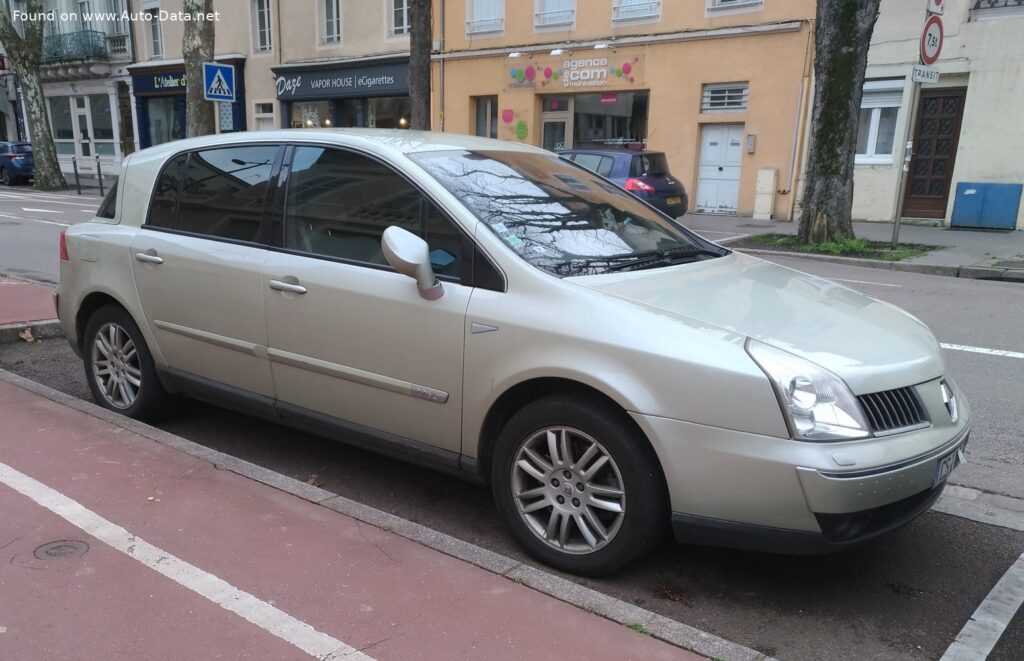
The Renault Vel Satis is a large family car produced by the French manufacturer Renault from 2001 to 2009. Positioned as a flagship model, the Vel Satis aimed to offer a blend of comfort, space, and distinctive styling, primarily targeting the European market. While never officially sold in the United States, it represented Renault’s attempt to compete with executive hatchbacks and large sedans like the Ford Mondeo and Opel/Vauxhall Vectra. This article focuses on the 2.0 dCi variant, produced from 2006 to 2009, equipped with a 175 horsepower diesel engine.
Renault Vel Satis 2.0 dCi: An Overview
The Vel Satis occupied a unique niche in Renault’s lineup. It was larger and more upscale than the Laguna, but positioned below the more luxurious and chauffeur-driven Renault Espace. The vehicle’s name, “Vel Satis,” is derived from the Latin “vel satis” meaning “as much as is enough,” reflecting Renault’s intention to provide a comprehensively equipped and comfortable vehicle. The 2.0 dCi model, introduced in 2006, offered a more fuel-efficient alternative to the gasoline engines, appealing to buyers prioritizing economy without sacrificing performance.
Engine & Performance
The heart of the Vel Satis 2.0 dCi is Renault’s M9R engine, a 1.998-liter (121.93 cubic inches) inline-four cylinder diesel engine. This engine produces 175 horsepower at 4000 rpm and 360 Nm (265.52 lb.-ft.) of torque at 2000 rpm. The engine utilizes a diesel commonrail fuel injection system and is equipped with a turbocharger and intercooler to enhance power and efficiency. This configuration allows for a respectable 0-100 km/h (0-62 mph) acceleration time of 9.5 seconds and a maximum speed of 211 km/h (131.11 mph). The engine’s power-to-weight ratio is 9.5 kg/Hp, and the torque-to-weight ratio is 4.6 kg/Nm, contributing to a responsive driving experience. Fuel economy is rated at 7.3 l/100 km (32.2 US mpg, 38.7 UK mpg) on a combined cycle, with CO2 emissions of 194 g/km.
Design & Features
The Vel Satis is characterized by its distinctive, somewhat polarizing, exterior design. It features a high roofline, a short rear overhang, and a prominent front grille. The body style is a five-door hatchback, offering a practical and spacious interior. The interior was designed with a focus on comfort and ergonomics, featuring supportive seats and a well-laid-out dashboard. Standard features typically included air conditioning, power windows, central locking, and an audio system. Safety features, crucial for a vehicle in this segment, included ABS (Anti-lock Braking System) and front and side airbags. The Vel Satis offered a generous amount of interior space, with a focus on rear passenger comfort. The hatchback configuration provides easy access to the cargo area, enhancing practicality. The vehicle’s dimensions are substantial, measuring 4860 mm (191.34 in) in length, 1860 mm (73.23 in) in width, and 1577 mm (62.09 in) in height.
Technical Specifications
| Brand | Renault |
| Model | Vel Satis |
| Generation | Vel Satis |
| Type (Engine) | 2.0 dCi (175 Hp) |
| Start of production | 2006 |
| End of production | 2009 |
| Powertrain Architecture | Internal Combustion engine |
| Body type | Hatchback |
| Seats | 5 |
| Doors | 5 |
| Fuel consumption (urban) | 9.2 l/100 km (25.6 US mpg) |
| Fuel consumption (extra urban) | 6.4 l/100 km (36.8 US mpg) |
| Fuel consumption (combined) | 7.3 l/100 km (32.2 US mpg) |
| CO2 emissions | 194 g/km |
| Fuel Type | Diesel |
| Acceleration 0 – 100 km/h | 9.5 sec |
| Acceleration 0 – 62 mph | 9.5 sec |
| Acceleration 0 – 60 mph | 9 sec |
| Maximum speed | 211 km/h (131.11 mph) |
| Weight-to-power ratio | 9.5 kg/Hp |
| Weight-to-torque ratio | 4.6 kg/Nm |
| Power | 175 Hp @ 4000 rpm |
| Torque | 360 Nm @ 2000 rpm (265.52 lb.-ft. @ 2000 rpm) |
| Engine layout | Front, Transverse |
| Engine Model/Code | M9R |
| Engine displacement | 1998 cm3 (121.93 cu. in.) |
| Number of cylinders | 4 |
| Engine configuration | Inline |
| Cylinder Bore | 84 mm (3.31 in.) |
| Piston Stroke | 90 mm (3.54 in.) |
| Compression ratio | 15.6:1 |
| Number of valves per cylinder | 4 |
| Fuel injection system | Diesel Commonrail |
| Engine oil capacity | 7.4 l (7.82 US qt | 6.51 UK qt) |
| Coolant capacity | 6.8 l (7.19 US qt | 5.98 UK qt) |
| Kerb Weight | 1665 kg (3670.7 lbs.) |
| Max. weight | 2505 kg (5522.58 lbs.) |
| Max load | 840 kg (1851.88 lbs.) |
| Fuel tank capacity | 80 l (21.13 US gal | 17.6 UK gal) |
| Permitted trailer load (braked) | 1600 kg (3527.4 lbs.) |
| Permitted trailer load (unbraked) | 750 kg (1653.47 lbs.) |
| Length | 4860 mm (191.34 in.) |
| Width | 1860 mm (73.23 in.) |
| Width (with mirrors) | 2177 mm (85.71 in.) |
| Height | 1577 mm (62.09 in.) |
| Wheelbase | 2840 mm (111.81 in.) |
| Front track | 1575 mm (62.01 in.) |
| Rear track | 1550 mm (61.02 in.) |
| Minimum turning circle | 12 m (39.37 ft.) |
| Drivetrain | Front wheel drive |
| Gearbox | 6 gears, manual transmission |
| Front suspension | Independent McPherson |
| Rear suspension | Independent multi-link |
| Front brakes | Disc, 324 mm |
| Rear brakes | Disc, 300 mm |
| Tire size | 225/55 R17; 245/45 R18 |
The Renault Vel Satis 2.0 dCi, while not a mainstream success in terms of sales, offered a compelling package of space, comfort, and efficiency. It remains a distinctive and somewhat underrated vehicle, representing a unique chapter in Renault’s history.
