
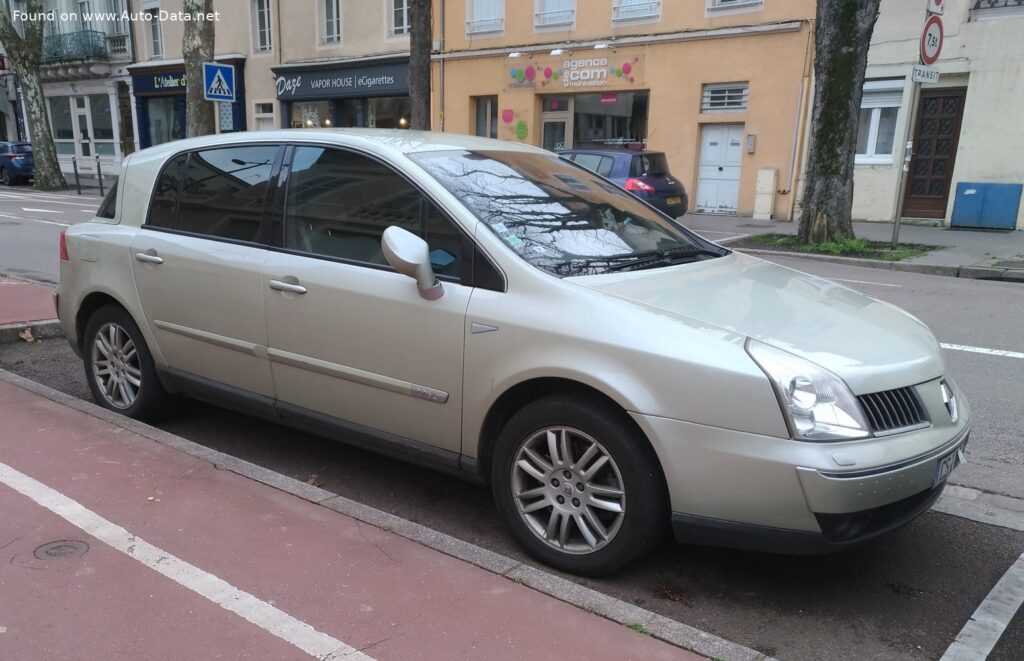
The Renault Vel Satis is a large family car produced by the French manufacturer Renault from 2001 to 2009. Positioned as a flagship model, it aimed to offer a blend of comfort, space, and distinctive styling. While not officially sold in the United States, the Vel Satis was a significant vehicle in the European market, competing with cars like the Ford Mondeo, Peugeot 607, and Volkswagen Passat. This article focuses on the 2.0 i 16V Turbo variant produced from 2005 to 2009, equipped with a 170 horsepower engine and automatic transmission.
Renault Vel Satis 2.0 i 16V Turbo: An Overview
The Vel Satis represented Renault’s attempt to create a uniquely styled and spacious executive car. Its design, penned by Matthew Humphreys, was deliberately unconventional, prioritizing interior space and a commanding driving position. The 2.0 i 16V Turbo model, introduced in 2005, offered a balance between performance and fuel economy, making it a popular choice within the Vel Satis range. It featured a turbocharged four-cylinder engine paired with a five-speed automatic transmission, catering to drivers seeking a comfortable and refined driving experience.
Engine & Performance
The heart of the Vel Satis 2.0 i 16V Turbo is a 1,998 cc (121.93 cubic inches) inline-four cylinder engine. This engine, designated F4Rt, utilizes a turbocharger and intercooler to boost power output to 170 horsepower at 5,000 rpm. Torque figures stand at 270 Nm (199.14 lb-ft) available at 3,250 rpm, providing ample pulling power for everyday driving and overtaking maneuvers. The engine features multi-port fuel injection and a double overhead camshaft (DOHC) valvetrain with four valves per cylinder.
Performance-wise, the Vel Satis 2.0 i 16V Turbo achieves a 0-100 km/h (0-62 mph) acceleration time of 10 seconds, and a 0-60 mph time of approximately 9.5 seconds. Its maximum speed is electronically limited to 206 km/h (128 mph). Fuel consumption is rated at 10.2 liters per 100 kilometers (23.1 US mpg) on a combined cycle, with urban consumption reaching 14.5 l/100km (16.2 US mpg) and extra-urban consumption at 7.7 l/100km (30.5 US mpg). CO2 emissions are rated at 237 g/km, placing it within the Euro 4 emission standard.
Design & Features
The Renault Vel Satis is a five-door hatchback, offering a practical and versatile body style. Its distinctive exterior design is characterized by its high roofline, large glass area, and pronounced shoulder line. The interior is spacious and well-appointed, with seating for five adults. The Vel Satis prioritized passenger comfort, offering generous legroom and headroom in both the front and rear seats.
Standard features on the 2.0 i 16V Turbo model typically included air conditioning, power windows, central locking, and an audio system. Higher trim levels offered features such as leather upholstery, automatic climate control, and a navigation system. Safety features included ABS (Anti-lock Braking System) and front airbags. The Vel Satis’s design emphasized a commanding driving position, providing the driver with excellent visibility. The hatchback configuration provides a practical 460-liter (16.24 cubic feet) trunk space, expandable by folding down the rear seats.
Technical Specifications
| Brand | Renault |
| Model | Vel Satis |
| Generation | Vel Satis |
| Type (Engine) | 2.0 i 16V Turbo (170 Hp) Automatic |
| Start of production | 2005 |
| End of production | November, 2009 |
| Powertrain Architecture | Internal Combustion engine |
| Body type | Hatchback |
| Seats | 5 |
| Doors | 5 |
| Fuel consumption (urban) | 14.5 l/100 km (16.2 US mpg) |
| Fuel consumption (extra urban) | 7.7 l/100 km (30.5 US mpg) |
| Fuel consumption (combined) | 10.2 l/100 km (23.1 US mpg) |
| CO2 emissions | 237 g/km |
| Fuel Type | Petrol (Gasoline) |
| Acceleration 0 – 100 km/h | 10 sec |
| Acceleration 0 – 62 mph | 10 sec |
| Acceleration 0 – 60 mph | 9.5 sec |
| Maximum speed | 206 km/h (128 mph) |
| Emission standard | Euro 4 |
| Weight-to-power ratio | 9.8 kg/Hp |
| Weight-to-torque ratio | 6.1 kg/Nm |
| Power | 170 Hp @ 5000 rpm |
| Power per litre | 85.1 Hp/l |
| Torque | 270 Nm @ 3250 rpm (199.14 lb.-ft. @ 3250 rpm) |
| Engine layout | Front, Transverse |
| Engine Model/Code | F4Rt |
| Engine displacement | 1998 cm3 (121.93 cu. in.) |
| Number of cylinders | 4 |
| Engine configuration | Inline |
| Cylinder Bore | 82.7 mm (3.26 in.) |
| Piston Stroke | 93 mm (3.66 in.) |
| Compression ratio | 9.5:1 |
| Number of valves per cylinder | 4 |
| Fuel injection system | Multi-port manifold injection |
| Engine aspiration | Turbocharger, Intercooler |
| Valvetrain | DOHC |
| Engine oil capacity | 5.4 l (5.71 US qt | 4.75 UK qt) |
| Coolant | 6.8 l (7.19 US qt | 5.98 UK qt) |
| Kerb Weight | 1660 kg (3659.67 lbs.) |
| Max. weight | 2210 kg (4872.22 lbs.) |
| Max load | 550 kg (1212.54 lbs.) |
| Trunk (boot) space – minimum | 460 l (16.24 cu. ft.) |
| Fuel tank capacity | 80 l (21.13 US gal | 17.6 UK gal) |
| Permitted trailer load with brakes (12%) | 1600 kg (3527.4 lbs.) |
| Permitted trailer load without brakes | 750 kg (1653.47 lbs.) |
| Length | 4860 mm (191.34 in.) |
| Width | 1860 mm (73.23 in.) |
| Width including mirrors | 2177 mm (85.71 in.) |
| Height | 1575 mm (62.01 in.) |
| Wheelbase | 2840 mm (111.81 in.) |
| Front track | 1575 mm (62.01 in.) |
| Rear (Back) track | 1555 mm (61.22 in.) |
| Front overhang | 1065 mm (41.93 in.) |
| Rear overhang | 955 mm (37.6 in.) |
| Minimum turning circle (turning diameter) | 12 m (39.37 ft.) |
| Drivetrain Architecture | The Internal combustion engine (ICE) drives the front wheels of the vehicle. |
| Drive wheel | Front wheel drive |
| Number of gears and type of gearbox | 5 gears, automatic transmission |
| Front suspension | Independent type McPherson |
| Rear suspension | Independent multi-link suspension |
| Front brakes | Ventilated discs, 324 mm |
| Rear brakes | Disc, 300 mm |
| Assisting systems | ABS (Anti-lock braking system) |
| Steering type | Steering rack and pinion |
| Power steering | Hydraulic Steering |
| Tires size | 255/55 R17; 245/45 R18 |
| Wheel rims size | 17; 18 |
