
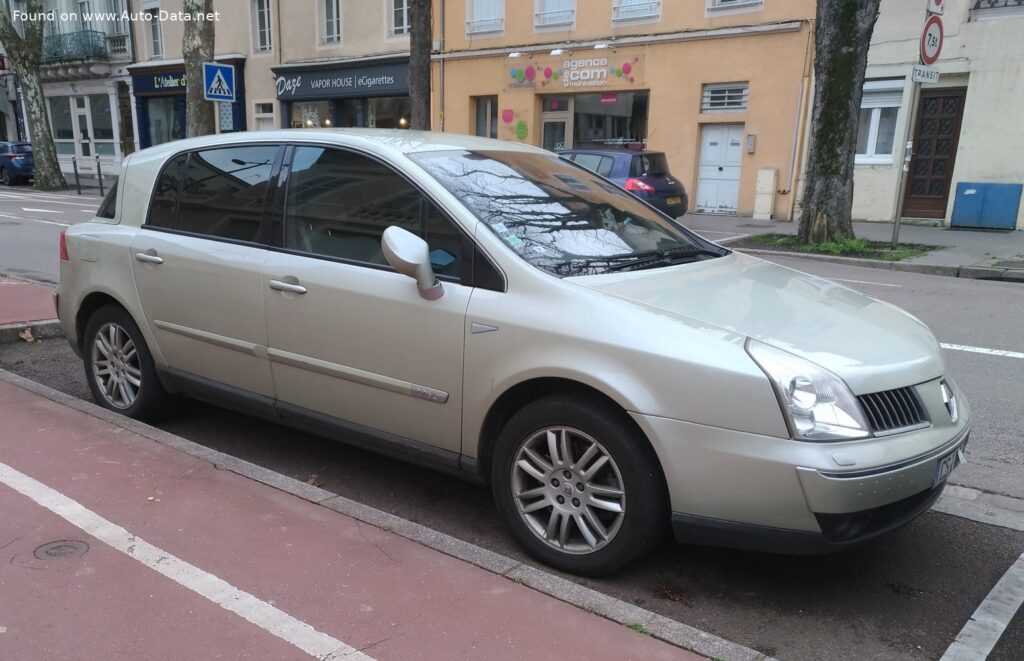
The Renault Vel Satis is a large family car produced by the French manufacturer Renault from 2001 to 2005. Positioned as a flagship model, the Vel Satis aimed to offer a blend of comfort, space, and distinctive styling, primarily targeting the European market. It represented Renault’s attempt to compete with executive cars like the Citroën C6 and the BMW 5 Series, though it occupied a slightly lower price point. The Vel Satis was notable for its spacious interior and unconventional design, which, while polarizing, set it apart from more conservative offerings in its class. This article focuses on the 2.0 T variant, equipped with a turbocharged petrol engine producing 163 horsepower.
Renault Vel Satis 2.0 T: An Overview
The Vel Satis was a unique vehicle in Renault’s lineup, designed to offer a premium experience without the premium price tag of its German competitors. It was built on the Renault Laguna platform, benefiting from a relatively sophisticated chassis and suspension setup. The 2.0 T model, powered by the F4Rt engine, was a popular choice, offering a balance between performance and fuel economy. While not a massive sales success, the Vel Satis remains a noteworthy vehicle for its innovative features and distinctive design.
Engine & Performance
The Renault Vel Satis 2.0 T is powered by a 1,998 cc (121.93 cubic inches) inline-four cylinder engine, designated the F4Rt. This engine utilizes a turbocharger and intercooler to boost power output to 163 horsepower at 5000 rpm, and 250 Nm (184.39 lb-ft) of torque at 2000 rpm. This configuration provides a reasonable level of performance for a vehicle of its size. Acceleration from 0 to 100 km/h (0-62 mph) takes 9.6 seconds, while 0 to 60 mph is achieved in approximately 9.1 seconds. The top speed is rated at 210 km/h (130.49 mph). The engine features multi-port fuel injection and a double overhead camshaft (DOHC) valvetrain with four valves per cylinder. The power-to-weight ratio is 10.1 kg/Hp, and the torque-to-weight ratio is 6.6 kg/Nm.
Fuel consumption figures are as follows: 12.6 l/100 km (18.7 US mpg, 22.4 UK mpg, 7.9 km/l) in urban driving, 7.6 l/100 km (30.9 US mpg, 37.2 UK mpg, 13.2 km/l) on the extra-urban cycle, and a combined consumption of 9.4 l/100 km (25 US mpg, 30.1 UK mpg, 10.6 km/l). The engine requires 5.4 liters (5.71 US quarts, 4.75 UK quarts) of engine oil and 6.8 liters (7.19 US quarts, 5.98 UK quarts) of coolant.
Design & Features
The Vel Satis is a five-door hatchback, offering a practical and spacious interior. Its design, penned by Matthew Humphreys, is characterized by its high roofline and distinctive rear end. The interior is designed with comfort in mind, offering ample space for five passengers and a generous 460-liter (16.24 cubic feet) trunk. The Vel Satis aimed to provide a more luxurious experience than many of its competitors, with features such as comfortable seating, a well-appointed dashboard, and a range of available options.
Safety features included ABS (Anti-lock Braking System) as standard. The Vel Satis also featured a robust chassis and suspension setup, providing a comfortable ride and good handling characteristics. The vehicle’s dimensions are: length 4860 mm (191.34 in), width 1860 mm (73.23 in), height 1575 mm (62.01 in), and wheelbase 2840 mm (111.81 in). The front and rear track widths are 1575 mm (62.01 in) and 1555 mm (61.22 in) respectively. The Vel Satis has a kerb weight of 1640 kg (3615.58 lbs) and a maximum weight of 2200 kg (4850.17 lbs), with a maximum load capacity of 560 kg (1234.59 lbs).
Technical Specifications
| Brand | Renault |
| Model | Vel Satis |
| Generation | Vel Satis |
| Type (Engine) | 2.0 T (163 Hp) |
| Start of production | 2001 |
| End of production | 2005 |
| Powertrain Architecture | Internal Combustion engine |
| Body type | Hatchback |
| Seats | 5 |
| Doors | 5 |
| Fuel consumption (urban) | 12.6 l/100 km (18.7 US mpg, 22.4 UK mpg) |
| Fuel consumption (extra urban) | 7.6 l/100 km (30.9 US mpg, 37.2 UK mpg) |
| Fuel consumption (combined) | 9.4 l/100 km (25 US mpg, 30.1 UK mpg) |
| Fuel Type | Petrol (Gasoline) |
| Acceleration 0 – 100 km/h | 9.6 sec |
| Acceleration 0 – 62 mph | 9.6 sec |
| Acceleration 0 – 60 mph | 9.1 sec |
| Maximum speed | 210 km/h (130.49 mph) |
| Weight-to-power ratio | 10.1 kg/Hp |
| Weight-to-torque ratio | 6.6 kg/Nm |
| Power | 163 Hp @ 5000 rpm |
| Torque | 250 Nm @ 2000 rpm (184.39 lb.-ft. @ 2000 rpm) |
| Engine layout | Front, Transverse |
| Engine Model/Code | F4Rt |
| Engine displacement | 1998 cm3 (121.93 cu. in.) |
| Number of cylinders | 4 |
| Engine configuration | Inline |
| Cylinder Bore | 82.7 mm (3.26 in.) |
| Piston Stroke | 93 mm (3.66 in.) |
| Compression ratio | 9.5:1 |
| Number of valves per cylinder | 4 |
| Fuel injection system | Multi-port manifold injection |
| Engine aspiration | Turbocharger, Intercooler |
| Valvetrain | DOHC |
| Engine oil capacity | 5.4 l (5.71 US qt | 4.75 UK qt) |
| Coolant | 6.8 l (7.19 US qt | 5.98 UK qt) |
| Kerb Weight | 1640 kg (3615.58 lbs.) |
| Max. weight | 2200 kg (4850.17 lbs.) |
| Max load | 560 kg (1234.59 lbs.) |
| Trunk (boot) space – minimum | 460 l (16.24 cu. ft.) |
| Fuel tank capacity | 80 l (21.13 US gal | 17.6 UK gal) |
| Length | 4860 mm (191.34 in.) |
| Width | 1860 mm (73.23 in.) |
| Height | 1575 mm (62.01 in.) |
| Wheelbase | 2840 mm (111.81 in.) |
| Front track | 1575 mm (62.01 in.) |
| Rear (Back) track | 1555 mm (61.22 in.) |
| Drivetrain Architecture | The Internal combustion engine (ICE) drives the front wheels of the vehicle. |
| Drive wheel | Front wheel drive |
| Number of gears and type of gearbox | 6 gears, manual transmission |
| Front suspension | Spring Strut |
| Rear suspension | Coil spring |
| Front brakes | Ventilated discs |
| Rear brakes | Disc |
| Assisting systems | ABS (Anti-lock braking system) |
| Steering type | Steering rack and pinion |
| Power steering | Hydraulic Steering |
| Tires size | 245/45 R18 |
| Wheel rims size | 18 |
