
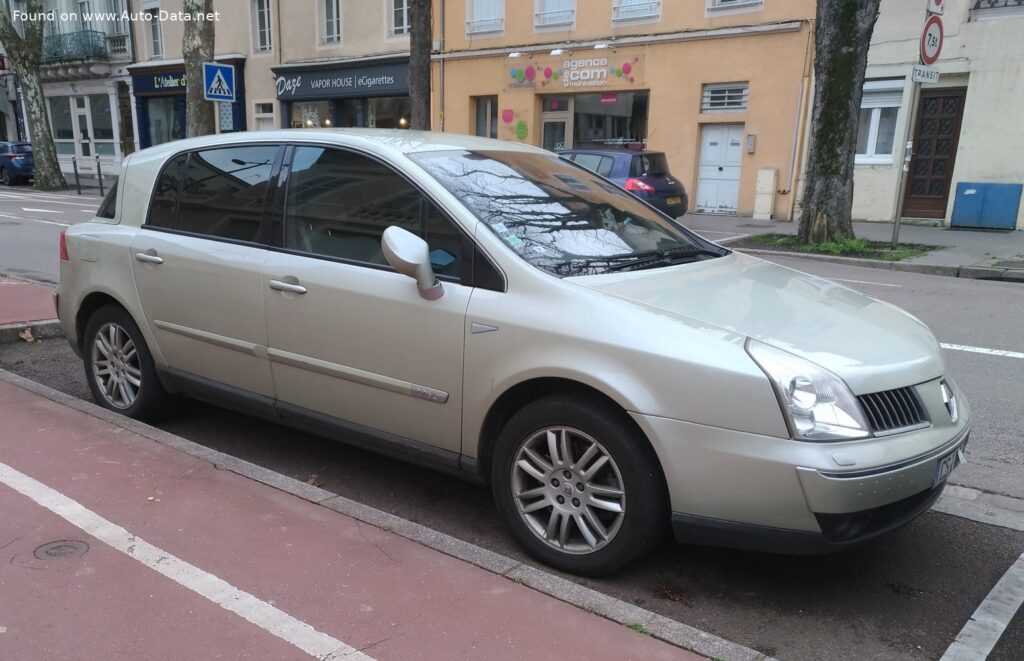
The Renault Vel Satis is a large family car produced by the French manufacturer Renault from 2002 to 2009. Positioned as a flagship model, the Vel Satis aimed to offer a blend of comfort, space, and distinctive styling, primarily targeting the European market. While never officially sold in the United States, it represented Renault’s attempt to compete with executive cars like the Citroën C6 and the BMW 5 Series. This article focuses on the 2.2 dCi variant, a diesel-powered version produced between 2002 and 2005, offering 150 horsepower.
Renault Vel Satis 2.2 dCi: An Overview
The Vel Satis was a unique offering in its segment, characterized by its unconventional, somewhat polarizing design. It was intended to be a spacious and comfortable vehicle, appealing to families and those seeking a more luxurious experience than typically found in mainstream Renault models. The 2.2 dCi engine was a key component of the Vel Satis lineup, providing a balance of performance and fuel efficiency. It utilized common rail direct injection and a turbocharger to deliver respectable power and torque for its size.
Engine & Performance
The heart of the Vel Satis 2.2 dCi is a 2.2-liter inline-four cylinder diesel engine, designated the G9t. This engine produces 150 horsepower at 4000 rpm and 320 Nm (236.02 lb.-ft.) of torque at 1750 rpm. The engine features a turbocharger with an intercooler, enhancing power output and efficiency. The power-to-weight ratio is 11.1 kg/Hp, or 90.4 Hp/tonne, while the torque-to-weight ratio is 5.2 kg/Nm, or 192.8 Nm/tonne. This translates to a 0-100 km/h (0-62 mph) acceleration time of 10.9 seconds, and a 0-60 mph time of approximately 10.4 seconds. The vehicle boasts a maximum speed of 200 km/h (124.27 mph). Fuel economy is a strong point for this engine, achieving approximately 7.1 l/100 km (33.1 US mpg or 39.8 UK mpg) on a combined cycle. Urban fuel consumption is rated at 9.2 l/100 km (25.6 US mpg), while extra-urban figures are significantly better at 5.9 l/100 km (39.9 US mpg).
Design & Features
The Renault Vel Satis is a five-door hatchback, offering a practical and versatile body style. Its design is notable for its high roofline and relatively short rear overhang, maximizing interior space. The vehicle seats five passengers comfortably. The interior was designed with a focus on comfort and refinement, featuring high-quality materials and a spacious cabin. Key features included a comprehensive safety package, including ABS (Anti-lock Braking System), and a hydraulic power steering system. The Vel Satis also offered a generous trunk space of 460 liters (16.24 cu. ft.). The suspension utilizes a spring strut setup at the front and coil springs at the rear, providing a comfortable ride. The vehicle rides on 18-inch wheel rims with 245/45 R18 tires. The Vel Satis aimed to provide a premium experience, though it didn’t achieve the sales success Renault hoped for, largely due to its unconventional styling and competition from established executive car brands.
Safety and Technology
For its time, the Vel Satis incorporated several safety features. The inclusion of ABS was standard, contributing to improved braking performance and stability. While advanced driver-assistance systems common in modern vehicles were not available, the Vel Satis prioritized passive safety through a robust body structure. The vehicle’s design focused on occupant protection in the event of a collision. The 2.2 dCi engine also benefited from advancements in diesel technology, including common rail fuel injection, which improved efficiency and reduced emissions compared to older diesel engines.
Technical Specifications
| Brand | Renault |
| Model | Vel Satis |
| Generation | Vel Satis |
| Type (Engine) | 2.2 dCi (150 Hp) |
| Start of production | April, 2002 |
| End of production | March, 2005 |
| Powertrain Architecture | Internal Combustion engine |
| Body type | Hatchback |
| Seats | 5 |
| Doors | 5 |
| Fuel consumption (urban) | 9.2 l/100 km (25.6 US mpg) |
| Fuel consumption (extra urban) | 5.9 l/100 km (39.9 US mpg) |
| Fuel consumption (combined) | 7.1 l/100 km (33.1 US mpg) |
| Fuel Type | Diesel |
| Acceleration 0 – 100 km/h | 10.9 sec |
| Acceleration 0 – 62 mph | 10.9 sec |
| Acceleration 0 – 60 mph | 10.4 sec |
| Maximum speed | 200 km/h (124.27 mph) |
| Weight-to-power ratio | 11.1 kg/Hp |
| Weight-to-torque ratio | 5.2 kg/Nm |
| Power | 150 Hp @ 4000 rpm |
| Torque | 320 Nm @ 1750 rpm (236.02 lb.-ft. @ 1750 rpm) |
| Engine layout | Front, Transverse |
| Engine Model/Code | G9t |
| Engine displacement | 2188 cm3 (133.52 cu. in.) |
| Number of cylinders | 4 |
| Engine configuration | Inline |
| Cylinder Bore | 87 mm (3.43 in.) |
| Piston Stroke | 92 mm (3.62 in.) |
| Compression ratio | 18:1 |
| Number of valves per cylinder | 4 |
| Fuel injection system | Diesel Commonrail |
| Engine aspiration | Turbocharger, Intercooler |
| Valvetrain | DOHC |
| Engine oil capacity | 6.3 l (6.66 US qt | 5.54 UK qt) |
| Coolant | 7 l (7.4 US qt | 6.16 UK qt) |
| Kerb Weight | 1660 kg (3659.67 lbs.) |
| Max. weight | 2260 kg (4982.45 lbs.) |
| Max load | 600 kg (1322.77 lbs.) |
| Trunk (boot) space – minimum | 460 l (16.24 cu. ft.) |
| Fuel tank capacity | 80 l (21.13 US gal | 17.6 UK gal) |
| Length | 4680 mm (184.25 in.) |
| Width | 1860 mm (73.23 in.) |
| Height | 1575 mm (62.01 in.) |
| Wheelbase | 2840 mm (111.81 in.) |
| Front track | 1575 mm (62.01 in.) |
| Rear (Back) track | 1555 mm (61.22 in.) |
| Drivetrain Architecture | Front wheel drive |
| Number of gears and type of gearbox | 6 gears, manual transmission |
| Front suspension | Spring Strut |
| Rear suspension | Coil spring |
| Front brakes | Ventilated discs |
| Rear brakes | Disc |
| Assisting systems | ABS (Anti-lock braking system) |
| Steering type | Steering rack and pinion |
| Power steering | Hydraulic Steering |
| Tires size | 245/45 R18 |
| Wheel rims size | 18 |
