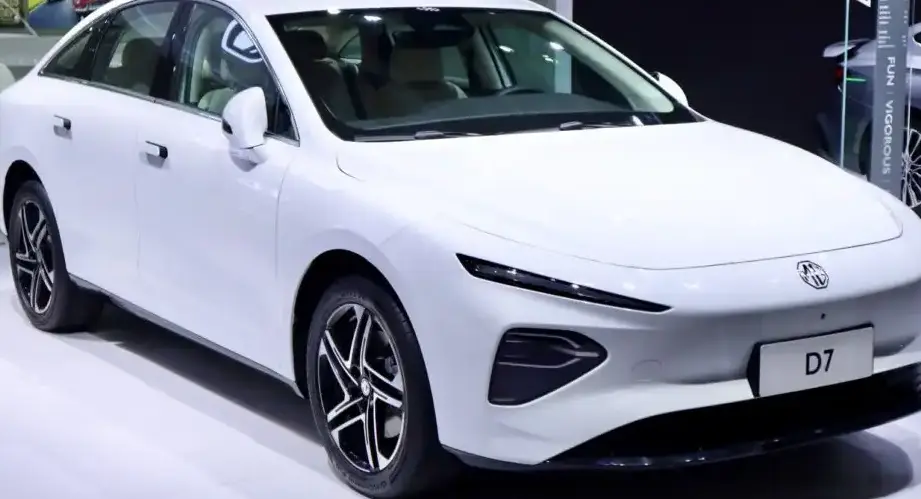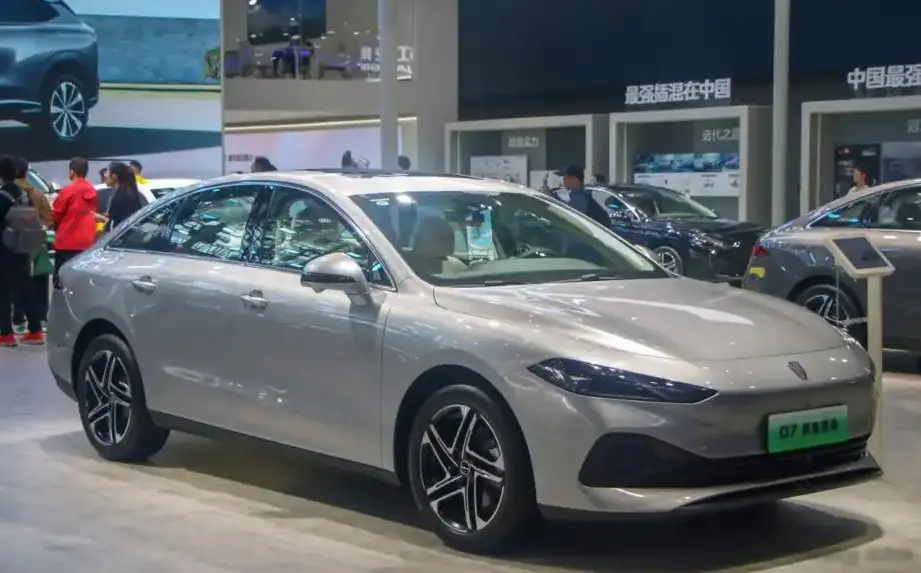
The Roewe D7 DMH 1.5 19.7 kWh (298 Hp) Plug-in Hybrid DHT is a compact sedan introduced by the Chinese automaker Roewe in November 2024. Positioned as a technologically advanced offering within the D7 lineup, this variant combines a 1.5-liter gasoline engine with an electric motor and a 19.7 kWh battery pack, delivering both fuel efficiency and substantial performance. It represents Roewe’s commitment to new energy vehicles and caters to a growing segment of consumers seeking electrified transportation options. The DMH designation signifies the model’s plug-in hybrid drivetrain, and it’s built on Roewe’s modern platform designed for efficient packaging and driving dynamics.
Technical Specifications
| Brand | Roewe |
| Model | D7 |
| Generation | D7 |
| Type (Engine) | DMH 1.5 19.7 kWh (298 Hp) Plug-in Hybrid DHT |
| Start of production | November, 2024 |
| Powertrain Architecture | PHEV (Plug-in Hybrid Electric Vehicle) |
| Body type | Sedan |
| Seats | 5 |
| Doors | 4 |
| Fuel consumption (economy) – combined | 0.97-4.31 l/100 km (242.5 – 54.6 US mpg, 291.2 – 65.5 UK mpg, 103.1 – 23.2 km/l) |
| Fuel Type | Petrol / electricity |
| Acceleration 0 – 100 km/h | 8.5 sec |
| Acceleration 0 – 62 mph | 8.5 sec |
| Acceleration 0 – 60 mph | 8.1 sec |
| Maximum speed | 185 km/h (114.95 mph) |
| Weight-to-power ratio | 5.6 kg/Hp, 178.4 Hp/tonne |
| Weight-to-torque ratio | 12.4 kg/Nm, 80.8 Nm/tonne |
| Gross battery capacity | 19.7 kWh |
| Battery technology | Lithium iron phosphate (LiFePO4) |
| Battery location | Below the floor |
| All-electric range | 103-125 km (64 – 77.67 mi) |
| Average Energy consumption | 13.9 kWh/100 km (22.37 kWh/100 mi, 151 MPGe, 7.2 km/kWh, 4.5 mi/kWh) |
| Electric motor power | 186 Hp |
| Electric motor Torque | 330 Nm (243.4 lb.-ft.) |
| Electric motor model/code | TZ210XY105 |
| Electric motor location | Integrated into the transmission |
| Electric motor type | Synchronous |
| System power | 298 Hp |
| Power | 112 Hp |
| Torque | 135 Nm (99.57 lb.-ft.) |
| Engine layout | Front, Transverse |
| Engine Model/Code | 15FHC |
| Engine displacement | 1498 cm3 (91.41 cu. in.) |
| Number of cylinders | 4 |
| Engine configuration | Inline |
| Compression ratio | 16:1 |
| Number of valves per cylinder | 4 |
| Fuel injection system | Multi-port manifold injection |
| Engine aspiration | Naturally aspirated engine |
| Valvetrain | DOHC |
| Kerb Weight | 1670 kg (3681.72 lbs.) |
| Max. weight | 2117 kg (4667.19 lbs.) |
| Max load | 447 kg (985.47 lbs.) |
| Trunk (boot) space – minimum | 450 l (15.89 cu. ft.) |
| Fuel tank capacity | 55 l (14.53 US gal | 12.1 UK gal) |
| Length | 4890 mm (192.52 in.) |
| Width | 1890 mm (74.41 in.) |
| Height | 1510 mm (59.45 in.) |
| Wheelbase | 2810 mm (110.63 in.) |
| Front track | 1600 mm (62.99 in.) |
| Rear (Back) track | 1600 mm (62.99 in.) |
| Drag coefficient (Cd) | 0.26 |
| Minimum turning circle (turning diameter) | 11.62 m (38.12 ft.) |
| Approach angle | 14° |
| Departure angle | 19° |
| Drivetrain Architecture | The Internal combustion engine (ICE) and electric motor drive the front wheels of the car with the ability to work in full electric or mixed mode. |
| Drive wheel | Front wheel drive |
| Number of gears and type of gearbox | 1 gears, automatic transmission DHT |
| Front suspension | Independent, type McPherson with coil spring and anti-roll bar |
| Rear suspension | Independent multi-link spring suspension with stabilizer |
| Front brakes | Ventilated discs |
| Rear brakes | Disc |
| Assisting systems | ABS (Anti-lock braking system) |
| Steering type | Steering rack and pinion |
| Power steering | Electric Steering |
| Tires size | 225/50 R18 |
| Wheel rims size | 18 |
Powertrain & Engine Architecture
The Roewe D7 DMH 1.5 utilizes a plug-in hybrid powertrain centered around a 1.5-liter naturally aspirated inline-four cylinder engine (code 15FHC). This engine produces 112 horsepower and 135 Nm (99.57 lb.-ft.) of torque. It features multi-point fuel injection and a double overhead camshaft (DOHC) valvetrain with four valves per cylinder. The engine is paired with a 186 horsepower electric motor (TZ210XY105) and a 19.7 kWh lithium iron phosphate (LiFePO4) battery pack. The battery is positioned under the floor of the vehicle, contributing to a lower center of gravity. The drivetrain employs Roewe’s DHT (Dedicated Hybrid Transmission) – a single-speed automatic transmission that intelligently manages power delivery from both the engine and the electric motor. This system allows for seamless transitions between electric-only, hybrid, and engine-only modes.
Driving Characteristics
The D7 DMH 1.5 offers a refined driving experience. In electric-only mode, it provides near-silent acceleration and a range of 103-125 km (64-77.67 miles), suitable for daily commutes. When the battery is depleted or requires assistance, the gasoline engine seamlessly engages, providing a combined system output of 298 horsepower. The DHT transmission contributes to smooth acceleration, and the vehicle achieves a 0-100 km/h (0-62 mph) time of 8.5 seconds. Compared to potential gasoline-only versions of the D7, the DMH offers improved fuel economy and reduced emissions. While the 1.5-liter engine isn’t as powerful as larger engine options, the electric motor provides instant torque, compensating for the engine’s limitations. The front-wheel-drive configuration provides adequate traction for most driving conditions.
Equipment & Trim Levels
The Roewe D7 DMH 1.5 typically comes well-equipped with standard features including automatic climate control, a touchscreen infotainment system, Bluetooth connectivity, and a suite of advanced driver-assistance systems (ADAS). Interior upholstery is generally cloth or leatherette, depending on the specific trim level. Optional extras may include a panoramic sunroof, premium audio system, and upgraded interior trim materials. The dashboard layout is modern and driver-focused, with a digital instrument cluster providing key vehicle information.
Chassis & Braking
The D7 DMH 1.5 features an independent suspension system, with McPherson struts at the front and a multi-link setup at the rear, providing a comfortable ride and stable handling. Anti-roll bars are included on both axles to minimize body roll during cornering. The braking system consists of ventilated discs at the front and solid discs at the rear, coupled with an Anti-lock Braking System (ABS) for enhanced safety. The electric steering system provides light and precise steering feel.
Market Reception & Comparison
The Roewe D7 DMH 1.5 has been well-received in the Chinese market, where demand for plug-in hybrid vehicles is strong. Critics have praised its fuel efficiency, comfortable ride, and advanced technology. Compared to other plug-in hybrid sedans in its class, the D7 DMH 1.5 offers a competitive combination of performance, range, and price. Its fuel economy of 0.97-4.31 l/100 km is significantly better than traditional gasoline-powered vehicles. Reliability reports are still emerging, but Roewe has been steadily improving its quality control in recent years.
Legacy
The Roewe D7 DMH 1.5 represents a significant step forward for Roewe in the realm of electrified vehicles. The longevity of the powertrain will depend on factors such as battery degradation and maintenance practices. The LiFePO4 battery technology is known for its stability and long lifespan, which should contribute to the vehicle’s long-term reliability. As the used car market matures, the D7 DMH 1.5 is expected to hold its value reasonably well, particularly among buyers seeking a fuel-efficient and technologically advanced sedan.