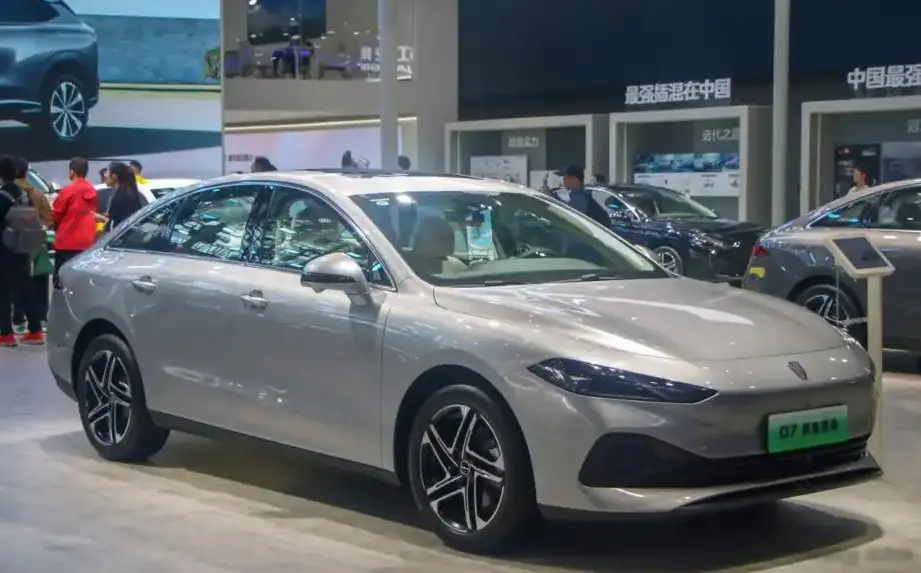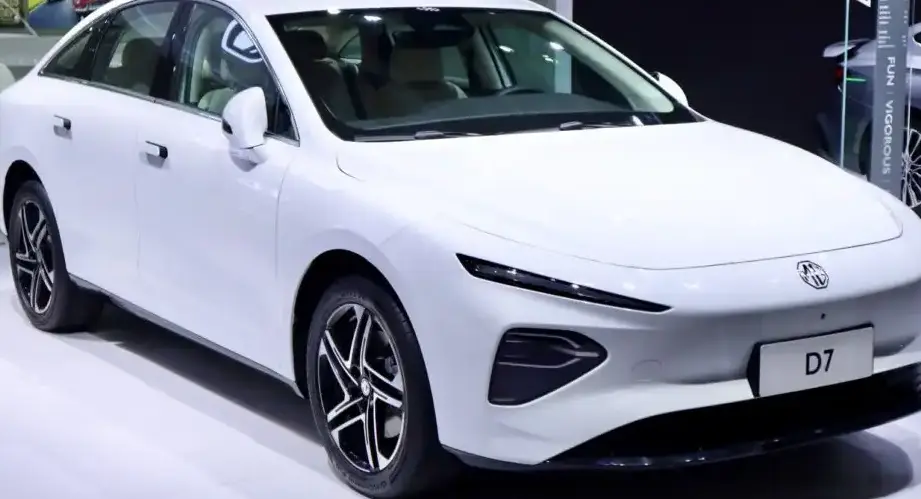
The Roewe D7 EV 57.6 kWh (197 hp) is an all-electric sedan launched by the Chinese automaker Roewe in November 2024. Positioned as a mainstream electric vehicle, the D7 represents Roewe’s entry into the increasingly competitive EV sedan market, targeting consumers seeking a balance of range, performance, and modern features. It is built on a dedicated electric vehicle platform and is intended primarily for the Chinese domestic market, though export potential remains a possibility. The D7 aims to offer a compelling alternative to established EV players, leveraging Roewe’s growing brand recognition and manufacturing capabilities.
Technical Specifications
| Brand | Roewe |
| Model | D7 |
| Generation | D7 |
| Type (Engine) | EV 57.6 kWh (197 Hp) |
| Start of production | November, 2024 |
| Powertrain Architecture | BEV (Electric Vehicle) |
| Body type | Sedan |
| Seats | 5 |
| Doors | 4 |
| Fuel Type | Electricity |
| Acceleration 0 – 100 km/h | 7.3 sec |
| Acceleration 0 – 62 mph | 7.3 sec |
| Acceleration 0 – 60 mph | 6.9 sec |
| Maximum speed | 170 km/h (105.63 mph) |
| Weight-to-power ratio | 8.7 kg/Hp, 114.4 Hp/tonne |
| Weight-to-torque ratio | 5.6 kg/Nm, 180 Nm/tonne |
| Gross battery capacity | 57.6 kWh |
| Battery technology | Lithium iron phosphate (LiFePO4) |
| Battery location | Below the floor |
| All-electric range (CLTC) | 510 km (316.9 mi) |
| Average Energy consumption (CLTC) | 12.9 kWh/100 km (20.76 kWh/100 mi) |
| MPGe | 162 |
| km/kWh | 7.8 |
| mi/kWh | 4.8 |
| Electric motor power | 197 Hp |
| Electric motor Torque | 310 Nm (228.64 lb.-ft.) |
| Electric motor model/code | TZ180XS1181 |
| Electric motor location | Rear axle, Transverse |
| Electric motor type | Synchronous |
| System power | 197 Hp |
| System torque | 310 Nm (228.64 lb.-ft.) |
| Kerb Weight | 1722 kg (3796.36 lbs.) |
| Trunk (boot) space – minimum | 376 l (13.28 cu. ft.) |
| Length | 4890 mm (192.52 in.) |
| Width | 1872 mm (73.7 in.) |
| Height | 1510 mm (59.45 in.) |
| Wheelbase | 2810 mm (110.63 in.) |
| Front track | 1600 mm (62.99 in.) |
| Rear (Back) track | 1600 mm (62.99 in.) |
| Drag coefficient (Cd) | 0.23 |
| Minimum turning circle | 11.62 m (38.12 ft.) |
| Approach angle | 15° |
| Departure angle | 19° |
| Drivetrain Architecture | One electric motor drives the rear wheels. |
| Drive wheel | Rear wheel drive |
| Number of gears | 1 |
| Gearbox type | Automatic transmission |
| Front suspension | Independent, type McPherson with coil spring and anti-roll bar |
| Rear suspension | Independent multi-link spring suspension with stabilizer |
| Front brakes | Ventilated discs |
| Rear brakes | Ventilated discs |
| Assisting systems | ABS (Anti-lock braking system) |
| Steering type | Steering rack and pinion |
| Power steering | Electric Steering |
| Tires size | 225/50 R18 |
| Wheel rims size | 18 |
Powertrain & Engine Architecture
The Roewe D7 EV utilizes a single, rear-mounted synchronous electric motor, designated TZ180XS1181, producing 197 horsepower and 310 Nm (228.64 lb.-ft.) of torque. The powertrain is built around a 57.6 kWh Lithium Iron Phosphate (LiFePO4) battery pack, positioned under the vehicle floor to optimize weight distribution and passenger space. LiFePO4 chemistry is favored for its improved thermal stability and longer cycle life compared to traditional Nickel Manganese Cobalt (NMC) batteries, though it typically offers slightly lower energy density. The single-speed automatic transmission is a standard component in most modern EVs, providing seamless acceleration without the need for multiple gears. The vehicle operates with a rear-wheel-drive configuration.
Driving Characteristics
The D7 EV delivers a respectable 0-60 mph acceleration time of approximately 6.9 seconds. The rear-wheel-drive layout contributes to a balanced driving experience, offering good traction and predictable handling. The single-speed transmission provides linear power delivery, making it easy to modulate acceleration in urban environments. While not a performance-oriented EV, the D7 offers sufficient power for everyday driving and highway merging. Compared to potential higher-performance variants (should Roewe offer them), this 197 hp version prioritizes efficiency and affordability.
Equipment & Trim Levels
Specific trim levels and standard equipment for the Roewe D7 EV can vary depending on the market and optional packages selected. However, standard features generally include air conditioning, power windows and locks, a touchscreen infotainment system, and a suite of driver-assistance systems such as ABS and electronic stability control. Higher trim levels may add features like leather upholstery, a panoramic sunroof, advanced driver-assistance systems (ADAS) such as adaptive cruise control and lane-keeping assist, and upgraded audio systems. Interior design emphasizes a modern aesthetic with a minimalist dashboard layout and comfortable seating.
Chassis & Braking
The Roewe D7 EV features an independent suspension system at both the front and rear. The front utilizes a McPherson strut setup with coil springs and an anti-roll bar, while the rear employs a multi-link suspension with a stabilizer bar. This configuration aims to provide a comfortable ride and responsive handling. The braking system consists of ventilated discs on all four wheels, providing adequate stopping power. The electric steering system offers precise control and ease of maneuverability.
Market Reception & Comparison
As a relatively new entrant to the market, the Roewe D7 EV’s reception is still developing. Initial reviews highlight its competitive pricing, decent range, and modern features. Compared to other EVs in its class, such as the BYD Qin Plus EV or the Geely Geometry C, the D7 offers a compelling value proposition. Its LiFePO4 battery pack is seen as a positive attribute for long-term durability, though it may result in slightly lower range compared to vehicles using NMC batteries. Fuel economy, expressed as energy consumption, is rated at 12.9 kWh/100 km (20.76 kWh/100 mi), translating to approximately 162 MPGe.
Legacy
The long-term reliability of the Roewe D7 EV remains to be seen, as it is a newly launched model. However, Roewe’s increasing focus on quality control and the inherent durability of LiFePO4 batteries suggest a promising outlook. In the used car market, the D7 EV is expected to hold its value reasonably well, particularly if it proves to be a reliable and efficient vehicle. Its position as an early adopter of LiFePO4 technology in the mainstream EV segment could also contribute to its desirability among environmentally conscious buyers.