
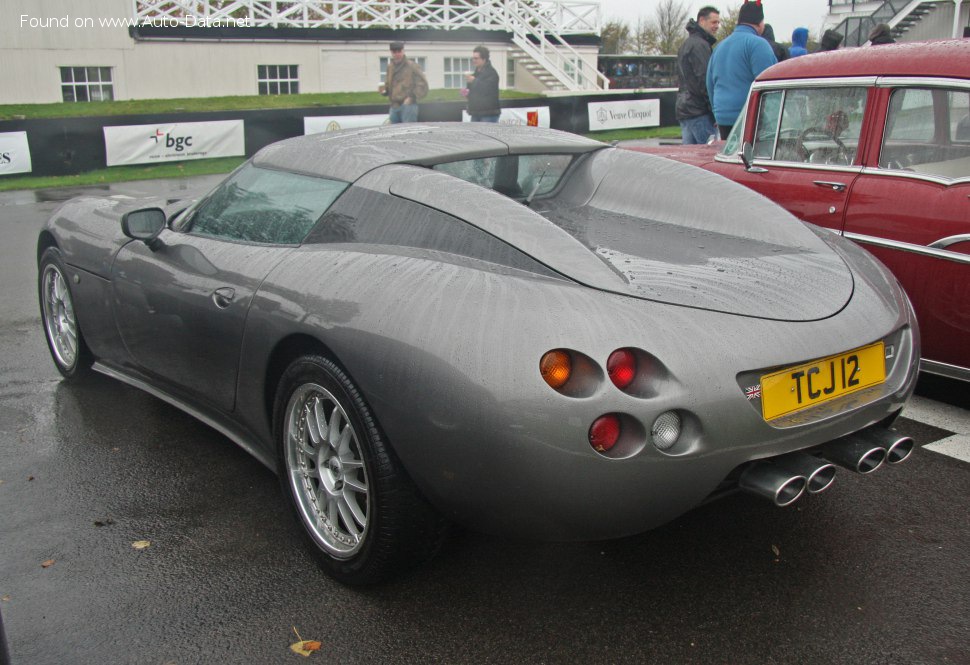
The Ronart Lightning 4.6 i V8 32V, produced between October 1999 and June 2003, was a British-built, two-seat sports car designed to offer a unique blend of performance and exclusivity. Positioned as a premium, hand-built alternative to more mainstream sports cars, the Lightning aimed to deliver a visceral driving experience with a powerful V8 engine and rear-wheel drive configuration. It was built on a bespoke chassis and featured a lightweight body, primarily constructed from composite materials. The 4.6 i V8 32V variant represented the top-tier offering within the Ronart Lightning lineup, boasting the most powerful engine available and a focus on driver engagement.
Powertrain & Engine Architecture
At the heart of the Ronart Lightning 4.6 i V8 32V lies a naturally aspirated 4.6-liter V8 engine, designated with 32 valves (four valves per cylinder). This engine, derived from Ford Modular V8 architecture, produced 325 horsepower at 5800 rpm and 407 Nm (300.19 lb-ft) of torque at 4800 rpm. The engine featured a 90.2 mm bore, 90 mm stroke, and a compression ratio of 9.85:1. Fuel delivery was managed by a multi-port manifold injection system. The valvetrain employed a Double Overhead Camshaft (DOHC) design, contributing to the engine’s high-revving nature and efficient breathing.
Power was transmitted to the rear wheels via a 5-speed manual transmission. The engine was mounted transversely in a mid-engine layout, contributing to balanced weight distribution and enhanced handling characteristics. This configuration, combined with the relatively lightweight construction of the vehicle, resulted in a power-to-weight ratio of 4.3 kg/Hp (232.1 Hp/tonne) and a torque-to-weight ratio of 3.4 kg/Nm (290.7 Nm/tonne).
Engine Codes & Variations
While the Ronart Lightning primarily utilized the 4.6-liter V8 in its 325 hp configuration, minor variations in engine management systems and exhaust components may have existed across the production run. However, the core engine architecture remained consistent throughout the model’s lifespan. The engine’s origins in the Ford Modular family meant that certain components and servicing knowledge were transferable from other Ford vehicles equipped with similar engines.
Driving Characteristics
The Ronart Lightning 4.6 i V8 32V offered a distinctly sporty driving experience. The mid-engine layout and rear-wheel drive configuration provided excellent balance and responsiveness. Acceleration from 0 to 100 km/h (0-62 mph) was achieved in 5 seconds, while 0-60 mph was quoted at 4.8 seconds. The car boasted a top speed of 290 km/h (180.2 mph). The 5-speed manual transmission allowed for precise control over the engine’s power delivery, and the relatively short gear ratios contributed to brisk acceleration in all gears.
Compared to potential future iterations with automatic transmissions (which were not offered during the production run), the manual gearbox provided a more engaging and direct connection between driver and machine. The engine’s torque curve, peaking at 4800 rpm, ensured strong acceleration throughout the rev range. The car’s lightweight construction further enhanced its agility and responsiveness, making it a rewarding vehicle to drive on both winding roads and open highways.
Equipment & Trim Levels
The Ronart Lightning 4.6 i V8 32V was offered with a relatively high level of standard equipment, reflecting its premium positioning. The interior featured leather upholstery, and a bespoke dashboard design. Standard features included power windows, central locking, and an aftermarket audio system. Air conditioning was typically included as standard, though specific options could vary depending on customer preferences.
Optional extras included upgraded audio systems, custom paint finishes, and various interior trim options. The car’s small production volume allowed for a degree of personalization, with customers able to specify unique features and finishes to suit their individual tastes. The focus was on providing a driver-centric experience, with a minimalist interior design and a clear emphasis on performance.
Chassis & Braking
The Ronart Lightning utilized a bespoke chassis constructed from a steel space frame, providing a rigid and lightweight foundation for the vehicle. Suspension was handled by a double wishbone setup at the front and a transverse stabilizer at the rear, designed to optimize handling and ride comfort. Braking duties were performed by ventilated discs on all four wheels, providing ample stopping power. An Anti-lock Braking System (ABS) was included as standard, enhancing safety and control.
The car rode on 18-inch wheels, fitted with 245/45 R18 tires. The steering system employed a rack and pinion setup with hydraulic power assistance, providing precise and responsive steering feel. The combination of a lightweight chassis, sophisticated suspension, and powerful brakes contributed to the Lightning’s dynamic handling characteristics.
Market Reception & Comparison
The Ronart Lightning 4.6 i V8 32V received generally positive reviews from automotive publications, with critics praising its performance, handling, and exclusivity. However, its relatively high price and limited production volume meant that it remained a niche vehicle. Compared to more mainstream sports cars of the era, such as the Porsche Boxster or BMW Z3, the Lightning offered a more raw and visceral driving experience, but lacked the brand recognition and extensive dealer network of its competitors.
Fuel economy was a notable drawback, with urban consumption rated at 16 l/100 km (14.7 US mpg), and extra-urban consumption at 10 l/100 km (23.5 US mpg). Reliability was generally good, owing to the use of proven Ford engine components, but the car’s hand-built nature meant that potential owners should be prepared for occasional maintenance issues.
Technical Specifications
| Brand | Ronart |
| Model | Lightning |
| Generation | Lightning |
| Type (Engine) | 4.6 i V8 32V (325 Hp) |
| Start of production | October, 1999 year |
| End of production | June, 2003 year |
| Powertrain Architecture | Internal Combustion engine |
| Body type | Cabriolet |
| Seats | 2 |
| Doors | 2 |
| Fuel consumption (urban) | 16 l/100 km (14.7 US mpg) |
| Fuel consumption (extra urban) | 10 l/100 km (23.5 US mpg) |
| Fuel Type | Petrol (Gasoline) |
| Acceleration 0 – 100 km/h | 5 sec |
| Acceleration 0 – 62 mph | 5 sec |
| Acceleration 0 – 60 mph | 4.8 sec |
| Maximum speed | 290 km/h (180.2 mph) |
| Weight-to-power ratio | 4.3 kg/Hp |
| Weight-to-torque ratio | 3.4 kg/Nm |
| Power | 325 Hp @ 5800 rpm |
| Torque | 407 Nm @ 4800 rpm (300.19 lb.-ft. @ 4800 rpm) |
| Engine layout | Middle, Transverse |
| Engine displacement | 4601 cm3 (280.77 cu. in.) |
| Number of cylinders | 8 |
| Engine configuration | V-engine |
| Cylinder Bore | 90.2 mm (3.55 in.) |
| Piston Stroke | 90 mm (3.54 in.) |
| Compression ratio | 9.85:1 |
| Number of valves per cylinder | 4 |
| Fuel injection system | Multi-port manifold injection |
| Engine aspiration | Naturally aspirated engine |
| Valvetrain | DOHC |
| Kerb Weight | 1400 kg (3086.47 lbs.) |
| Fuel tank capacity | 73 l (19.28 US gal | 16.06 UK gal) |
| Length | 4470 mm (175.98 in.) |
| Width | 1870 mm (73.62 in.) |
| Height | 1195 mm (47.05 in.) |
| Wheelbase | 2590 mm (101.97 in.) |
| Front track | 1590 mm (62.6 in.) |
| Rear track | 1575 mm (62.01 in.) |
| Drivetrain Architecture | Rear wheel drive |
| Drive wheel | Rear wheel drive |
| Number of gears and type of gearbox | 5 gears, manual transmission |
| Front suspension | Double wishbone |
| Rear suspension | Transverse stabilizer |
| Front brakes | Ventilated discs |
| Rear brakes | Ventilated discs |
| Assisting systems | ABS (Anti-lock braking system) |
| Steering type | Steering rack and pinion |
| Power steering | Hydraulic Steering |
| Tires size | 245/45 R18 |
| Wheel rims size | 18 |
Legacy
The Ronart Lightning 4.6 i V8 32V remains a relatively rare and sought-after sports car among enthusiasts. The Ford-derived V8 engine is known for its durability and relatively easy maintenance, making the Lightning a viable option for those seeking a unique and engaging driving experience. While parts availability can be a challenge due to the car’s limited production run, many components are shared with other Ford vehicles, simplifying servicing. On the used car market, well-maintained examples command a premium price, reflecting the car’s exclusivity and performance potential. The Ronart Lightning represents a unique chapter in British sports car history, offering a compelling alternative to more mainstream offerings.
