The Rover 200 (XW) 218 TD: A European Compact Diesel Icon
The Rover 200, internally designated as the XW, represented a pivotal moment for the British automaker Rover Group. Launched in 1990, this second-generation Rover 200 series succeeded the original SD3 generation and was a testament to the fruitful collaboration between Rover and Honda. Positioned in the highly competitive European C-segment (compact car segment), the XW model aimed to offer a more sophisticated and modern alternative to its rivals. While never officially sold in the United States, the Rover 200 (XW) played a significant role in its primary European market, particularly its diesel variants like the 218 TD (88 Hp), which offered a compelling blend of efficiency and practical performance for families and commuters across the continent.
The 200 (XW) generation was a direct development from the Honda Concerto platform, sharing much of its underpinnings and some body panels with its Japanese counterpart. This partnership allowed Rover to leverage Honda’s renowned engineering and build quality, addressing past criticisms of British Leyland-era vehicles. The 218 TD model, specifically, represented Rover’s commitment to the burgeoning diesel market in Europe, where fuel economy and torque were increasingly valued. Produced between 1990 and 1995, this 5-door hatchback became a familiar sight on European roads, known for its comfortable ride, refined interior for its class, and the robust, economical performance delivered by its turbodiesel powertrain.
Engine & Performance: The Robust Rover 200 (XW) 218 TD Powertrain
At the heart of the Rover 200 (XW) 218 TD (88 Hp) was a highly regarded 1.8-liter (1769 cm3 or 107.95 cu. in.) inline four-cylinder turbodiesel engine. This particular powerplant, designated XUD 7TE, was not a Rover original but a widely acclaimed unit sourced from Peugeot-Citroën, known for its reliability and efficiency. For its time, this engine was a benchmark in the small-to-medium displacement diesel segment.
The XUD 7TE engine featured a single overhead camshaft (OHC) with two valves per cylinder, a common and effective setup for diesel engines of that era. Fuel delivery was managed by a precombustion chamber injection system, a robust and proven technology before the widespread adoption of direct injection. Crucially, the engine was equipped with a turbocharger, which significantly boosted its power output and torque, making it a much more responsive and capable vehicle than naturally aspirated diesel alternatives.
In the 218 TD specification, the engine produced a healthy 88 horsepower at 4300 rpm. More importantly for a diesel, it delivered a substantial 133.5 lb.-ft. of torque at a relatively low 2500 rpm. This strong low-end torque was instrumental in the car’s practical drivability, providing ample pulling power for daily commuting and highway cruising. Power was sent to the front wheels via a smooth-shifting 5-speed manual transmission, a standard and reliable setup for the segment.
Performance figures for the 218 TD were competitive for a family diesel hatchback of its era. It could accelerate from 0 to 60 mph in a respectable 11.2 seconds, with a top speed of 106.25 mph (171 km/h). These figures demonstrate that while not a sports car, the 218 TD offered more than adequate performance for European roads. Where the 218 TD truly shone was in its fuel economy. The combined fuel consumption was an impressive 38.6 US mpg (6.1 l/100 km), rising to an outstanding 54.7 US mpg (4.3 l/100 km) on the extra-urban cycle. This efficiency made the 218 TD a very attractive option for cost-conscious drivers and high-mileage users across Europe.
Design & Features: A Refined European Hatchback
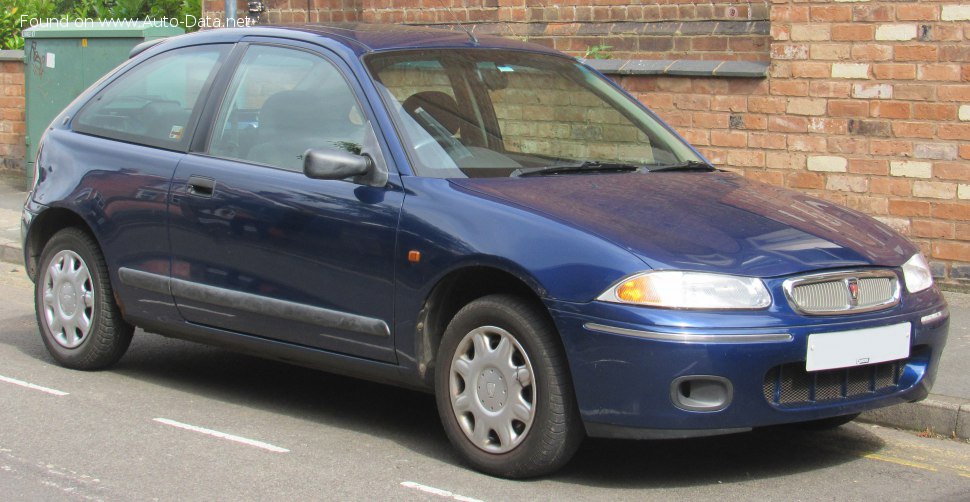
The Rover 200 (XW) adopted a contemporary and somewhat conservative design for its 5-door hatchback body, which helped it blend seamlessly into the European streetscape. Its styling was a departure from Rover’s more traditional aesthetic, influenced heavily by the Honda Concerto, resulting in cleaner lines and a more aerodynamic profile. The car measured 166.14 inches in length, 66.14 inches in width, and 54.72 inches in height, with a wheelbase of 100.39 inches. These dimensions placed it firmly within the compact segment, offering a good balance of interior space and maneuverability.
Inside, the Rover 200 (XW) aimed for an upmarket feel compared to many of its direct competitors. Rover applied its distinctive British touch to the interior, featuring more luxurious materials and trim options than its Honda counterpart. The cabin was designed to comfortably accommodate five occupants, with adequate legroom and headroom for its class. The trunk offered a practical 12.43 cubic feet (352 liters) of cargo space, which could be expanded by folding down the rear seats, enhancing its versatility as a family vehicle.
From a chassis perspective, the 200 (XW) featured an independent front suspension with wishbones, providing precise steering and a comfortable ride. The rear utilized a coil spring setup, further contributing to its refined road manners. Braking performance was handled by disc brakes at the front and drum brakes at the rear, a common and effective combination for vehicles of this size and power. An important safety feature for the early 1990s, the Anti-lock Braking System (ABS), was available as an assisting system, enhancing control during emergency braking. Steering was managed by a rack and pinion system, offering direct and predictable responses. The car rode on 175/65 R13 tires, a sensible size for comfort and efficiency.
Technical Specifications
| Category | Specification | US Equivalent / Notes |
|---|---|---|
| General Information | ||
| Brand | Rover | |
| Model | 200 | |
| Generation | 200 (XW) | |
| Type (Engine) | 218 TD (88 Hp) | |
| Production Start | 1990 year | |
| Production End | 1995 year | |
| Powertrain Architecture | Internal Combustion engine | |
| Body Type | Hatchback | |
| Seats | 5 | |
| Doors | 5 | |
| Performance Specs | ||
| Fuel consumption (urban) | 6.6 l/100 km | 35.6 US mpg |
| Fuel consumption (extra urban) | 4.3 l/100 km | 54.7 US mpg |
| Fuel consumption (combined) | 6.1 l/100 km | 38.6 US mpg |
| Fuel Type | Diesel | |
| Acceleration 0-60 mph | 11.2 sec | |
| Maximum speed | 171 km/h | 106.25 mph |
| Weight-to-power ratio | 13 kg/Hp | 76.9 Hp/tonne |
| Weight-to-torque ratio | 6.3 kg/Nm | 158.1 Nm/tonne |
| Engine Specs | ||
| Power | 88 Hp @ 4300 rpm | |
| Power per liter | 49.7 Hp/l | |
| Torque | 181 Nm @ 2500 rpm | 133.5 lb.-ft. @ 2500 rpm |
| Engine layout | Front, Transverse | |
| Engine Model/Code | XUD 7TE | |
| Engine displacement | 1769 cm3 | 1.8 liters / 107.95 cu. in. |
| Number of cylinders | 4 | |
| Engine configuration | Inline | |
| Cylinder Bore | 80 mm | 3.15 in. |
| Piston Stroke | 88 mm | 3.46 in. |
| Compression ratio | 22:1 | |
| Number of valves per cylinder | 2 | |
| Fuel injection system | Precombustion chamber injection | |
| Engine aspiration | Turbocharger | |
| Valvetrain | OHC | |
| Space, Volume and Weights | ||
| Kerb Weight | 1145 kg | 2524.29 lbs. |
| Max. weight (Gross Vehicle Weight) | 1610 kg | 3549.44 lbs. |
| Max load | 465 kg | 1025.15 lbs. |
| Trunk (boot) space – minimum | 352 l | 12.43 cu. ft. |
| Fuel tank capacity | 55 l | 14.53 US gal |
| Dimensions | ||
| Length | 4220 mm | 166.14 in. |
| Width | 1680 mm | 66.14 in. |
| Height | 1390 mm | 54.72 in. |
| Wheelbase | 2550 mm | 100.39 in. |
| Front track | 1475 mm | 58.07 in. |
| Rear (Back) track | 1470 mm | 57.87 in. |
| Drivetrain, Brakes and Suspension Specs | ||
| Drivetrain Architecture | Internal combustion engine drives front wheels | |
| Drive wheel | Front wheel drive | |
| Number of gears and type of gearbox | 5 gears, manual transmission | |
| Front suspension | Wishbone | |
| Rear suspension | Coil spring | |
| Front brakes | Disc | |
| Rear brakes | Drum | |
| Assisting systems | ABS (Anti-lock braking system) | |
| Steering type | Steering rack and pinion | |
| Tires size | 175/65 R13 |
Legacy & Market Impact of the Rover 200 (XW)
The Rover 200 (XW) 218 TD (88 Hp) holds a significant place in Rover’s history, particularly within the competitive European market of the early 1990s. As a product of the Honda-Rover collaboration, it was instrumental in improving Rover’s reputation for quality and reliability, areas where the brand had struggled in previous decades. The XW generation, in general, was well-received for its comfortable ride, decent handling, and a more refined interior ambiance than many of its rivals, positioning it as a slightly more premium offering in the compact segment.
In its primary European market, the Rover 200 (XW) faced stiff competition from established players such as the Volkswagen Golf (Mk2 and later Mk3), the Ford Escort (Mk5 and Mk6), the Vauxhall Astra (Mk2 and Mk3), and French contenders like the Peugeot 309/306 and Renault 19. The 218 TD variant carved out its niche by offering the efficiency and durability of a proven Peugeot diesel engine within a more classically styled, British-badged package. At a time when diesel engines were rapidly gaining popularity in Europe due to their superior fuel economy and torque characteristics, the 218 TD was a particularly strong contender for those seeking low running costs and robust performance.
The XUD 7TE engine itself had a sterling reputation across Europe, powering numerous models from Peugeot, Citroën, and even some Fiat and Suzuki vehicles. Its inclusion in the Rover 200 (XW) 218 TD provided a reliable and economical heart for the car, contributing to its appeal among a demographic that valued longevity and cost-effective motoring. This engine was known for its mechanical simplicity and ease of maintenance, further bolstering its market position.
While the Rover 200 (XW) was never targeted at the North American market, its impact on Rover’s brand image and its contribution to the European compact car landscape were substantial. It helped Rover maintain volume sales and provided a stable platform from which the company could attempt to move further upmarket with subsequent models. The success of the 200 (XW) generation ultimately laid important groundwork for Rover’s later models, demonstrating the potential for British design combined with reliable, modern engineering, even if that engineering often came from international partners. Today, the Rover 200 (XW) 218 TD is remembered as a capable and economical family car that played a vital role in Rover’s efforts to modernize and compete effectively in a fiercely competitive era of European automotive history.