
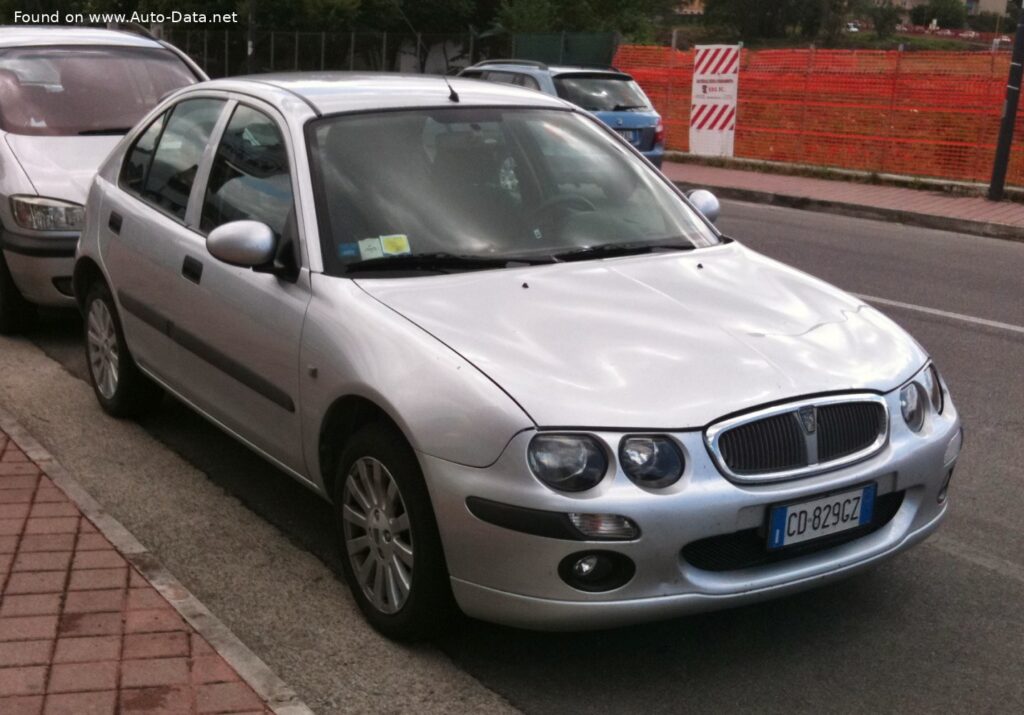
The Rover 25 (RF) 1.4 i 16V (84 Hp): A British Compact Hatchback
The Rover 25, internally designated RF, represents a significant chapter in the history of the British automotive manufacturer, Rover Group. Introduced in 1999, it served as a heavily revised and rebadged version of the popular Rover 200 (R3) series, aiming to refresh the brand’s presence in the highly competitive European compact car segment. Positioned as a practical and affordable hatchback, the Rover 25 sought to combine traditional British styling cues with modern driving dynamics. Its production spanned from 1999 until the unfortunate demise of the MG Rover Group in 2005. The specific variant under review, the Rover 25 (RF) 1.4 i 16V (84 Hp), was a core offering, providing a balance of economy and adequate performance for its target market, primarily in the United Kingdom and continental Europe. While never officially sold in the United States, the Rover 25 played a crucial role in maintaining Rover’s market share in its home territories during a challenging period for the company.
Powertrain and Performance Characteristics
At the heart of the Rover 25 (RF) 1.4 i 16V (84 Hp) lies Rover’s venerable K-Series engine, a 1.4-liter (1396 cm³ or 85.19 cu. in.) naturally aspirated inline-four unit. This engine, known for its compact design and lively character, featured a Double Overhead Camshaft (DOHC) valvetrain with four valves per cylinder, totaling 16 valves. It employed a multi-port manifold fuel injection system and a compression ratio of 10:1, contributing to its efficiency and responsiveness.
The engine delivered a peak power output of 84 horsepower (Hp) at 6000 revolutions per minute (rpm), making it a suitable choice for urban commuting and occasional highway trips. Its power per liter stood at 60.2 Hp/l, a respectable figure for a non-turbocharged engine of its era. Torque was rated at 110 Nm (81.13 lb-ft) at 4500 rpm, providing decent low-to-mid range grunt. This powertrain was configured in a front, transverse layout, driving the front wheels through a 5-speed manual transmission, a common and effective setup for compact hatchbacks.
In terms of performance, the Rover 25 (RF) 1.4 i 16V (84 Hp) could accelerate from 0 to 60 miles per hour (mph) in an estimated 11.2 seconds, with a 0-100 km/h sprint taking 11.8 seconds. Its maximum speed was approximately 108.74 mph (175 km/h). These figures placed it firmly within the performance expectations for its class, offering sufficient capability for daily driving without being overtly sporty. The vehicle’s kerb weight of 2392.02 lbs (1085 kg) contributed to a weight-to-power ratio of 12.9 kg/Hp, or 77.4 Hp per tonne, which aided its relatively sprightly feel.
Fuel economy was a strong point for this variant. The combined fuel consumption was rated at 6.4 liters per 100 kilometers, translating to an impressive 36.8 US miles per gallon. In urban driving, it achieved 26.7 US mpg (8.8 l/100 km), while extra-urban driving could see figures as high as 44.4 US mpg (5.3 l/100 km). This efficiency, coupled with a 13.21 US gallon (50-liter) fuel tank, provided a practical range for commuters.
Design Philosophy and Interior Amenities
The Rover 25 retained the core body shell of its predecessor, the Rover 200, but received a substantial facelift to align it with Rover’s updated design language. The front fascia was redesigned with a more aggressive, dual-headlight treatment, a larger grille, and updated bumpers, giving it a more contemporary and assertive appearance. The rear also saw revisions, primarily to the taillight clusters and bumper design. The car was available in both 3-door and 5-door hatchback configurations, offering versatility to buyers.
Dimensionally, the Rover 25 measured 157.09 inches (3990 mm) in length, 66.46 inches (1688 mm) in width, and 55.79 inches (1417 mm) in height. Its wheelbase of 98.43 inches (2500 mm) provided a stable platform, while front and rear tracks were 57.99 inches (1473 mm) and 57.72 inches (1466 mm), respectively. These compact dimensions made it agile in city traffic and easy to park, characteristics highly valued in European markets.
Inside, the Rover 25 (RF) offered seating for five occupants. The interior design, while largely carried over from the 200 series, featured updated trim materials and minor ergonomic improvements. Rover aimed for a slightly more upscale feel than many of its direct competitors, with touches like wood trim (on higher specs) and comfortable seating. Practicality was a key consideration, evidenced by a minimum trunk space of 10.74 cubic feet (304 liters), which could expand to a substantial 38.35 cubic feet (1086 liters) with the rear seats folded down, making it capable of handling varied cargo needs.
Key features for its time included hydraulic power steering, providing a direct and communicative feel, and a robust suspension setup with wishbones at the front and a spring strut system at the rear, contributing to a comfortable ride and competent handling. Braking was handled by ventilated discs at the front and drum brakes at the rear, augmented by an Anti-lock Braking System (ABS) for enhanced safety, a crucial feature for vehicles of its production era. The car rode on 175/65 R14 T tires, balancing grip with ride comfort.
Comprehensive Technical Specifications
| Rover 25 (RF) 1.4 i 16V (84 Hp) – Technical Specifications | |
|---|---|
| General Information | |
| Brand | Rover |
| Model | 25 |
| Generation | 25 (RF) |
| Type (Engine) | 1.4 i 16V (84 Hp) |
| Start of Production | 1999 year |
| End of Production | 2005 year |
| Powertrain Architecture | Internal Combustion engine |
| Body type | Hatchback |
| Seats | 5 |
| Doors | 3-5 |
| Performance Specs | |
| Fuel Consumption (Economy) – Urban | 8.8 l/100 km (26.7 US mpg) |
| Fuel Consumption (Economy) – Extra Urban | 5.3 l/100 km (44.4 US mpg) |
| Fuel Consumption (Economy) – Combined | 6.4 l/100 km (36.8 US mpg) |
| Fuel Type | Petrol (Gasoline) |
| Acceleration 0 – 60 mph | 11.2 sec |
| Acceleration 0 – 100 km/h | 11.8 sec |
| Maximum Speed | 175 km/h (108.74 mph) |
| Weight-to-Power Ratio | 12.9 kg/Hp (77.4 Hp/tonne) |
| Weight-to-Torque Ratio | 9.9 kg/Nm (101.4 Nm/tonne) |
| Engine Specs | |
| Power | 84 Hp @ 6000 rpm |
| Power per Liter | 60.2 Hp/l |
| Torque | 110 Nm (81.13 lb-ft) @ 4500 rpm |
| Engine Layout | Front, Transverse |
| Engine Model/Code | K |
| Engine Displacement | 1396 cm³ (85.19 cu. in.) |
| Number of Cylinders | 4 |
| Engine Configuration | Inline |
| Cylinder Bore | 75 mm (2.95 in.) |
| Piston Stroke | 79 mm (3.11 in.) |
| Compression Ratio | 10:1 |
| Number of Valves per Cylinder | 4 |
| Fuel Injection System | Multi-port manifold injection |
| Engine Aspiration | Naturally aspirated engine |
| Valvetrain | DOHC |
| Engine Oil Capacity | 5 l (5.28 US qt) |
| Coolant Capacity | 5.3 l (5.6 US qt) |
| Space, Volume and Weights | |
| Kerb Weight | 1085 kg (2392.02 lbs) |
| Max. Weight | 1500 kg (3306.93 lbs) |
| Max Load | 415 kg (914.92 lbs) |
| Trunk (Boot) Space – Minimum | 304 l (10.74 cu. ft.) |
| Trunk (Boot) Space – Maximum | 1086 l (38.35 cu. ft.) |
| Fuel Tank Capacity | 50 l (13.21 US gal) |
| Dimensions | |
| Length | 3990 mm (157.09 in.) |
| Width | 1688 mm (66.46 in.) |
| Height | 1417 mm (55.79 in.) |
| Wheelbase | 2500 mm (98.43 in.) |
| Front Track | 1473 mm (57.99 in.) |
| Rear (Back) Track | 1466 mm (57.72 in.) |
| Drivetrain, Brakes and Suspension Specs | |
| Drivetrain Architecture | The Internal combustion engine (ICE) drives the front wheels of the vehicle. |
| Drive Wheel | Front wheel drive |
| Number of Gears and Type of Gearbox | 5 gears, manual transmission |
| Front Suspension | Wishbone |
| Rear Suspension | Spring Strut |
| Front Brakes | Ventilated discs |
| Rear Brakes | Drum |
| Assisting Systems | ABS (Anti-lock braking system) |
| Steering Type | Steering rack and pinion |
| Power Steering | Hydraulic Steering |
| Tires Size | 175/65 R14 T |
Legacy, Competition, and Market Footprint
The Rover 25, particularly the Rover 25 (RF) 1.4 i 16V (84 Hp) variant, holds a unique place in automotive history as one of the final models produced under the original Rover Group before its collapse. It represented a valiant effort to keep the brand competitive in the compact segment, leveraging an existing, proven platform (the Rover 200) with updated styling and features. Despite its facelift, the underlying architecture dated back to the mid-1990s, which meant it faced stiff competition from newer, more technologically advanced rivals.
In its primary markets, the Rover 25 competed against a host of popular European compacts. Key rivals included the Ford Fiesta and Focus, Vauxhall Corsa (Opel Corsa), Volkswagen Polo, Peugeot 206, and Renault Clio. While these competitors often boasted more modern platforms or innovative features, the Rover 25 carved out its niche by offering a perceived level of refinement and a slightly more “premium” feel than some budget alternatives, often at a competitive price point. Its ride comfort and relatively engaging handling, inherited from the well-regarded Rover 200, were frequently praised.
However, the Rover 25 also inherited some of the criticisms associated with the K-Series engine, most notably the susceptibility to head gasket failure, which became a widely recognized issue and somewhat tarnished the engine’s reputation despite its otherwise strong performance and efficiency. This perception, coupled with the ongoing financial instability of the MG Rover Group, impacted its long-term market standing.
The car’s legacy is intrinsically tied to the fate of MG Rover. Its discontinuation in 2005 marked the end of an era for the historic British marque. Today, the Rover 25 is largely a budget-friendly used car in the UK and parts of Europe, appreciated by enthusiasts for its classic British design cues and comfortable driving experience, particularly when well-maintained. It stands as a testament to Rover’s resilience and design capabilities, even as the company navigated increasingly turbulent waters in its final years. While not a global powerhouse, the Rover 25 (RF) 1.4 i 16V (84 Hp) remains a recognizable and fondly remembered vehicle in the annals of British automotive production.
