
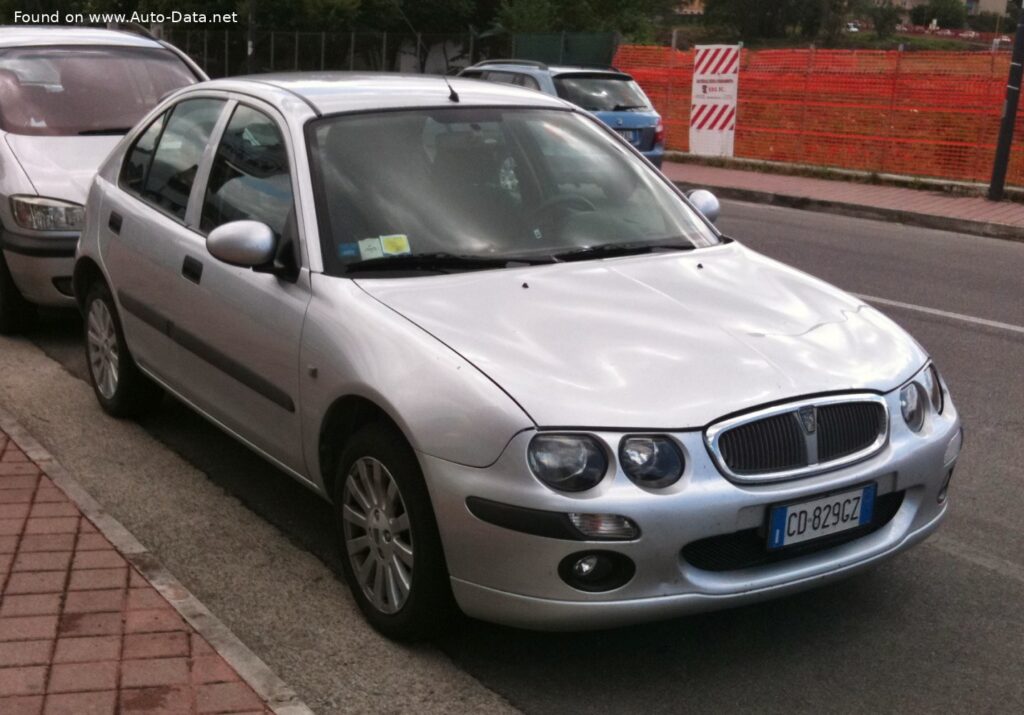
The Rover 25 (RF) 1.8 i 16V (117 Hp): A British Compact Hatchback
The Rover 25 (RF) represents a significant chapter in the history of the British Rover Group, launched in 1999 as a substantial facelift and rebrand of the Rover 200 (R3) series. Positioned in the highly competitive European supermini and compact car segments, the Rover 25 (RF) aimed to offer a more upscale and sporting alternative to mainstream rivals. This particular variant, the 1.8 i 16V (117 Hp), was a prominent offering, featuring the venerable K-Series engine and providing a blend of performance and economy for its class. As a model never officially sold in the United States, its primary market influence was felt across Europe, where it competed fiercely with established players and sought to maintain Rover’s traditional values of comfort, refinement, and British character in a modern package. The Rover 25 (RF) was produced from 1999 until the unfortunate demise of MG Rover Group in 2005, making it one of the final models to bear the iconic Rover badge.
Rover 25 (RF) Powertrain and Performance
At the heart of the Rover 25 (RF) 1.8 i 16V (117 Hp) lies Rover’s widely used K-Series engine, specifically the K18 variant. This 1.8-liter (1796 cm3 or 109.6 cu. in.) naturally aspirated, inline-four gasoline engine was a double overhead camshaft (DOHC) design with four valves per cylinder, a configuration that was advanced for its time and contributed to its efficiency and responsiveness. It featured multi-port manifold fuel injection, ensuring precise fuel delivery and combustion.
The engine generated a respectable 117 horsepower at 5500 rpm, providing a lively performance for a car of its size and class. Torque output was 118.01 lb.-ft. (160 Nm) delivered at a relatively low 2750 rpm, which translated into good mid-range acceleration and flexibility in everyday driving. This powertrain architecture, with the engine mounted transversely at the front and driving the front wheels, was a conventional and efficient setup for compact hatchbacks.
Performance figures for the Rover 25 (RF) 1.8 i 16V were competitive. It could accelerate from 0 to 60 mph in approximately 9 seconds, and from 0 to 62 mph (100 km/h) in 9.5 seconds. Its top speed was rated at 114.95 mph (185 km/h). Fuel economy, while not segment-leading by modern standards, was reasonable for its era. The combined cycle consumption was around 28.7 US mpg (8.2 l/100 km), with urban driving yielding approximately 20.3 US mpg (11.6 l/100 km) and extra-urban driving significantly better at 37.3 US mpg (6.3 l/100 km). These figures highlighted the engine’s balance between power and efficiency.
Design and Features
The Rover 25 (RF) retained much of the underlying structure of the Rover 200 (R3) but received a significant visual overhaul to align it with Rover’s new corporate identity, which included the larger 75 sedan. Key design changes included a more prominent grille, updated headlights, and revised bumpers, giving it a more contemporary and upmarket appearance. The car was offered in both 3-door and 5-door hatchback configurations, emphasizing its versatility and appeal to a broad demographic, from young singles to small families.
Measuring 157.09 inches (3990 mm) in length, 66.46 inches (1688 mm) in width, and 55.87 inches (1419 mm) in height, the Rover 25 (RF) was compact, making it agile in urban environments while offering sufficient interior space for five occupants. The wheelbase of 98.43 inches (2500 mm) contributed to a stable ride. Cargo capacity was practical, with a minimum trunk space of 10.74 cu. ft. (304 liters), expandable to 38.35 cu. ft. (1086 liters) with the rear seats folded, typical for a hatchback of its size.
In terms of chassis and safety, the Rover 25 (RF) featured a front-wheel-drive architecture. The suspension system comprised a wishbone setup at the front and spring struts at the rear, providing a comfortable yet engaging ride quality. Braking duties were handled by ventilated discs at the front and drum brakes at the rear, complemented by an Anti-lock Braking System (ABS) as a crucial safety feature, increasingly standard in cars of this period. Steering was a hydraulic rack and pinion system, offering direct feedback to the driver. The car rode on 185/55 R15 H tires, providing a good balance of grip and ride comfort.
Technical Specifications: Rover 25 (RF) 1.8 i 16V (117 Hp)
| Category | Specification |
|---|---|
| General Information | |
| Brand | Rover |
| Model | 25 |
| Generation | 25 (RF) |
| Type (Engine) | 1.8 i 16V (117 Hp) |
| Production Start | 1999 |
| Production End | 2005 |
| Powertrain Architecture | Internal Combustion Engine |
| Body Type | Hatchback |
| Seats | 5 |
| Doors | 3-5 |
| Performance Specs | |
| Fuel Consumption (Urban) | 20.3 US mpg (11.6 l/100 km) |
| Fuel Consumption (Extra Urban) | 37.3 US mpg (6.3 l/100 km) |
| Fuel Consumption (Combined) | 28.7 US mpg (8.2 l/100 km) |
| Fuel Type | Petrol (Gasoline) |
| Acceleration 0 – 60 mph | 9.0 sec |
| Acceleration 0 – 62 mph (100 km/h) | 9.5 sec |
| Maximum Speed | 114.95 mph (185 km/h) |
| Weight-to-Power Ratio | 9.7 kg/Hp, 103.1 Hp/tonne |
| Weight-to-Torque Ratio | 7.1 kg/Nm, 141 Nm/tonne |
| Engine Specs | |
| Power | 117 Hp @ 5500 rpm |
| Power per Liter | 65.1 Hp/l |
| Torque | 118.01 lb.-ft. (160 Nm) @ 2750 rpm |
| Engine Layout | Front, Transverse |
| Engine Model/Code | K18 |
| Engine Displacement | 1.8 l (1796 cm3, 109.6 cu. in.) |
| Number of Cylinders | 4 |
| Engine Configuration | Inline |
| Cylinder Bore | 3.15 in. (80 mm) |
| Piston Stroke | 3.52 in. (89.3 mm) |
| Compression Ratio | 10.5:1 |
| Valves per Cylinder | 4 |
| Fuel Injection System | Multi-port manifold injection |
| Engine Aspiration | Naturally aspirated |
| Valvetrain | DOHC |
| Engine Oil Capacity | 5.28 US qt (5 l) |
| Coolant Capacity | 5.81 US qt (5.5 l) |
| Space, Volume and Weights | |
| Curb Weight | 2502.25 lbs. (1135 kg) |
| Max. Weight (Gross Vehicle Weight) | 3417.17 lbs. (1550 kg) |
| Max Load | 914.92 lbs. (415 kg) |
| Trunk (Boot) Space – Minimum | 10.74 cu. ft. (304 l) |
| Trunk (Boot) Space – Maximum | 38.35 cu. ft. (1086 l) |
| Fuel Tank Capacity | 13.21 US gal (50 l) |
| Dimensions | |
| Length | 157.09 in. (3990 mm) |
| Width | 66.46 in. (1688 mm) |
| Height | 55.87 in. (1419 mm) |
| Wheelbase | 98.43 in. (2500 mm) |
| Front Track | 57.99 in. (1473 mm) |
| Rear Track | 57.72 in. (1466 mm) |
| Drivetrain, Brakes and Suspension Specs | |
| Drivetrain Architecture | Front-wheel drive, Internal Combustion Engine |
| Drive Wheel | Front-wheel drive |
| Front Suspension | Wishbone |
| Rear Suspension | Spring Strut |
| Front Brakes | Ventilated discs |
| Rear Brakes | Drum |
| Assisting Systems | ABS (Anti-lock braking system) |
| Steering Type | Steering rack and pinion |
| Power Steering | Hydraulic Steering |
| Tires Size | 185/55 R15 H |
Rover 25 (RF) Legacy and Market Impact
The Rover 25 (RF) was introduced at a challenging time for the Rover Group. While it represented a significant improvement over the outgoing 200 series in terms of styling and perceived quality, it faced stiff competition in the European market. Its primary rivals included the Ford Fiesta, Vauxhall Corsa, Volkswagen Polo, and Peugeot 206, all of which were highly popular and often offered more extensive dealer networks and marketing budgets. The Rover 25 aimed to distinguish itself with a more traditional, slightly more upmarket feel and a hint of British luxury, which resonated with a specific segment of buyers.
Despite its qualities, including its capable K-Series engine and comfortable ride, the Rover 25 (RF) inherited some of the reliability concerns associated with the K-Series, particularly the infamous head gasket issues, which, though often exaggerated, did impact its reputation. Nevertheless, many owners praised its driving dynamics, interior comfort, and distinctive styling. The 1.8 i 16V model, in particular, offered a good balance of power and refinement, making it one of the more desirable variants.
The Rover 25 (RF) served as a crucial model in Rover’s lineup during its final years under the MG Rover Group. It underwent a minor facelift in 2004, aligning its styling more closely with its sportier MG ZR sibling. The car’s production ceased abruptly in April 2005 with the collapse of MG Rover, marking the end of an era for British volume car manufacturing. Today, the Rover 25 (RF) is remembered as one of the last truly British-designed and built compact cars, a testament to Rover’s enduring attempt to compete in a globalized automotive landscape. Its legacy is intertwined with the larger narrative of the British automotive industry, representing both the innovation and the struggles of a storied brand.
