
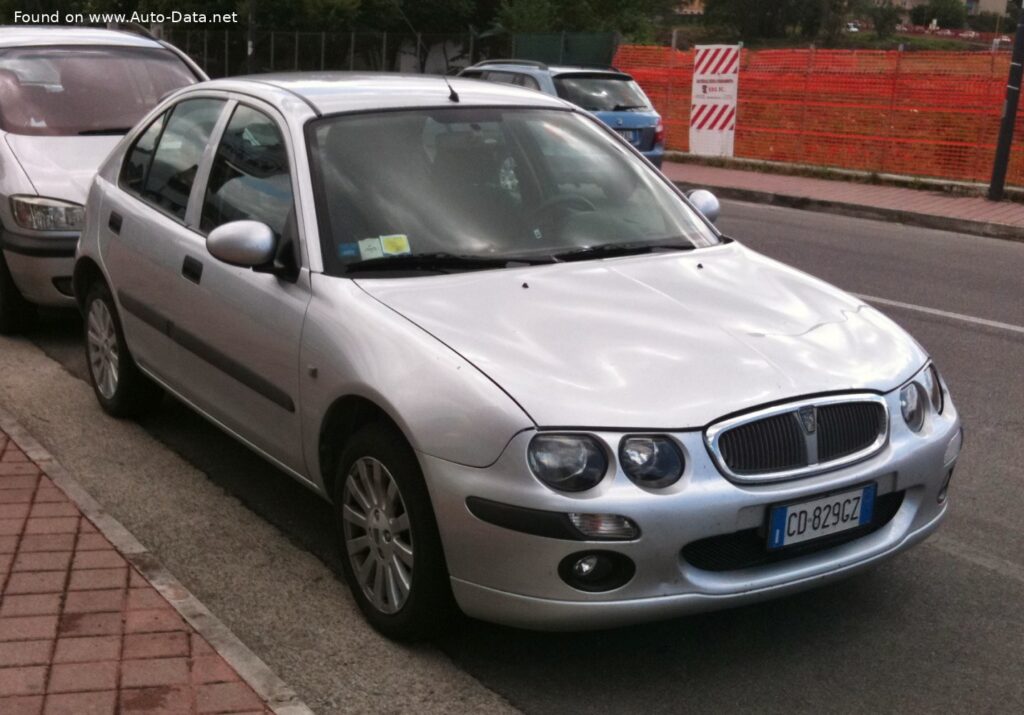
The Rover 25 (RF) 2.0 TD (101 Hp): A European Compact with Diesel Efficiency
The Rover 25 (RF) represents a significant chapter in the history of the British automotive manufacturer, Rover. Launched in 1999, the Rover 25 was essentially a heavily revised and rebadged version of the Rover 200 (R3) series, aiming to modernize its appeal in the highly competitive European compact car segment. Positioned as a practical and affordable hatchback, it sought to blend traditional British styling cues with contemporary engineering for its era. The specific variant under review, the Rover 25 (RF) 2.0 TD (101 Hp), was particularly notable for its robust and efficient turbodiesel powertrain, a popular choice in European markets where diesel engines were favored for their fuel economy and torque characteristics. Produced from 1999 until 2005, the Rover 25 played a crucial role in Rover’s lineup during its final years, offering a compelling package for buyers seeking a compact, front-wheel-drive vehicle with a blend of comfort and cost-effectiveness.
Engine & Performance: The Robust 2.0 TD Powertrain
At the heart of the Rover 25 (RF) 2.0 TD (101 Hp) was Rover’s venerable L-Series turbodiesel engine. This 2.0-liter (1994 cm3 or 121.68 cu. in.) inline four-cylinder unit was engineered for durability and efficiency, a hallmark of diesel technology popular in Europe. The engine, codenamed L / 20T2N, featured an overhead camshaft (OHC) valvetrain with two valves per cylinder and utilized a precombustion chamber injection system, characteristic of diesel engines of the late 1990s. Bolstered by a turbocharger, it delivered a respectable 101 horsepower at 4200 rpm. More significantly, it produced a substantial 177.01 lb.-ft. (240 Nm) of torque at a low 2000 rpm, providing excellent pulling power and making it well-suited for both city driving and highway cruising.
Mated to a 5-speed manual transmission, the front-wheel-drive Rover 25 (RF) 2.0 TD (101 Hp) offered brisk performance for a compact diesel hatchback of its time. It could accelerate from 0 to 60 mph in a swift 9.4 seconds, with a maximum speed of approximately 115 mph (185 km/h). These figures placed it competitively within its segment, offering a blend of performance and economy that appealed to a broad range of European consumers. The engine’s efficiency was particularly impressive, with a combined fuel economy rating of 46.1 US mpg (5.1 l/100 km), and an even more remarkable 57.4 US mpg (4.1 l/100 km) on the extra-urban cycle. This made the 2.0 TD a highly economical choice for daily commuting and longer journeys, underlining the practical advantages of diesel power.
Design & Features: Compact Form and Practical Functionality
The Rover 25 inherited much of its body shell from its predecessor, the Rover 200, but received a refreshed exterior and interior design to align with Rover’s updated brand identity. It was offered as a versatile 3-door or 5-door hatchback, providing seating for five occupants. The design aimed for a more modern and slightly more aggressive appearance compared to the softer lines of the 200, featuring a revised front fascia with new headlights and grille, along with updated taillights. Despite its compact dimensions, measuring 157.09 inches (3990 mm) in length and 66.46 inches (1688 mm) in width, the Rover 25 offered a practical interior.
Inside, the cabin was designed with functionality and British understated style in mind. While not opulent, it provided a comfortable environment for its occupants. The trunk space was practical for a car of its class, offering a minimum of 10.74 cu. ft. (304 liters) and expanding to a generous 38.35 cu. ft. (1086 liters) with the rear seats folded down, enhancing its versatility for cargo. In terms of safety, the Rover 25 came equipped with Anti-lock Braking System (ABS) as a standard or optional feature, a crucial safety enhancement for the era. The vehicle featured a front-wheel-drive architecture, with a wishbone front suspension and a spring strut rear suspension, providing a balanced ride and handling for its segment. Stopping power was managed by ventilated disc brakes at the front and drum brakes at the rear, a common setup for compact cars of this period. Hydraulic steering with a rack and pinion system ensured responsive and predictable handling.
Technical Specifications: Rover 25 (RF) 2.0 TD (101 Hp)
| Category | Specification | US Equivalent / Notes |
|---|---|---|
| General Information | ||
| Brand | Rover | |
| Model | 25 | |
| Generation | 25 (RF) | |
| Type (Engine) | 2.0 TD (101 Hp) | |
| Start of Production | 1999 year | |
| End of Production | 2005 year | |
| Powertrain Architecture | Internal Combustion engine | |
| Body type | Hatchback | |
| Seats | 5 | |
| Doors | 3-5 | |
| Performance Specs | ||
| Fuel consumption (economy) – urban | 6.9 l/100 km | 34.1 US mpg |
| Fuel consumption (economy) – extra urban | 4.1 l/100 km | 57.4 US mpg |
| Fuel consumption (economy) – combined | 5.1 l/100 km | 46.1 US mpg |
| Fuel Type | Diesel | |
| Acceleration 0 – 60 mph | 9.4 sec | |
| Acceleration 0 – 100 km/h | 9.9 sec | |
| Maximum speed | 185 km/h | 114.95 mph |
| Weight-to-power ratio | 11.2 kg/Hp | 89.4 Hp/tonne |
| Weight-to-torque ratio | 4.7 kg/Nm | 212.4 Nm/tonne |
| Engine Specs | ||
| Power | 101 Hp @ 4200 rpm. | |
| Power per liter | 50.7 Hp/l | |
| Torque | 240 Nm @ 2000 rpm. | 177.01 lb.-ft. @ 2000 rpm. |
| Engine layout | Front, Transverse | |
| Engine Model/Code | L / 20T2N | |
| Engine displacement | 1994 cm3 | 121.68 cu. in. |
| Number of cylinders | 4 | |
| Engine configuration | Inline | |
| Cylinder Bore | 84.5 mm | 3.33 in. |
| Piston Stroke | 88.9 mm | 3.5 in. |
| Compression ratio | 19.5:1 | |
| Number of valves per cylinder | 2 | |
| Fuel injection system | Precombustion chamber injection | |
| Engine aspiration | Turbocharger | |
| Valvetrain | OHC | |
| Engine oil capacity | 4.5 l | 4.76 US qt |
| Coolant | 7 l | 7.4 US qt |
| Space, Volume and Weights | ||
| Kerb Weight | 1130 kg | 2491.22 lbs. |
| Max. weight | 1600 kg | 3527.4 lbs. |
| Max load | 470 kg | 1036.17 lbs. |
| Trunk (boot) space – minimum | 304 l | 10.74 cu. ft. |
| Trunk (boot) space – maximum | 1086 l | 38.35 cu. ft. |
| Fuel tank capacity | 50 l | 13.21 US gal |
| Dimensions | ||
| Length | 3990 mm | 157.09 in. |
| Width | 1688 mm | 66.46 in. |
| Height | 1419 mm | 55.87 in. |
| Wheelbase | 2500 mm | 98.43 in. |
| Front track | 1473 mm | 57.99 in. |
| Rear (Back) track | 1466 mm | 57.72 in. |
| Drivetrain, Brakes and Suspension Specs | ||
| Drivetrain Architecture | The Internal combustion engine (ICE) drives the front wheels of the vehicle. | Front-wheel drive (FWD) |
| Drive wheel | Front wheel drive | |
| Number of gears and type of gearbox | 5 gears, manual transmission | |
| Front suspension | Wishbone | |
| Rear suspension | Spring Strut | |
| Front brakes | Ventilated discs | |
| Rear brakes | Drum | |
| Assisting systems | ABS (Anti-lock braking system) | |
| Steering type | Steering rack and pinion | |
| Power steering | Hydraulic Steering | |
| Tires size | 175/65 R14 T | |
Legacy & Market Impact: The Rover 25 in a Changing Landscape
The Rover 25, particularly its diesel variants like the 2.0 TD (101 Hp), was a critical model for Rover in its domestic UK market and across Europe during the early 2000s. It competed directly with established players in the compact hatchback segment, such as the Ford Focus, Vauxhall (Opel) Astra, Volkswagen Golf, and Peugeot 307. While it faced stiff competition from these more modern and often better-funded rivals, the Rover 25 carved out its niche by offering a distinctive British character, competitive pricing, and, in the case of the diesel, exceptional fuel economy.
The 2.0 TD variant was particularly well-received in markets where the running costs and long-distance capabilities of diesel engines were highly valued. Its robust L-Series engine had a reputation for reliability, a significant selling point in a segment often dominated by practicality. The car’s modest curb weight of 2491.22 lbs. (1130 kg) combined with its torquey diesel engine resulted in a lively feel and impressive efficiency, making it an attractive proposition for budget-conscious buyers and fleet operators.
However, the Rover 25’s legacy is inextricably linked to the broader struggles of the Rover Group. Despite its competent engineering and practical appeal, the company faced increasing financial difficulties and ownership changes throughout its production run. The 25, along with its larger sibling the 45 and the MG ZR/ZS performance derivatives, represented Rover’s final attempt to remain competitive in the mass market. When MG Rover Group ultimately collapsed in 2005, the production of the Rover 25 ceased, marking the end of an era for the historic British marque. Today, the Rover 25 is remembered as a capable and economical compact car that, despite its merits, could not stem the tide of its parent company’s decline. It stands as a testament to British automotive engineering in a challenging global market, particularly highlighting the efficiency and practicality of its diesel powertrains.
