
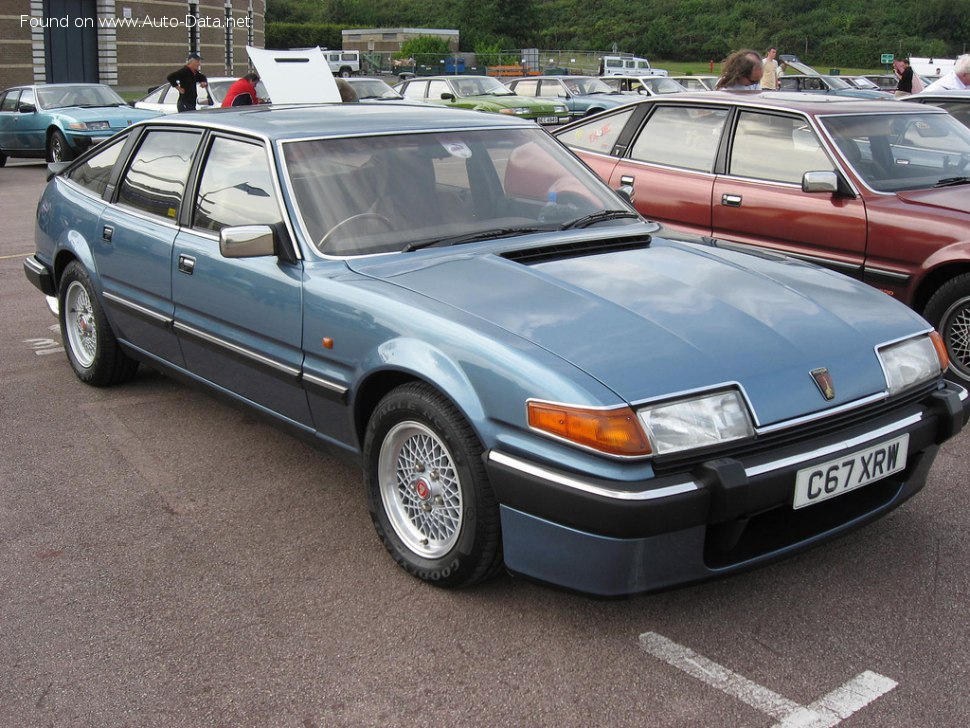
Introduction to the Rover 2000-3500 Hatchback (SD1) 2600 (135 Hp)
The Rover SD1, officially known as the Rover 2000-3500 Hatchback, represents a significant chapter in British automotive history, embodying a bold attempt by British Leyland to redefine the executive car segment in Europe during the late 1970s and early 1980s. Launched in 1976, the SD1 (Specialist Division 1) was lauded for its striking, aerodynamic design, which drew inspiration from contemporary Italian sports cars, most notably the Ferrari Daytona. It aimed to merge the traditional luxury and comfort associated with the Rover brand with modern engineering and a more practical body style.
While the SD1 was never officially imported into the United States in significant numbers, its impact was primarily felt across Europe and other Commonwealth markets. Its innovative fastback silhouette, a departure from the conventional three-box sedan design prevalent in the executive class, garnered critical acclaim, including the prestigious European Car of the Year award in 1977. This article focuses specifically on the Rover 2000-3500 Hatchback (SD1) 2600 (135 Hp) variant, produced between 1977 and 1982, which offered a compelling blend of performance and refinement within the SD1 lineup.
The Rover SD1: A Bold Statement in European Automotive Design
The design of the Rover SD1 was a radical departure for the conservative Rover marque. Penned by David Bache, the car’s exterior was characterized by its sleek, wedge-shaped profile, a large glass area, and a distinctive five-door hatchback configuration. This body style was highly unconventional for an executive car of its era, offering enhanced practicality without compromising its elegant lines. The absence of a traditional grille, instead featuring a smooth, integrated front end, contributed to its modern aesthetic and improved aerodynamic efficiency, a concept that was gaining traction in automotive design during the late 1970s.
Inside, the SD1 continued its theme of innovation. The dashboard, in particular, was forward-thinking, featuring a driver-oriented layout with instruments grouped logically for ease of access and minimal distraction. As an executive class vehicle, the cabin was typically appointed with comfortable seating, often in durable velour or luxurious leather, and a strong emphasis was placed on ride comfort and sound insulation to provide a serene driving environment. The five-door hatchback design, while initially surprising for the segment, proved to be remarkably versatile, allowing the SD1 to function effectively as both a sophisticated executive cruiser and a practical family vehicle, capable of carrying substantial luggage or cargo.
Safety features for a car of this vintage were standard for the time, likely including three-point seatbelts for front occupants, a robust chassis designed with crumple zones, and powerful disc brakes on all four wheels, which was a premium feature for executive cars. The SD1’s unitary body construction provided a strong safety cell, and its overall design aimed for a balance of aesthetic appeal and occupant protection, reflective of late 1970s automotive engineering standards before the advent of widespread airbags and advanced driver-assistance systems.
Engine and Performance of the Rover 2000-3500 Hatchback (SD1) 2600 (135 Hp)
Under the hood of the Rover 2000-3500 Hatchback (SD1) 2600 (135 Hp) lay a naturally aspirated, 2.6-liter (specifically 2,597 cc) inline-six gasoline engine, designated with the model code PE166. This engine was a key component in the SD1’s diverse powertrain offerings, strategically positioned as a mid-range option between the entry-level four-cylinder models and the more powerful, iconic V8 versions. Delivering a respectable 135 horsepower (Hp), the 2.6-liter unit provided a smooth, linear, and refined driving experience, characteristic of a well-balanced inline-six powerplant, which was highly regarded for its inherent smoothness and torque delivery.
The performance figures for this variant were quite competitive for its class in the late 1970s. The car could accelerate from 0 to 60 mph in a brisk 10.7 seconds, a respectable time for an executive sedan of its size and weight, especially considering the performance benchmarks of the era. Its maximum speed was recorded at 119.3 mph (192 km/h), allowing for comfortable and sustained cruising on European highways, where speed limits were often higher than in the U.S. The naturally aspirated nature of the engine meant a predictable and progressive power delivery, without the sudden surge associated with turbocharged units that would become more prevalent in later decades. This made the 2600 a predictable and enjoyable car to drive, suitable for both daily commuting and longer, more demanding journeys.
The powertrain architecture consisted of an internal combustion engine, primarily driving the rear wheels, which was the conventional and preferred layout for executive and performance cars of the era, contributing to balanced handling dynamics. This setup provided a traditional driving feel that many enthusiasts appreciated for its directness and engagement. The engine’s reputation was generally positive for its smoothness and durability, though specific maintenance practices were crucial for longevity, a common theme with British-built vehicles of the period, which sometimes suffered from inconsistent quality control across the broader British Leyland conglomerate.
Technical Specifications
| Category | Specification |
|---|---|
| Brand | Rover |
| Model | 2000-3500 Hatchback |
| Generation | 2000-3500 Hatchback (SD1) |
| Type (Engine) | 2600 (135 Hp) |
| Start of Production | 1977 year |
| End of Production | 1982 year |
| Powertrain Architecture | Internal Combustion engine |
| Body Type | Hatchback |
| Seats | 5 |
| Doors | 5 |
| Fuel Type | Petrol (Gasoline) |
| Acceleration 0 – 60 mph | 10.7 sec |
| Maximum Speed | 192 km/h (119.3 mph) |
| Power | 135 Hp |
| Engine Model/Code | PE166 |
| Engine Aspiration | Naturally aspirated engine |
Legacy, Competition, and Market Impact
The Rover 2000-3500 Hatchback (SD1) 2600 (135 Hp), and the SD1 range as a whole, left an indelible mark on the European automotive landscape, albeit a complex one. Its stunning design and advanced concept positioned it as a serious contender against established German rivals like the BMW 5 Series (E12 and later E28 generations), Mercedes-Benz W123, and the Audi 100 (C2 generation), as well as domestic competitors such as the Ford Granada. At its best, the SD1 offered a unique blend of Italian styling flair, American-inspired V8 power (in other variants), and traditional British luxury, all wrapped in a practical and aerodynamic package.
However, the SD1’s legacy is often overshadowed by the industrial turmoil and variable build quality issues that plagued British Leyland during its production run. While the initial design and engineering were exemplary, inconsistencies in manufacturing and reliability problems, particularly in its early years, significantly damaged its reputation. This prevented the SD1 from fully realizing its potential and consistently competing with its more robustly built and reliable German counterparts, which were steadily gaining market share across Europe.
Despite these challenges, the SD1 achieved considerable success in motorsport, particularly in touring car racing, where its powerful V8 variants demonstrated formidable performance and cemented its image as a high-performance machine. This motorsport prowess helped to counteract some of the negative perceptions regarding its reliability. The 2600 variant, while not a track star, contributed significantly to the range’s overall appeal by offering a more economical yet still refined and capable option for the executive buyer who valued smoothness and a balanced driving experience over outright speed.
Today, the Rover SD1 is recognized as a cherished classic car, celebrated for its groundbreaking design and its significant, if troubled, place in British automotive history. It represents a period of ambitious innovation within the British car industry, a testament to what could be achieved in terms of styling and concept, even if execution sometimes fell short due to broader industrial issues. Enthusiasts appreciate its unique character, its comfortable ride, and its distinctively European charm. The 2600 variant, with its smooth inline-six engine, offers a particularly enjoyable and balanced classic driving experience, embodying the sophisticated aspirations of the Rover brand during a tumultuous but memorable era.
