The Rover 400 Hatchback (RT) 414 Si (103 Hp): A British Contender in the European Compact Segment
The Rover 400 Hatchback (RT) 414 Si (103 Hp) represents a significant chapter in the history of the British automotive manufacturer, Rover Group. Launched in 1995, this second-generation 400 series, internally designated as the RT, aimed to blend traditional British refinement with contemporary engineering, largely influenced by its partnership with Honda. Positioned in the highly competitive European C-segment (compact family car market), the 400 Hatchback sought to offer a more upmarket and comfortable alternative to its mainstream rivals. The 414 Si variant, specifically, was a popular choice, offering a balanced combination of a lively 1.4-liter engine, respectable performance, and a comprehensive feature set for its time. Produced until 2000, the Rover 400 (RT) played a crucial role in Rover’s efforts to maintain its market presence and appeal to a broader customer base across Europe, even though it was not officially sold in the United States.
Engineering and Performance of the Rover 400 Hatchback (RT)
At the heart of the Rover 400 Hatchback (RT) 414 Si model was the widely utilized Rover K-Series engine, a powerplant renowned for its lightweight aluminum construction and advanced design for its era. The specific unit in the 414 Si was a 1.4-liter (1396 cm3 or 85.19 cu. in.) naturally aspirated inline four-cylinder engine, designated with the code K16. This engine featured a Double Overhead Camshaft (DOHC) valvetrain with four valves per cylinder, a configuration that allowed for efficient breathing and improved power delivery across the rev range. Fuel was supplied via a multi-port manifold injection system, ensuring precise fuel metering and combustion efficiency.
The engine produced a respectable 103 horsepower at 6000 rpm, which translated to a power-per-liter figure of 73.8 HP/l – a competitive output for a non-turbocharged 1.4-liter engine in the mid-1990s. Torque output stood at 93.67 lb.-ft. (127 Nm) delivered at 5000 rpm, providing adequate pulling power for daily driving scenarios. Power was sent to the front wheels through a five-speed manual transmission, a common and reliable setup for compact cars of this period. This drivetrain architecture, where the internal combustion engine drives the front wheels, contributed to the car’s predictable handling characteristics and efficient packaging.
In terms of performance, the 414 Si was capable of accelerating from 0 to 60 mph in a calculated 11.2 seconds, with a 0 to 62 mph (100 km/h) sprint taking 11.8 seconds. Its top speed was rated at 114.95 mph (185 km/h), making it suitable for sustained highway cruising. Despite its capable performance, the Rover 414 Si also offered commendable fuel economy. The combined fuel consumption was rated at 36.2 US mpg (6.5 l/100 km), with extra-urban driving achieving an impressive 46.1 US mpg (5.1 l/100 km). Urban consumption stood at 24.5 US mpg (9.6 l/100 km), reflecting the engine’s efficiency in varied driving conditions. The K-Series engine’s lightweight construction also contributed to a favorable weight-to-power ratio of 10.9 kg/Hp and a weight-to-torque ratio of 8.8 kg/Nm, enhancing its responsiveness.
Design and Features
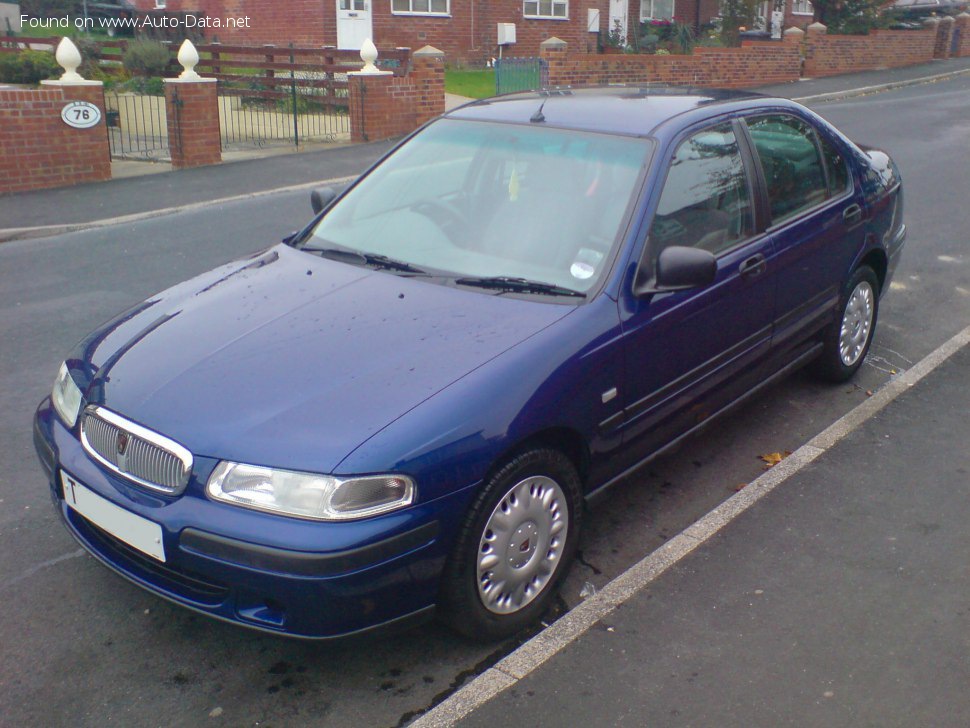
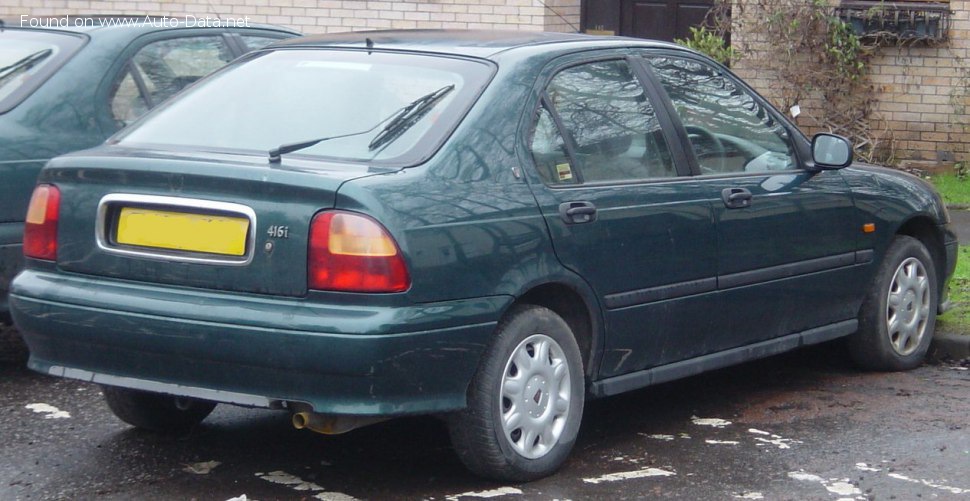
The Rover 400 Hatchback (RT) adopted a 5-door hatchback body style, a practical choice for the family car segment. Its design, while sharing its underpinnings with the Honda Domani (a variant of the Civic), was distinctly Rover, featuring a more traditional and slightly conservative aesthetic compared to its Japanese counterpart. The exterior styling incorporated classic Rover design cues, aiming for an elegant and understated appearance that appealed to buyers looking for something a bit more refined than the typical mass-market compact. At 170.08 inches long, 66.93 inches wide, and 54.72 inches high, with a wheelbase of 103.15 inches, the 400 Hatchback offered a compact footprint while still providing ample interior space.
Inside, the Rover 400 Hatchback was designed to accommodate five occupants comfortably. Rover interiors of this era were often praised for their traditional British appointments, which could include wood trim accents, plush seating fabrics, and a generally comfortable ambiance. The instrumentation was clear and logically laid out, prioritizing ease of use. Practicality was a strong suit, with a minimum trunk space of 13.07 cu. ft. (370 liters), which could be expanded significantly to 258.5 cu. ft. (7320 liters) by folding down the rear seats, offering considerable versatility for cargo. The fuel tank capacity of 14.53 US gallons (55 liters) provided a good cruising range.
Safety features for the time included an Anti-lock Braking System (ABS), which was a significant advancement, particularly in a mainstream compact car. The braking system comprised disc brakes at the front and drum brakes at the rear, a common setup for cost-effective and efficient stopping power. The suspension system utilized a Spring Strut design for both the front and rear, providing a comfortable ride quality that was a hallmark of Rover vehicles. Steering was managed by a hydraulic rack and pinion system, offering direct and communicative feedback to the driver. The car rode on 175/65 R14 tires, balancing grip and ride comfort.
Technical Specifications
| Specification | Value |
|---|---|
| Brand | Rover |
| Model | 400 |
| Generation | 400 Hatchback (RT) |
| Type (Engine) | 414 Si (103 Hp) |
| Production Start | 1995 |
| Production End | 2000 |
| Body Type | Hatchback |
| Seats | 5 |
| Doors | 5 |
| Performance | |
| Fuel Consumption (Urban) | 24.5 US mpg (9.6 l/100 km) |
| Fuel Consumption (Extra Urban) | 46.1 US mpg (5.1 l/100 km) |
| Fuel Consumption (Combined) | 36.2 US mpg (6.5 l/100 km) |
| Fuel Type | Petrol (Gasoline) |
| Acceleration 0-60 mph | 11.2 sec |
| Acceleration 0-62 mph (0-100 km/h) | 11.8 sec |
| Maximum Speed | 114.95 mph (185 km/h) |
| Weight-to-Power Ratio | 10.9 kg/Hp |
| Weight-to-Torque Ratio | 8.8 kg/Nm |
| Engine Specs | |
| Power | 103 Hp @ 6000 rpm |
| Power per Liter | 73.8 Hp/l |
| Torque | 93.67 lb.-ft. (127 Nm) @ 5000 rpm |
| Engine Layout | Front, Transverse |
| Engine Model/Code | K16 |
| Engine Displacement | 1.4 Liters (1396 cm3 / 85.19 cu. in.) |
| Number of Cylinders | 4 |
| Engine Configuration | Inline |
| Cylinder Bore | 2.95 in. (75 mm) |
| Piston Stroke | 3.11 in. (79 mm) |
| Compression Ratio | 9.5:1 |
| Valves per Cylinder | 4 |
| Fuel Injection System | Multi-port manifold injection |
| Engine Aspiration | Naturally aspirated |
| Valvetrain | DOHC |
| Engine Oil Capacity | 4.76 US qt (4.5 l) |
| Coolant Capacity | 6.13 US qt (5.8 l) |
| Dimensions & Weights | |
| Kerb Weight | 2469.18 lbs. (1120 kg) |
| Maximum Weight | 3417.17 lbs. (1550 kg) |
| Maximum Load | 947.99 lbs. (430 kg) |
| Trunk Space (Minimum) | 13.07 cu. ft. (370 l) |
| Trunk Space (Maximum) | 258.5 cu. ft. (7320 l) |
| Fuel Tank Capacity | 14.53 US gal (55 l) |
| Length | 170.08 in. (4320 mm) |
| Width | 66.93 in. (1700 mm) |
| Height | 54.72 in. (1390 mm) |
| Wheelbase | 103.15 in. (2620 mm) |
| Front Track | 58.27 in. (1480 mm) |
| Rear Track | 57.87 in. (1470 mm) |
| Drivetrain, Brakes & Suspension | |
| Drivetrain Architecture | Front-wheel drive, Internal Combustion engine |
| Drive Wheel | Front wheel drive |
| Number of Gears | 5 |
| Type of Gearbox | Manual transmission |
| Front Suspension | Spring Strut |
| Rear Suspension | Spring Strut |
| Front Brakes | Disc |
| Rear Brakes | Drum |
| Assisting Systems | ABS (Anti-lock braking system) |
| Steering Type | Steering rack and pinion |
| Power Steering | Hydraulic Steering |
| Tires Size | 175/65 R14 |
Legacy and Market Impact
The Rover 400 Hatchback (RT) played a vital role in Rover’s product portfolio during the latter half of the 1990s. In its primary European markets, it was positioned as a more refined and somewhat premium offering within the compact segment. Its blend of British styling, comfortable ride, and relatively well-appointed interior distinguished it from some of its more utilitarian competitors. The engineering collaboration with Honda, particularly the use of a shared platform, generally contributed to a perception of improved reliability and build quality compared to earlier Rover models, though some of Rover’s own manufacturing nuances could still lead to inconsistencies.
The 400 Hatchback faced stiff competition from a diverse array of established players in Europe. Key rivals included the segment-defining Volkswagen Golf, the ever-popular Ford Escort (later replaced by the Focus), the Vauxhall/Opel Astra, Peugeot 306, and Citroën Xsara. Against these competitors, the Rover 400 aimed to carve out a niche for buyers who appreciated a more traditional, comfortable, and slightly upscale driving experience without venturing into true premium brands like BMW or Audi.
While the K-Series engine was praised for its advanced design and light weight, it would, unfortunately, gain a reputation for head gasket issues in some applications over time, a factor that somewhat marred its long-term perception despite numerous revisions and improvements by Rover. Nevertheless, in its prime, the 414 Si offered a compelling package of performance, economy, and refinement for a compact family car.
Historically, the Rover 400 (RT) represents one of the final generations of Rover vehicles developed before the company’s ultimate decline in the early 2000s. It was a testament to Rover’s ambition to compete on the global stage, leveraging strategic partnerships while attempting to retain its distinct British identity. While not a groundbreaking model that redefined its segment, the Rover 400 Hatchback (RT) 414 Si (103 Hp) was a competent and well-loved car for many European families, embodying a particular moment in the challenging yet resilient history of the British automotive industry.