The Rover 400 Hatchback (RT) 420 Di (105 Hp): A European Family Contender
The Rover 400 series, particularly the RT generation produced from 1995 to 2000, represented a crucial offering from the British automaker Rover Group in the highly competitive European compact family car segment. Positioned as a more upscale alternative to mainstream rivals, the 400 aimed to blend traditional British craftsmanship with contemporary design and engineering. While never officially sold in the United States, the Rover 400 Hatchback (RT) 420 Di (105 Hp) was a significant player in markets like the United Kingdom and continental Europe, catering to buyers seeking a practical, comfortable, and fuel-efficient vehicle with a touch of refinement.
The RT generation of the Rover 400 was developed during a period of significant change for Rover, benefiting from its partnership with Honda. This particular variant, the 420 Di, highlighted Rover’s commitment to diesel power, a growing trend in Europe during the mid-to-late 1990s. With its 105 horsepower diesel engine, five-door hatchback body style, and a focus on economical yet capable performance, the Rover 400 Hatchback (RT) 420 Di (105 Hp) served as a sensible choice for families and business users across its primary markets.
Engine and Performance: The Rover 400 Hatchback (RT) 420 Di (105 Hp) Powertrain
At the heart of the Rover 400 Hatchback (RT) 420 Di (105 Hp) was a robust and efficient 2.0-liter (1994 cm³ or 121.68 cu. in.) inline four-cylinder diesel engine. Coded as the ‘L Series,’ this powerplant was a significant development for Rover, moving away from older diesel designs and embracing more modern common rail fuel injection technology. The engine was transversely mounted at the front, driving the front wheels through a precise 5-speed manual transmission, a typical setup for a car in this class.
The turbocharged diesel engine produced a respectable 105 horsepower at 4200 rpm, which was competitive for its era. More importantly for a diesel, it delivered a substantial 210 Nm (154.89 lb.-ft.) of torque at a low 2000 rpm. This ample low-end torque made the 420 Di particularly well-suited for everyday driving, offering strong acceleration from a standstill and effortless cruising, especially when loaded with passengers and luggage. The car could accelerate from 0 to 60 mph in a brisk 10.5 seconds, reaching a maximum speed of 114.95 mph (185 km/h).
Fuel economy was a major selling point for the 420 Di. Its combined fuel consumption was rated at an impressive 5.5 liters per 100 kilometers, translating to approximately 42.8 US mpg. This efficiency was even more pronounced on extra-urban cycles, where it could achieve 4.0 l/100 km (58.8 US mpg). These figures underscored its appeal as a cost-effective vehicle, especially in European markets where diesel fuel was often more affordable and widely available than gasoline, and where fuel efficiency was a primary purchasing consideration for many drivers.
Design and Features: Practicality Meets British Styling
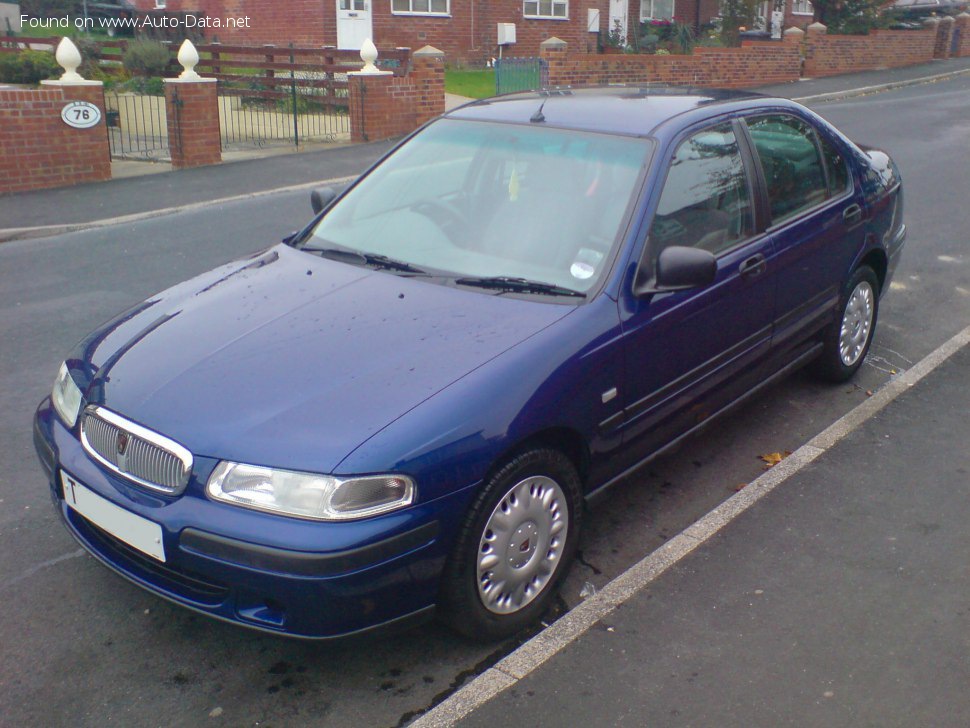
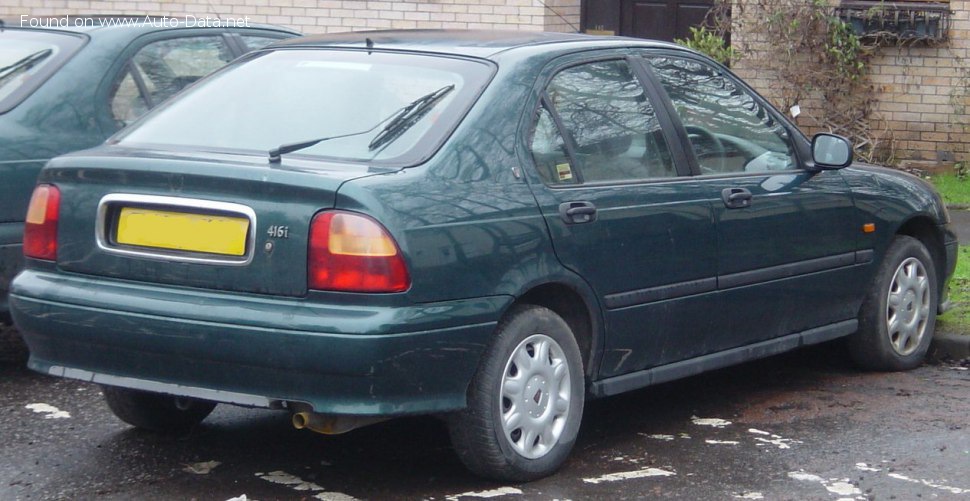
The Rover 400 Hatchback (RT) generation adopted a more contemporary and less angular design compared to its predecessors, while still retaining a distinctively British character. The five-door hatchback body offered excellent practicality, a hallmark of the compact segment in Europe. Measuring 170.08 inches (4320 mm) in length, 66.93 inches (1700 mm) in width, and 54.72 inches (1390 mm) in height, the 400 was dimensionally competitive, providing a good balance between interior space and maneuverability.
Inside, the Rover 400 offered seating for five occupants. The cabin was generally praised for its comfortable seats and a more upmarket feel than some of its direct rivals, featuring quality materials and a tasteful layout. The hatchback configuration provided versatile cargo space, ranging from a minimum of 13.07 cubic feet (370 liters) with the rear seats in place, expanding to a generous 25.43 cubic feet (720 liters) when the rear seats were folded down. This flexibility was crucial for families needing to carry groceries, luggage, or sports equipment.
Technological features, while modest by today’s standards, were appropriate for a mid-1990s family car. Safety was addressed with the inclusion of ABS (Anti-lock Braking System), a significant feature for the time. The steering system utilized a hydraulic rack and pinion setup, providing responsive and communicative steering feedback. The car rode on a conventional suspension setup, with spring struts at both the front and rear, tuned to provide a comfortable ride quality typical of Rover vehicles. Braking was handled by front disc brakes and rear drum brakes, supplemented by ABS for improved stopping power and control.
Technical Specifications
| Category | Specification |
|---|---|
| Brand | Rover |
| Model | 400 |
| Generation | 400 Hatchback (RT) |
| Type (Engine) | 420 Di (105 Hp) |
| Start of Production | 1995 year |
| End of Production | 2000 year |
| Powertrain Architecture | Internal Combustion engine |
| Body type | Hatchback |
| Seats | 5 |
| Doors | 5 |
| Performance Specifications | |
| Fuel consumption (economy) – urban | 5.6 l/100 km (42 US mpg) |
| Fuel consumption (economy) – extra urban | 4.0 l/100 km (58.8 US mpg) |
| Fuel consumption (economy) – combined | 5.5 l/100 km (42.8 US mpg) |
| Fuel Type | Diesel |
| Acceleration 0 – 60 mph | 10.5 sec |
| Maximum speed | 114.95 mph (185 km/h) |
| Weight-to-power ratio | 11.6 kg/Hp, 86.1 Hp/tonne |
| Weight-to-torque ratio | 5.8 kg/Nm, 172.1 Nm/tonne |
| Engine Specifications | |
| Power | 105 Hp @ 4200 rpm |
| Power per liter | 52.7 Hp/l |
| Torque | 210 Nm @ 2000 rpm (154.89 lb.-ft. @ 2000 rpm) |
| Engine layout | Front, Transverse |
| Engine Model/Code | L |
| Engine displacement | 1994 cm³ (2.0 l / 121.68 cu. in.) |
| Number of cylinders | 4 |
| Engine configuration | Inline |
| Cylinder Bore | 84.5 mm (3.33 in.) |
| Piston Stroke | 88.9 mm (3.5 in.) |
| Compression ratio | 19.5:1 |
| Number of valves per cylinder | 2 |
| Fuel injection system | Diesel Commonrail |
| Engine aspiration | Turbocharger |
| Valvetrain | OHC |
| Engine oil capacity | 4.5 l (4.76 US qt) |
| Coolant capacity | 7 l (7.4 US qt) |
| Space, Volume and Weights | |
| Kerb Weight | 1220 kg (2689.64 lbs.) |
| Trunk (boot) space – minimum | 370 l (13.07 cu. ft.) |
| Trunk (boot) space – maximum | 720 l (25.43 cu. ft.) |
| Fuel tank capacity | 55 l (14.53 US gal) |
| Dimensions | |
| Length | 4320 mm (170.08 in.) |
| Width | 1700 mm (66.93 in.) |
| Height | 1390 mm (54.72 in.) |
| Wheelbase | 2620 mm (103.15 in.) |
| Front track | 1480 mm (58.27 in.) |
| Rear (Back) track | 1470 mm (57.87 in.) |
| Drivetrain, Brakes and Suspension | |
| Drivetrain Architecture | Front-wheel drive, Internal Combustion engine |
| Drive wheel | Front wheel drive |
| Number of gears and type of gearbox | 5 gears, manual transmission |
| Front suspension | Spring Strut |
| Rear suspension | Spring Strut |
| Front brakes | Disc |
| Rear brakes | Drum |
| Assisting systems | ABS (Anti-lock braking system) |
| Steering type | Steering rack and pinion |
| Power steering | Hydraulic Steering |
| Tires size | 175/65 R14 |
Legacy and Market Impact
The Rover 400 Hatchback (RT) 420 Di (105 Hp) carved out a niche for itself in the European market as a respectable family car, offering a blend of comfort, economy, and a slightly more premium feel than many of its competitors. In its primary markets, it competed against a formidable array of rivals, including the Volkswagen Golf, Ford Escort (and later Focus), Opel Astra, Peugeot 306, and Renault Mégane. While it might not have always matched the sales volumes of these high-volume contenders, the Rover 400 appealed to buyers who valued its softer ride, traditional styling cues, and the perceived heritage of the Rover brand.
The diesel variant, in particular, was strategically important. During the late 1990s, the demand for diesel engines in Europe was surging due to their superior fuel economy and increasing refinement. The 420 Di, with its modern common rail technology, demonstrated Rover’s commitment to staying competitive in this segment. Its strong torque delivery and impressive fuel efficiency made it a popular choice for long-distance commuters and fleet operators, who prioritized running costs.
The Rover 400’s underlying platform shared much with the contemporary Honda Civic, a legacy of the Anglo-Japanese partnership. This collaboration generally provided a solid foundation for reliability and driving dynamics, although Rover tuned its cars for a distinctly different, more comfort-oriented feel. Despite its merits, the Rover 400, and indeed the entire Rover brand, faced increasing challenges in the late 1990s and early 2000s, ultimately leading to the brand’s demise. However, the RT generation, especially in its diesel forms like the 420 Di, remains an important chapter in Rover’s history, representing a period when the company successfully adapted to market demands with competent and competitive products for its intended European audience.