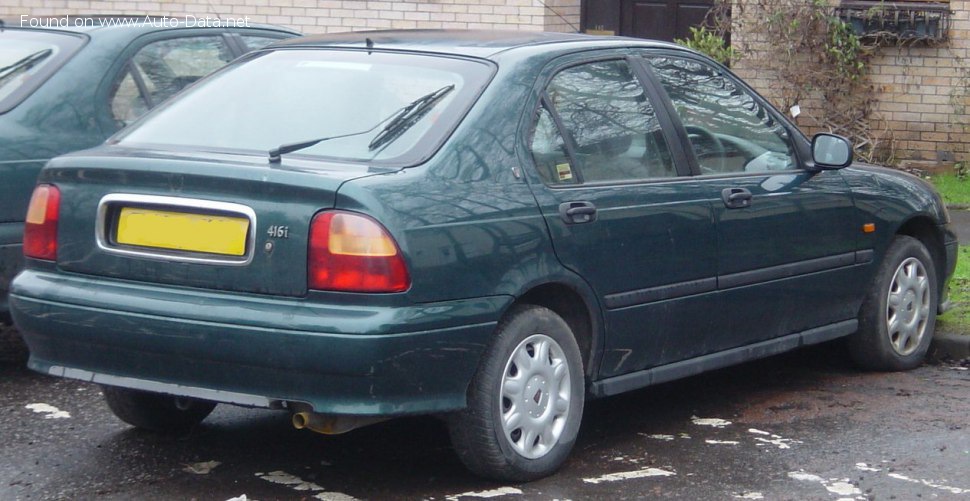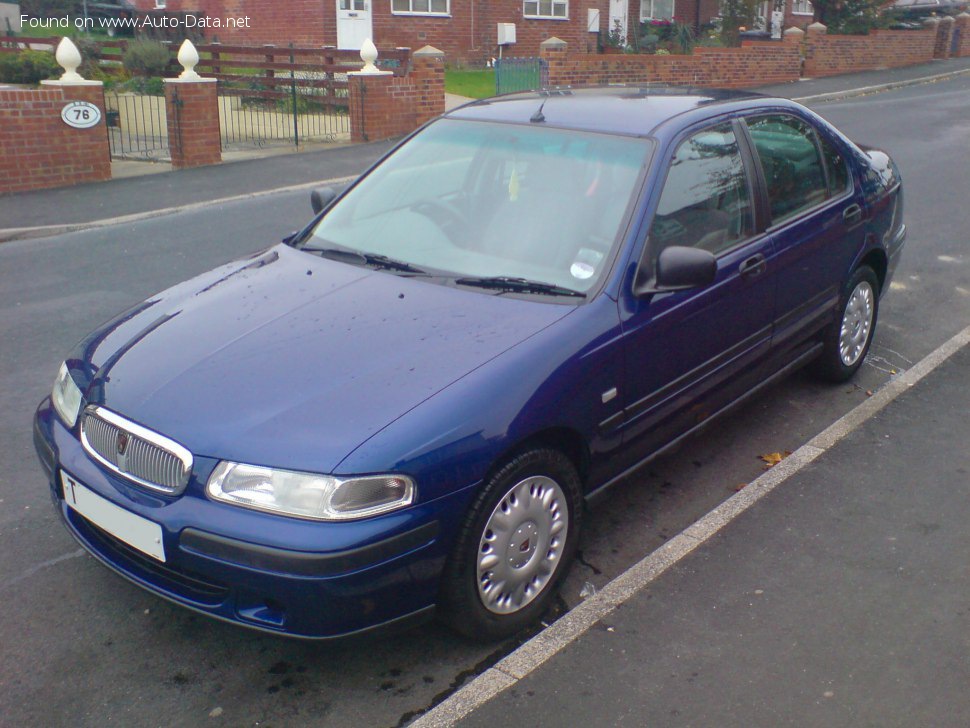
The Rover 400 (RT) 414 i (103 Hp): A British Contender in the European Compact Segment
The Rover 400 (RT) represents a significant chapter in the history of the British automotive manufacturer, Rover Group. Launched in 1995, this second-generation 400 series, internally designated “RT,” aimed to solidify Rover’s presence in the fiercely competitive European compact family car segment. Building upon a successful partnership with Honda, the RT generation shared its underpinnings with the Honda Civic (specifically the Domani/Concerto platform), yet it was distinctively styled and engineered by Rover to appeal to a more traditional European palate. The variant under review, the Rover 400 (RT) 414 i (103 Hp), was a popular choice, offering a blend of economical motoring, respectable performance, and a touch of traditional British refinement in a practical sedan package. Produced from 1995 to 2000, this model played a crucial role in Rover’s strategy during a period of intense change and ownership transitions for the company.
Engine and Performance: The Heart of the Rover 400 (RT) 414 i
At the core of the Rover 400 (RT) 414 i was Rover’s venerable K-Series engine, a lightweight and innovative all-aluminum inline-four unit. In this particular iteration, the K16 engine had a displacement of 1.4 liters (1396 cm³ or 85.19 cu. in.). This naturally aspirated powerplant was equipped with a Double Overhead Camshaft (DOHC) valvetrain and multi-port manifold injection, a relatively advanced setup for a mainstream compact car of its era. It generated a respectable 103 horsepower at 6000 rpm, delivering a power-per-liter output of 73.8 Hp/l, which was quite competitive for a non-turbocharged engine.
Torque figures stood at 127 Nm (93.67 lb.-ft.) peaking at 5000 rpm. While these numbers might seem modest by today’s standards, they provided adequate motivation for the 400 series. The engine was transversely mounted at the front, driving the front wheels through a standard 5-speed manual transmission. This configuration, common for compact cars, offered a good balance of packaging efficiency and predictable handling.
Performance-wise, the Rover 400 (RT) 414 i was capable of accelerating from 0 to 60 mph in a calculated 11.2 seconds (0-100 km/h in 11.8 seconds), and it could reach a top speed of 114.95 mph (185 km/h). These figures placed it firmly in the mainstream, offering sufficient capability for everyday driving and highway cruising without being a performance-oriented model. Its curb weight of 2469.18 lbs. (1120 kg) contributed to a weight-to-power ratio of 10.9 kg/Hp, indicating a reasonably agile feel for its segment.
Fuel economy was a strong suit for the 414 i, reflecting the K-Series engine’s inherent efficiency. The combined fuel consumption was rated at 36.2 US mpg (6.5 l/100 km), with extra-urban figures reaching an impressive 46.1 US mpg (5.1 l/100 km). Even in urban conditions, it managed 26.4 US mpg (8.9 l/100 km). These numbers made the 414 i an economical choice for families and commuters, especially in markets where fuel prices were a significant consideration.
Design and Features: British Style Meets Practicality
The Rover 400 (RT) was offered predominantly as a 4-door sedan, as is the case with the 414 i variant, though a 5-door hatchback was also available. The sedan body style emphasized a more traditional, executive look compared to its Honda Civic donor platform, reflecting Rover’s aspiration to position itself slightly upmarket. Its design language incorporated Rover’s signature grille and rounded, conservative lines, aiming for an elegant rather than overtly sporty aesthetic.
Measuring 176.77 inches (4490 mm) in length, 66.73 inches (1695 mm) in width, and 54.72 inches (1390 mm) in height, with a wheelbase of 103.23 inches (2622 mm), the Rover 400 (RT) 414 i offered a comfortable interior for five occupants. The cabin was designed with Rover’s traditional emphasis on comfort and perceived quality, often featuring wood trim and higher-grade fabrics than some of its direct competitors.
Practicality was a key consideration, with a generous trunk (boot) space ranging from 16.6 cu. ft. (470 liters) to 28.6 cu. ft. (810 liters) with the rear seats folded, making it suitable for family use and luggage. For safety, the RT generation incorporated features like ABS (Anti-lock Braking System), which was becoming standard on many European cars in the mid-to-late 1990s. The steering system was a hydraulic rack and pinion setup, providing a conventional and communicative steering feel. The suspension setup, featuring spring struts at both the front and rear, aimed for a comfortable ride quality, characteristic of Rover vehicles. Front disc brakes and rear drum brakes provided adequate stopping power for the vehicle’s class. The car rode on 175/65 R14 tires, a common size for compact cars of the period, balancing grip and ride comfort.
Technical Specifications: Rover 400 (RT) 414 i (103 Hp)
| General Information | |
|---|---|
| Brand | Rover |
| Model | 400 |
| Generation | 400 (RT) |
| Type (Engine) | 414 i (103 Hp) |
| Start of Production | 1995 year |
| End of Production | 2000 year |
| Powertrain Architecture | Internal Combustion Engine |
| Body Type | Sedan |
| Seats | 5 |
| Doors | 4 |
| Performance Specifications | |
| Fuel Consumption (Economy) – Urban | 8.9 l/100 km (26.4 US mpg) |
| Fuel Consumption (Economy) – Extra Urban | 5.1 l/100 km (46.1 US mpg) |
| Fuel Consumption (Economy) – Combined | 6.5 l/100 km (36.2 US mpg) |
| Fuel Type | Petrol (Gasoline) |
| Acceleration 0 – 60 mph (Calculated) | 11.2 sec |
| Acceleration 0 – 100 km/h | 11.8 sec |
| Maximum Speed | 185 km/h (114.95 mph) |
| Weight-to-Power Ratio | 10.9 kg/Hp (92 Hp/tonne) |
| Weight-to-Torque Ratio | 8.8 kg/Nm (113.4 Nm/tonne) |
| Engine Specifications | |
| Power | 103 Hp @ 6000 rpm |
| Power per Liter | 73.8 Hp/l |
| Torque | 127 Nm @ 5000 rpm (93.67 lb.-ft. @ 5000 rpm) |
| Engine Layout | Front, Transverse |
| Engine Model/Code | K16 |
| Engine Displacement | 1396 cm³ (1.4 l / 85.19 cu. in.) |
| Number of Cylinders | 4 |
| Engine Configuration | Inline |
| Cylinder Bore | 75 mm (2.95 in.) |
| Piston Stroke | 79 mm (3.11 in.) |
| Compression Ratio | 9.5:1 |
| Number of Valves per Cylinder | 4 |
| Fuel Injection System | Multi-port manifold injection |
| Engine Aspiration | Naturally Aspirated |
| Valvetrain | DOHC |
| Engine Oil Capacity | 4.5 l (4.76 US qt) |
| Coolant Capacity | 5.8 l (6.13 US qt) |
| Space, Volume, and Weights | |
| Kerb Weight | 1120 kg (2469.18 lbs) |
| Max. Weight | 1550 kg (3417.17 lbs) |
| Max Load | 430 kg (947.99 lbs) |
| Trunk (Boot) Space – Minimum | 470 l (16.6 cu. ft.) |
| Trunk (Boot) Space – Maximum | 810 l (28.6 cu. ft.) |
| Fuel Tank Capacity | 55 l (14.53 US gal) |
| Dimensions | |
| Length | 4490 mm (176.77 in.) |
| Width | 1695 mm (66.73 in.) |
| Height | 1390 mm (54.72 in.) |
| Wheelbase | 2622 mm (103.23 in.) |
| Front Track | 1477 mm (58.15 in.) |
| Rear (Back) Track | 1465 mm (57.68 in.) |
| Drivetrain, Brakes, and Suspension Specifications | |
| Drivetrain Architecture | Front-wheel drive, Internal Combustion Engine |
| Drive Wheel | Front-wheel drive |
| Number of Gears and Type of Gearbox | 5 gears, manual transmission |
| Front Suspension | Spring Strut |
| Rear Suspension | Spring Strut |
| Front Brakes | Disc |
| Rear Brakes | Drum |
| Assisting Systems | ABS (Anti-lock braking system) |
| Steering Type | Steering rack and pinion |
| Power Steering | Hydraulic Steering |
| Tires Size | 175/65 R14 |
Legacy and Market Impact of the Rover 400 (RT)
The Rover 400 (RT) series, including the 414 i variant, operated in one of the most cutthroat segments of the European automotive market, competing directly with established titans such as the Ford Escort (later Focus), Vauxhall Astra (Opel Astra in continental Europe), Volkswagen Golf/Jetta, and numerous offerings from French, Italian, and Japanese manufacturers. Its strategy was to leverage the robust and reliable Honda platform while infusing it with a distinctively British design and a slightly more premium feel than its direct competitors.
The Honda partnership, which had been a cornerstone of Rover’s product development for decades, provided the 400 (RT) with a solid mechanical foundation. This often translated into good reliability, a trait not always associated with British cars of earlier eras. The K-Series engine, while known for its performance and efficiency, later gained a reputation for head gasket issues in some applications, though this was often linked to maintenance and cooling system design rather than inherent engine flaws. For the 414 i, its smaller displacement and lighter load generally mitigated these concerns.
Despite its merits, the Rover 400 (RT) 414 i and the broader 400 series faced challenges. Rover Group itself was undergoing significant changes during this period, first under BMW ownership and then later, in its final years, as the independent MG Rover Group. The constant shifts in ownership and strategic direction often impacted brand perception and investment in new models. The 400 (RT)’s conservative styling and a perception of being “old-fashioned” compared to more dynamic rivals like the Ford Focus, which arrived late in the 400’s life cycle, meant it struggled to capture a younger audience.
Nevertheless, the Rover 400 (RT) was a successful model for Rover in terms of sales volumes, especially in the UK. It was often praised for its comfortable ride, refined interior, and economical engines. It served as a practical, family-friendly vehicle for many, offering a blend of European driving dynamics with a touch of British luxury at an accessible price point. The 400 (RT) eventually paved the way for the Rover 45, which was essentially a facelifted version of the RT, extending its lifespan into the early 2000s. Today, the 400 (RT) series is remembered as one of the last mainstream Rover models before the brand’s eventual demise, representing a pivotal era in the history of the British automotive industry. Its legacy is one of a solid, if somewhat understated, contender that delivered on its promise of comfortable and economical transportation with a touch of traditional British character.