The Rover 400 (RT) 416 Si (111 Hp) Automatic: A British Compact Sedan of the Mid-1990s
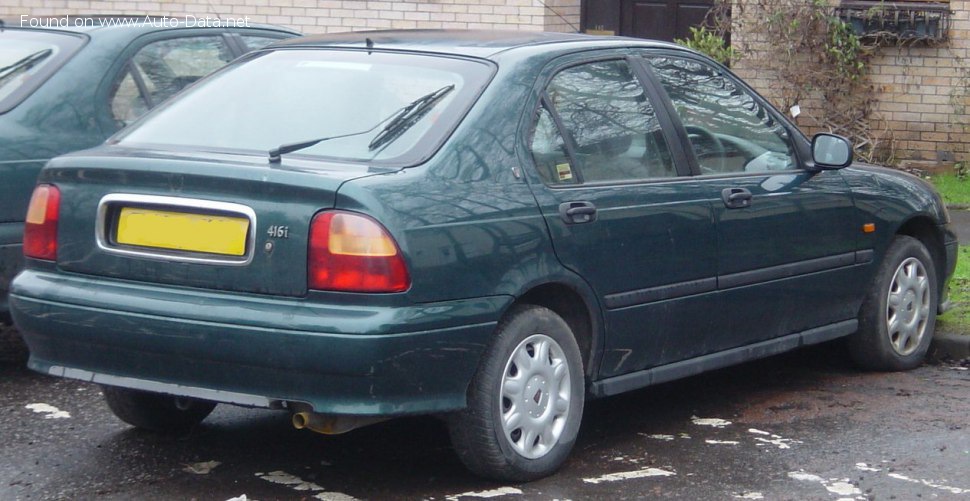
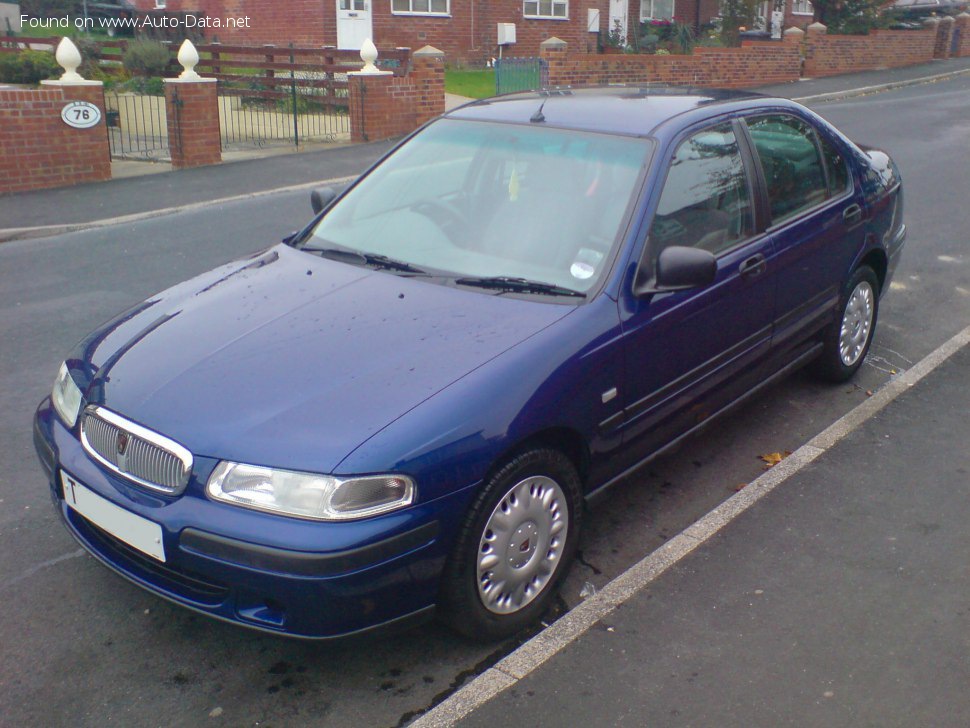
The Rover 400 (RT) 416 Si (111 Hp) Automatic represents a significant chapter in the history of the British automotive manufacturer, Rover. Launched in 1995, the second-generation Rover 400, internally codenamed “RT,” was a compact family car designed to compete in the highly competitive European C-segment. While never officially sold in the United States, the Rover 400 (RT) played a crucial role in its primary markets, particularly the United Kingdom and continental Europe, as a mainstream offering aiming to blend traditional British styling cues with reliable, modern engineering. This particular variant, the 416 Si, featured a capable 1.6-liter engine paired with a four-speed automatic transmission, positioning it as a comfortable and practical choice for families seeking a touch of perceived refinement without an exorbitant price tag. Its production run spanned from 1995 to 2000, during a period of considerable change and challenge for the Rover Group.
Engineering and Performance: The Rover 400 (RT)’s Powertrain
At the heart of the Rover 400 (RT) 416 Si (111 Hp) Automatic was Rover’s own K16 engine, a 1.6-liter (1589 cm3 or 96.97 cubic inches) naturally aspirated inline-four unit. This engine was a testament to Rover’s engineering capabilities, featuring a Double Overhead Camshaft (DOHC) valvetrain with four valves per cylinder, a configuration that was becoming standard for efficient power delivery in the mid-1990s. Fuel was supplied via a multi-port manifold injection system, ensuring precise fuel delivery and combustion.
The K16 engine in the 416 Si delivered a respectable 111 horsepower at 6000 rpm, translating to a power-per-liter figure of 69.9 HP/l. Torque output stood at 145 Newton-meters (106.95 lb.-ft.) at a relatively low 3000 rpm, providing decent low-end responsiveness for everyday driving. This powertrain was mounted transversely at the front, driving the front wheels, a standard layout for compact sedans of the era, optimizing interior space and manufacturing cost.
Paired with a 4-speed automatic transmission, the 416 Si variant prioritized smooth, effortless driving over outright performance. Despite the automatic gearbox, the car still managed a 0 to 60 mph acceleration time of 10.3 seconds, with a top speed of 118 mph (190 km/h). These figures placed it competitively within its segment, offering sufficient performance for highway cruising and urban commuting. The car’s weight-to-power ratio was 10.6 kg/Hp (94.5 Hp/tonne), and its weight-to-torque ratio was 8.1 kg/Nm (123.4 Nm/tonne), indicating a balanced approach to performance and efficiency for a family sedan.
Fuel economy for the Rover 400 (RT) 416 Si (111 Hp) Automatic was rated at a combined 8.1 liters per 100 kilometers, which translates to approximately 29 US miles per gallon. Urban consumption was higher at 10.1 l/100 km (23.3 US mpg), while extra-urban driving yielded a more efficient 6.5 l/100 km (36.2 US mpg). These figures were competitive for a 1.6-liter automatic sedan of the mid-1990s, offering a reasonable balance of performance and running costs for European drivers.
Design and Features: A Blend of Tradition and Modernity
The second-generation Rover 400 (RT) was offered as a 4-door sedan, a popular body style in its target markets. Its design aimed to project a more upmarket image than many of its direct competitors, incorporating classic Rover styling cues such as a distinctive grille and elegant lines, albeit within a more contemporary and aerodynamic shell. With a length of 176.77 inches (4490 mm), a width of 66.73 inches (1695 mm), and a height of 54.72 inches (1390 mm), the 400 (RT) was a compact yet substantial vehicle. Its wheelbase of 103.23 inches (2622 mm) contributed to a stable ride and adequate interior space.
Inside, the Rover 400 (RT) provided seating for five occupants, emphasizing comfort and practicality. The trunk space was generous for its class, offering a minimum of 16.6 cubic feet (470 liters) which could expand to a maximum of 28.6 cubic feet (810 liters) with the rear seats folded, making it suitable for family trips and daily errands. The cabin design, while not groundbreaking, featured a logical layout and materials that aimed for a slightly more premium feel than its rivals, often incorporating wood trim or higher-quality fabrics depending on the trim level.
Underneath, the Rover 400 (RT) utilized a robust chassis derived from a collaboration with Honda, specifically sharing its platform with the Honda Domani and the sixth-generation Civic. This provided a solid foundation, contributing to its reputation for reliability and competent handling. The suspension system featured spring struts at both the front and rear, a common and effective setup for balancing ride comfort and handling dynamics.
Safety features for the era included disc brakes on all four wheels, complemented by an Anti-lock Braking System (ABS), which was an important safety advancement in the mid-1990s. Steering was handled by a hydraulic rack and pinion system, providing direct and communicative feedback to the driver. The vehicle rode on 185/60 R14 H tires mounted on 14-inch wheel rims, offering a good balance of grip and ride comfort.
Technical Specifications: Rover 400 (RT) 416 Si (111 Hp) Automatic (1995-2000)
| Category | Specification |
|---|---|
| General Information | |
| Brand | Rover |
| Model | 400 |
| Generation | 400 (RT) |
| Type (Engine) | 416 Si (111 Hp) Automatic |
| Production Start | 1995 |
| Production End | 2000 |
| Powertrain Architecture | Internal Combustion Engine, Front-Wheel Drive |
| Body Type | Sedan |
| Seats | 5 |
| Doors | 4 |
| Performance Specifications | |
| Fuel Consumption (City) | 10.1 l/100 km (23.3 US mpg) |
| Fuel Consumption (Highway) | 6.5 l/100 km (36.2 US mpg) |
| Fuel Consumption (Combined) | 8.1 l/100 km (29 US mpg) |
| Fuel Type | Petrol (Gasoline) |
| Acceleration 0-60 mph | 10.3 seconds |
| Maximum Speed | 118.06 mph (190 km/h) |
| Weight-to-Power Ratio | 10.6 kg/Hp (94.5 Hp/tonne) |
| Weight-to-Torque Ratio | 8.1 kg/Nm (123.4 Nm/tonne) |
| Engine Specifications | |
| Power | 111 Hp @ 6000 rpm |
| Power per Liter | 69.9 Hp/l |
| Torque | 145 Nm (106.95 lb.-ft.) @ 3000 rpm |
| Engine Layout | Front, Transverse |
| Engine Model/Code | K16 |
| Engine Displacement | 1589 cm3 (96.97 cu. in.) |
| Number of Cylinders | 4 |
| Engine Configuration | Inline |
| Cylinder Bore | 80 mm (3.15 in.) |
| Piston Stroke | 79 mm (3.11 in.) |
| Compression Ratio | 10.5:1 |
| Valves per Cylinder | 4 |
| Fuel Injection System | Multi-port manifold injection |
| Engine Aspiration | Naturally aspirated |
| Valvetrain | DOHC |
| Engine Oil Capacity | 3.5 l (3.7 US qt) |
| Coolant Capacity | 5.5 l (5.81 US qt) |
| Dimensions, Volume & Weights | |
| Kerb Weight | 1175 kg (2590.43 lbs) |
| Max. Weight (GVWR) | 1640 kg (3615.58 lbs) |
| Max Load | 465 kg (1025.15 lbs) |
| Trunk Space (Minimum) | 470 l (16.6 cu. ft.) |
| Trunk Space (Maximum) | 810 l (28.6 cu. ft.) |
| Fuel Tank Capacity | 55 l (14.53 US gal) |
| Length | 4490 mm (176.77 in.) |
| Width | 1695 mm (66.73 in.) |
| Height | 1390 mm (54.72 in.) |
| Wheelbase | 2622 mm (103.23 in.) |
| Front Track | 1477 mm (58.15 in.) |
| Rear Track | 1465 mm (57.68 in.) |
| Drivetrain, Brakes & Suspension | |
| Drivetrain Architecture | Internal combustion engine drives the front wheels. |
| Drive Wheel | Front-wheel drive |
| Number of Gears | 4 gears, automatic transmission |
| Front Suspension | Spring Strut |
| Rear Suspension | Spring Strut |
| Front Brakes | Disc |
| Rear Brakes | Disc |
| Assisting Systems | ABS (Anti-lock braking system) |
| Steering Type | Steering rack and pinion |
| Power Steering | Hydraulic Steering |
| Tires Size | 185/60 R14 H |
| Wheel Rims Size | 14 inches |
Legacy and Market Impact: The Rover 400 (RT) in its Era
The Rover 400 (RT), particularly the 416 Si Automatic variant, carved out a distinct niche in the European compact car market during its production years. It faced stiff competition from established players like the Ford Mondeo, Vauxhall Vectra (known as Opel Vectra in continental Europe), Peugeot 406, and the Volkswagen Passat. While these rivals often emphasized practicality or driving dynamics, the Rover 400 aimed to offer a more traditional, slightly more “premium” British feel, a characteristic that resonated with a segment of the buying public.
A key aspect of the Rover 400 (RT)’s legacy was its shared platform with the Honda Civic (and Domani in Japan). This collaboration, a remnant of the earlier partnership between Rover and Honda, provided the 400 with a solid, reliable, and well-engineered foundation. This Honda connection often meant that the Rover 400 benefited from Japanese-derived reliability, a trait that was highly valued in its markets, offsetting some of the historical perceptions of British car reliability. The K16 engine, while a Rover design, proved to be a robust and capable unit, further contributing to the car’s dependability.
Despite its merits, the Rover 400 (RT) arrived during a turbulent period for the Rover Group. While its design was considered pleasant, some critics felt it lacked the distinctive flair or cutting-edge technology of some competitors. Its styling, though aiming for elegance, could be perceived as somewhat conservative, especially when compared to more adventurous designs emerging from French or Italian manufacturers. However, its comfortable ride, spacious interior, and the perceived quality of its cabin materials often won over buyers looking for a refined, understated family car.
The 416 Si Automatic variant specifically catered to drivers who prioritized ease of use and comfort in congested urban environments or during long-distance cruising. The smooth shifts of the automatic transmission made it a less fatiguing car to drive daily. Ultimately, the Rover 400 (RT) served as a core volume model for Rover, helping to sustain the brand through the latter half of the 1990s. It represented an attempt by Rover to compete effectively in the mainstream family car segment by offering a blend of British character and reliable engineering. Its eventual replacement, the Rover 45, continued the lineage, but the 400 (RT) remains an important example of Rover’s efforts to adapt and compete in a rapidly changing automotive landscape before the brand’s eventual demise.