The Rover 400 (RT) 416 Si (113 Hp): A Mid-Nineties European Contender
The Rover 400 (RT) 416 Si (113 Hp) represents a significant chapter in the history of the British automotive manufacturer Rover Group. Launched in 1995 and produced until 2000, the second-generation Rover 400 series, internally designated “RT,” aimed to elevate Rover’s standing in the highly competitive European compact family car segment. While Rover vehicles were not typically sold in the United States, they held a distinct position in their primary markets, particularly the United Kingdom and continental Europe, often leveraging a blend of traditional British styling cues with modern engineering. The 400 (RT) generation was a crucial model for Rover, positioned above the smaller 200 series and below the executive-class 600, directly competing with popular models like the Ford Mondeo, Vauxhall Vectra (Opel Vectra), and Volkswagen Passat.
The Rover 400 (RT) was a product of the long-standing collaboration between Rover and Honda, sharing its platform and many mechanical components with the contemporary Honda Civic and Concerto models. This partnership allowed Rover to benefit from Honda’s renowned engineering prowess and reliability, while Rover contributed its distinctive styling and interior refinement. The 416 Si variant, with its 113 horsepower engine, was a popular choice, offering a balance of performance and fuel efficiency suitable for families and fleet buyers across Europe. This article delves into the technical specifications, design philosophies, and market impact of this quintessential mid-nineties European sedan.
Engine and Performance of the Rover 400 (RT) 416 Si (113 Hp)
At the heart of the Rover 400 (RT) 416 Si (113 Hp) lies the Rover K-series engine, a powerplant that, despite its challenges in other applications, was generally well-regarded for its lightweight design and free-revving nature in this configuration. Specifically, the 416 Si was equipped with a 1.6-liter (1590 cm3 or 97.03 cubic inches) naturally aspirated inline four-cylinder engine, designated K16. This engine featured a Double Overhead Camshaft (DOHC) valvetrain with four valves per cylinder, a setup that was increasingly common in the mid-90s for optimizing both power output and efficiency.
The engine produced a respectable 113 horsepower at 6200 rpm, translating to 71.1 horsepower per liter, a solid figure for a non-turbocharged engine of its era. Torque output stood at 103.26 lb.-ft. (140 Nm) delivered at 5100 rpm. This power and torque profile, while not designed for outright blistering performance, provided adequate acceleration for daily driving. The sedan could accelerate from 0 to 60 mph in a calculated 12.1 seconds (0-100 km/h in 12.7 seconds) and reach a maximum speed of 118.06 mph (190 km/h).
Power was sent to the front wheels via a 4-speed automatic transmission, emphasizing comfort and ease of driving over sporty engagement. The powertrain architecture, with the engine mounted transversely at the front, was a standard configuration for front-wheel-drive vehicles of its class, contributing to efficient packaging and interior space. Fuel economy for the 416 Si was competitive, with an urban rating of approximately 23.3 US mpg (10.1 l/100 km) and an extra-urban rating of around 27.7 US mpg (8.5 l/100 km). This made the 416 Si an economical choice for European motorists, balancing running costs with its perceived upmarket appeal.
Design and Features
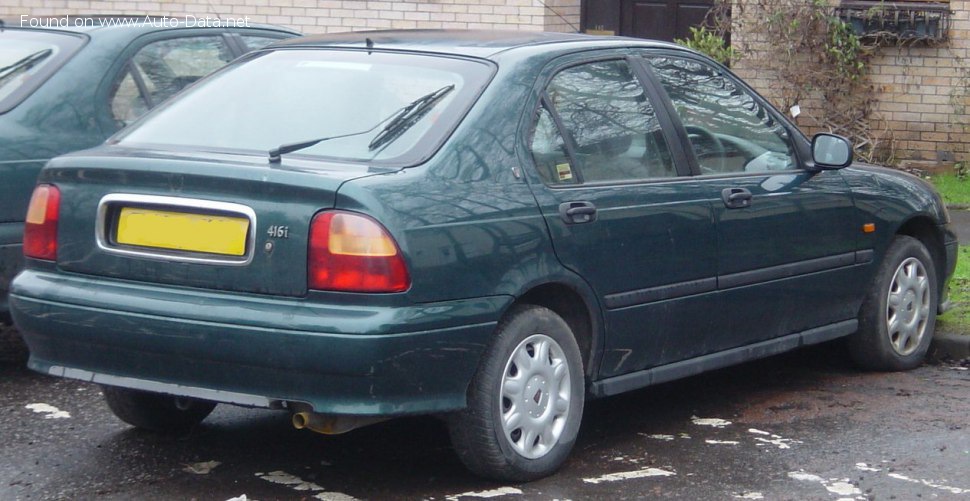
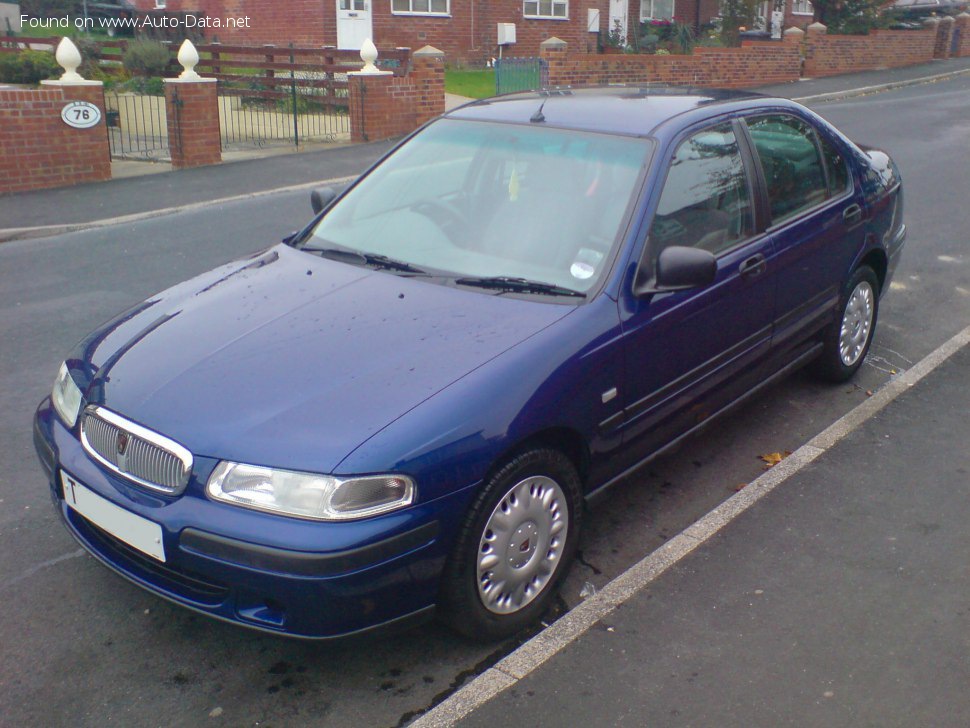
The Rover 400 (RT) 416 Si adopted a classic four-door sedan body type, a popular choice in its target markets. Its design was a conscious effort by Rover to impart a more premium and sophisticated feel compared to its predecessor and many of its rivals. While sharing its basic underpinnings with Honda, Rover designers ensured the 400 possessed a distinct British character, featuring a more rounded, elegant aesthetic than the angular Japanese counterparts. The front fascia typically included Rover’s signature grille, often chrome-accented, flanked by distinctive headlights, contributing to an understated yet refined appearance.
Inside, the Rover 400 aimed for an ambiance of comfort and understated luxury. Seating for five occupants was standard, with materials and finishes often perceived as a step above mainstream competitors. Depending on the trim level, features could include wood or faux-wood trim, plush fabric upholstery, and a well-laid-out dashboard. The emphasis was on ergonomic design and a pleasant driving environment.
In terms of practicality, the 400 sedan offered a generous trunk space, ranging from 16.6 cubic feet (470 liters) to a maximum of 28.6 cubic feet (810 liters) with the rear seats folded, making it suitable for family use and longer journeys. Safety features for the era included the Anti-lock Braking System (ABS) as an assisting system, which was becoming standard on higher trim levels or as an option in the mid-1990s. The car utilized a hydraulic power steering system with a rack and pinion setup, providing a comfortable and predictable steering feel. Suspension comprised spring struts at both the front and rear, a common and effective setup for balancing ride comfort and handling in this segment. Braking was handled by discs at the front and drums at the rear, a typical arrangement for a vehicle of its performance level and cost considerations.
Technical Specifications: Rover 400 (RT) 416 Si (113 Hp)
| Category | Specification |
|---|---|
| General Information | |
| Brand | Rover |
| Model | 400 |
| Generation | 400 (RT) |
| Type (Engine) | 416 Si (113 Hp) |
| Production Start | 1995 |
| Production End | 2000 |
| Powertrain Architecture | Internal Combustion Engine |
| Body Type | Sedan |
| Seats | 5 |
| Doors | 4 |
| Performance Specs | |
| Fuel Consumption (Urban) | 10.1 l/100 km (23.3 US mpg) |
| Fuel Consumption (Extra Urban) | 8.5 l/100 km (27.7 US mpg) |
| Fuel Type | Petrol (Gasoline) |
| Acceleration 0-60 mph | 12.1 seconds |
| Acceleration 0-100 km/h | 12.7 seconds |
| Maximum Speed | 118.06 mph (190 km/h) |
| Weight-to-Power Ratio | 10.2 kg/Hp (97.8 Hp/tonne) |
| Weight-to-Torque Ratio | 8.3 kg/Nm (121.2 Nm/tonne) |
| Engine Specs | |
| Power | 113 Hp @ 6200 rpm |
| Power per Liter | 71.1 Hp/l |
| Torque | 103.26 lb.-ft. (140 Nm) @ 5100 rpm |
| Engine Layout | Front, Transverse |
| Engine Model/Code | K16 |
| Engine Displacement | 1.6 liters (1590 cm3 / 97.03 cu. in.) |
| Number of Cylinders | 4 |
| Engine Configuration | Inline |
| Cylinder Bore | 2.95 in. (75 mm) |
| Piston Stroke | 3.54 in. (90 mm) |
| Compression Ratio | 9.1:1 |
| Valves per Cylinder | 4 |
| Fuel Injection System | Multi-port manifold injection |
| Engine Aspiration | Naturally aspirated |
| Valvetrain | DOHC |
| Engine Oil Capacity | 3.7 US qt (3.5 l) |
| Coolant Capacity | 5.81 US qt (5.5 l) |
| Space, Volume, and Weights | |
| Kerb Weight | 2546.34 lbs. (1155 kg) |
| Max. Weight | 3615.58 lbs. (1640 kg) |
| Max Load | 1069.24 lbs. (485 kg) |
| Trunk (Boot) Space – Minimum | 16.6 cu. ft. (470 l) |
| Trunk (Boot) Space – Maximum | 28.6 cu. ft. (810 l) |
| Fuel Tank Capacity | 14.53 US gal (55 l) |
| Dimensions | |
| Length | 176.81 in. (4491 mm) |
| Width | 66.73 in. (1695 mm) |
| Height | 54.53 in. (1385 mm) |
| Wheelbase | 103.23 in. (2622 mm) |
| Front Track | 58.07 in. (1475 mm) |
| Rear Track | 57.68 in. (1465 mm) |
| Drivetrain, Brakes, and Suspension Specs | |
| Drivetrain Architecture | Internal combustion engine drives the front wheels. |
| Drive Wheel | Front-wheel drive |
| Number of Gears and Type | 4 gears, automatic transmission |
| Front Suspension | Spring Strut |
| Rear Suspension | Spring Strut |
| Front Brakes | Disc |
| Rear Brakes | Drum |
| Assisting Systems | ABS (Anti-lock braking system) |
| Steering Type | Steering rack and pinion |
| Power Steering | Hydraulic Steering |
| Tire Size | 185/60 R14 |
Legacy and Market Impact
The Rover 400 (RT) played a pivotal role in Rover’s strategy during the mid-to-late 1990s. Positioned as a more upmarket alternative to mainstream compact family cars, it sought to attract buyers with its distinctive British styling, comfortable interiors, and the perceived reliability derived from its Honda underpinnings. In the European market, it faced stiff competition from established players such as the Ford Mondeo, Vauxhall Vectra, Volkswagen Passat, and French rivals like the Peugeot 406 and Renault Laguna. While it didn’t outsell these volume leaders, the 400 carved out a niche for itself, particularly among those who appreciated its blend of traditional aesthetics and modern mechanics.
The collaboration with Honda provided significant engineering benefits, including the robust K-series engine (when properly maintained) and a well-sorted chassis. However, this partnership also meant that the 400 had to balance Rover’s desire for a unique identity with the need to share components for cost-effectiveness. Critics often praised the 400 for its comfortable ride, refined interior, and relatively quiet cabin, making it a pleasant car for long-distance cruising. The 416 Si variant, with its 113 horsepower, was considered a sweet spot in the range, offering adequate performance without excessive fuel consumption, which was a key consideration for European buyers.
Despite its merits, the Rover 400 (RT) era was also a period of increasing turbulence for the Rover Group. The eventual dissolution of the partnership with Honda, followed by the acquisition by BMW, brought new challenges and strategic shifts. While the 400 (RT) itself was a competent and appealing vehicle for its time, it ultimately couldn’t reverse the long-term fortunes of the Rover brand. Its legacy is that of a well-intentioned, Anglo-Japanese collaboration that produced a car with a distinct character, striving to maintain a premium feel in a highly competitive segment. Today, the Rover 400 (RT) is remembered as a testament to Rover’s efforts to blend heritage with modernity, offering a comfortable and somewhat refined driving experience that stood apart from its more utilitarian rivals. Its role in the European automotive landscape was significant, representing a final hurrah for a truly independent Rover design philosophy before the brand’s ultimate demise.