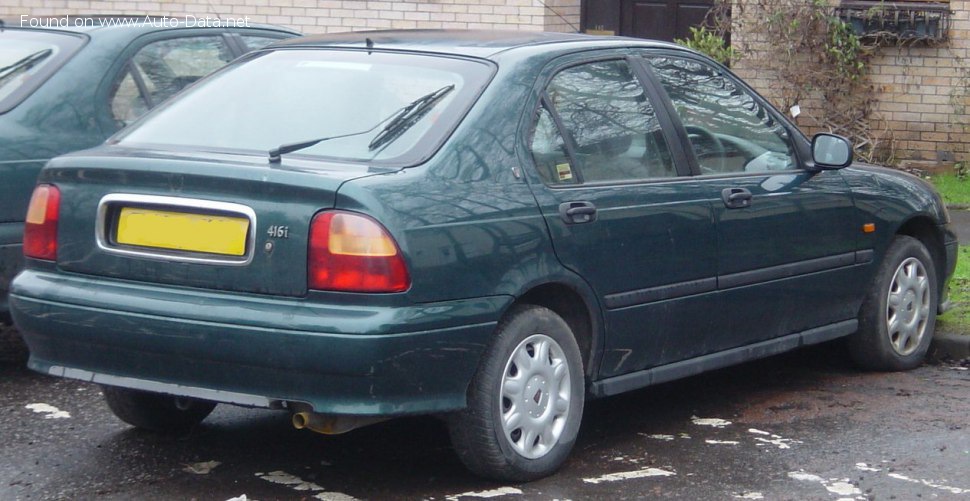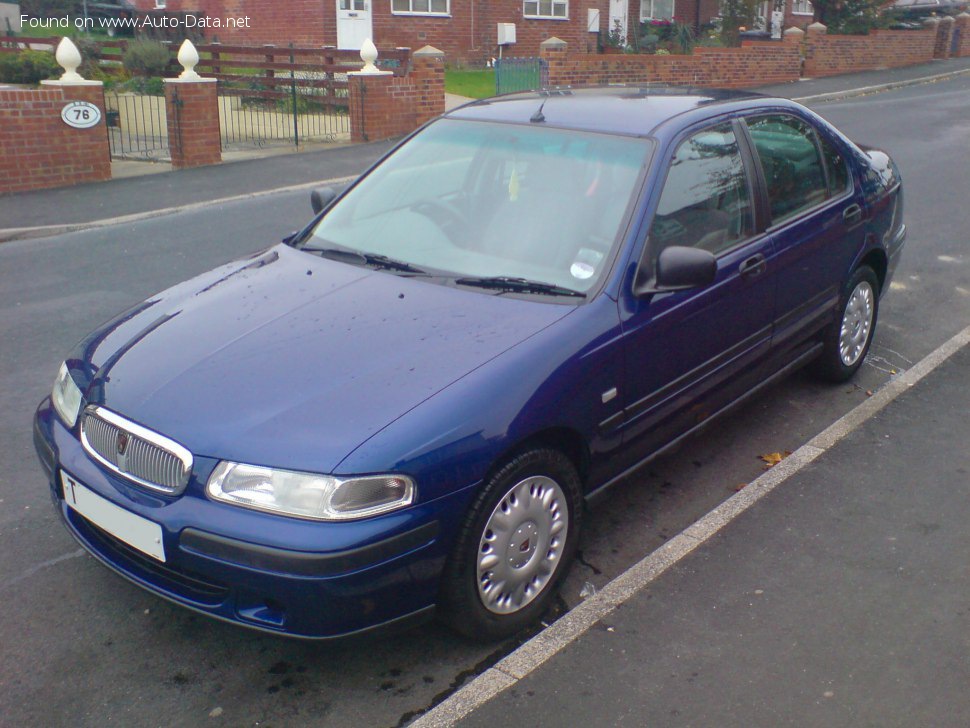
The Rover 400 (RT) Series: A European Contender
The Rover 400 (RT) 420 Di (105 Hp) represents a significant chapter in the history of the British automotive manufacturer, Rover. Launched in 1995 and produced until 2000, the RT generation of the Rover 400 series was a compact family car, primarily aimed at the competitive European market. This particular variant, the 420 Di, stood out due to its efficient and robust diesel powertrain, a popular choice among European buyers prioritizing fuel economy and low running costs. Unlike many of its contemporaries that were developed from scratch, the Rover 400 (RT) shared its underpinnings with the Honda Civic (Domani in Japan), a legacy of the long-standing collaboration between Rover and Honda. This partnership aimed to blend British design sensibilities with Japanese engineering reliability, a strategy that defined much of Rover’s output during this era. The 400 (RT) was offered in both sedan and five-door hatchback body styles, with the 420 Di being a strong performer in the 4-door sedan configuration, offering a practical and comfortable option for families and business users across the UK and continental Europe.
Engineering and Performance of the Rover 400 (RT) 420 Di (105 Hp)
At the heart of the Rover 400 (RT) 420 Di was Rover’s own L-series diesel engine, a 2.0-liter (1994 cm3 or 121.68 cu. in.) turbocharged, inline-four unit. This engine was a testament to Rover’s engineering capabilities, designed to offer a blend of performance and exceptional fuel efficiency. With a power output of 105 horsepower at 4200 rpm and a substantial 154.89 lb.-ft. of torque available at a low 2000 rpm, the 420 Di provided ample pulling power, crucial for both city driving and highway cruising. The engine featured a two-valve-per-cylinder OHC (Overhead Camshaft) valvetrain and utilized a modern Commonrail diesel fuel injection system, which contributed to its refined operation and efficient fuel atomization for its time.
Performance figures for the 420 Di were respectable for a family sedan of its class in the mid-to-late 1990s. The car could accelerate from 0 to 60 mph in a computed 10.6 seconds (0-100 km/h in 11.2 seconds) and reach a top speed of 114.95 mph (185 km/h). These figures positioned it competitively against other diesel offerings from European rivals. Power was delivered to the front wheels via a smooth-shifting 5-speed manual transmission, a common and reliable setup for the segment. The engine’s front, transverse layout was typical for front-wheel-drive vehicles, optimizing cabin space and weight distribution. A critical aspect of the 420 Di’s appeal was its fuel economy: an impressive 42.8 US mpg combined, with highway figures reaching up to 51.1 US mpg. This made it a very attractive proposition for budget-conscious drivers and fleets.
Design and Features
The design of the Rover 400 (RT) sedan aimed for a more upscale and conservative aesthetic compared to its Honda Civic counterpart, reflecting Rover’s aspiration to position itself as a premium mainstream brand. The 4-door sedan body type offered seating for five occupants, providing a comfortable and reasonably spacious interior for a vehicle in its class. With a length of 176.77 inches, a width of 66.73 inches, and a height of 54.72 inches, the 400 (RT) maintained compact exterior dimensions suitable for European city driving while still offering a decent cabin. The wheelbase measured 103.23 inches, contributing to a stable ride and adequate interior room.
Inside, the Rover 400 (RT) featured a well-appointed cabin, often trimmed with wood veneer and chrome accents, typical of Rover’s attempt to evoke a sense of traditional British luxury. Standard features for the era included power steering, and importantly, an Anti-lock Braking System (ABS) was available, enhancing safety. The car’s suspension system utilized spring struts at both the front and rear, providing a balanced ride quality that prioritized comfort without sacrificing too much in terms of handling. Braking was handled by disc brakes on all four wheels, ensuring confident stopping power. The trunk space was generous for the segment, offering a minimum of 16.6 cu. ft. (470 liters) and expanding to 28.6 cu. ft. (810 liters) with the rear seats folded, making it practical for family use and luggage. The 185/65 R14 T tires provided a good balance of grip and ride comfort.
Technical Specifications: Rover 400 (RT) 420 Di (105 Hp)
| Category | Specification |
|---|---|
| Brand | Rover |
| Model | 400 |
| Generation | 400 (RT) |
| Type (Engine) | 420 Di (105 Hp) |
| Production Start | 1995 |
| Production End | 2000 |
| Powertrain Architecture | Internal Combustion Engine, Front-Wheel Drive |
| Body Type | Sedan |
| Seats | 5 |
| Doors | 4 |
| Fuel Type | Diesel |
| Fuel Consumption (Urban) | 5.6 l/100 km (42 US mpg) |
| Fuel Consumption (Extra Urban) | 4.6 l/100 km (51.1 US mpg) |
| Fuel Consumption (Combined) | 5.5 l/100 km (42.8 US mpg) |
| Acceleration 0-60 mph | 10.6 seconds |
| Acceleration 0-100 km/h | 11.2 seconds |
| Maximum Speed | 114.95 mph (185 km/h) |
| Power | 105 Hp @ 4200 rpm |
| Torque | 154.89 lb.-ft. (210 Nm) @ 2000 rpm |
| Engine Layout | Front, Transverse |
| Engine Model/Code | L |
| Engine Displacement | 2.0 liters (1994 cm3, 121.68 cu. in.) |
| Number of Cylinders | 4 |
| Engine Configuration | Inline |
| Cylinder Bore | 3.33 in. (84.5 mm) |
| Piston Stroke | 3.5 in. (88.9 mm) |
| Compression Ratio | 19.5:1 |
| Valves per Cylinder | 2 |
| Fuel Injection System | Diesel Commonrail |
| Engine Aspiration | Turbocharger |
| Valvetrain | OHC |
| Engine Oil Capacity | 4.76 US qt (4.5 l) |
| Coolant Capacity | 7.4 US qt (7 l) |
| Kerb Weight | 2854.99 lbs. (1295 kg) |
| Max. Weight | 3791.95 lbs. (1720 kg) |
| Max Load | 936.96 lbs. (425 kg) |
| Trunk Space (Min) | 16.6 cu. ft. (470 l) |
| Trunk Space (Max) | 28.6 cu. ft. (810 l) |
| Fuel Tank Capacity | 14.53 US gal (55 l) |
| Length | 176.77 in. (4490 mm) |
| Width | 66.73 in. (1695 mm) |
| Height | 54.72 in. (1390 mm) |
| Wheelbase | 103.23 in. (2622 mm) |
| Front Track | 58.15 in. (1477 mm) |
| Rear Track | 57.68 in. (1465 mm) |
| Drive Wheel | Front-Wheel Drive |
| Gearbox Type | 5-speed manual transmission |
| Front Suspension | Spring Strut |
| Rear Suspension | Spring Strut |
| Front Brakes | Disc |
| Rear Brakes | Disc |
| Assisting Systems | ABS (Anti-lock braking system) |
| Steering Type | Steering rack and pinion |
| Power Steering | Hydraulic Steering |
| Tires Size | 185/65 R14 T |
| Weight-to-power ratio | 12.3 kg/Hp, 81.1 Hp/tonne |
| Weight-to-torque ratio | 6.2 kg/Nm, 162.2 Nm/tonne |
Legacy and Market Impact
The Rover 400 (RT) 420 Di (105 Hp) played a crucial role in Rover’s lineup during the late 1990s, particularly in its home market and across Europe. It faced stiff competition from well-established rivals such as the Ford Mondeo, Vauxhall Vectra (Opel Vectra in continental Europe), Peugeot 406, and Volkswagen Passat. Against these competitors, the 400 (RT) carved out a niche by offering a blend of traditional British styling cues, a comfortable ride, and the perceived reliability derived from its Honda underpinnings. The 420 Di variant, in particular, was highly regarded for its exceptional fuel economy and strong torque delivery, making it a popular choice for families and company car drivers who covered significant mileage.
Despite its merits, the Rover 400 (RT) generation, and the Rover brand as a whole, struggled with an identity crisis and a perception of being somewhat dated compared to more dynamically styled and technologically advanced European and Japanese rivals. The partnership with Honda, while providing a solid engineering foundation, also limited Rover’s ability to fully differentiate its products. The L-series diesel engine itself gained a reputation for being robust and economical, becoming a favored powerplant in various Rover and MG models. However, the car’s legacy is intertwined with the broader struggles of the Rover Group. The RT generation was one of the last models developed before the dissolution of the Rover-Honda alliance and the subsequent acquisition by BMW, marking a period of significant upheaval for the brand.
Ultimately, the Rover 400 (RT) 420 Di (105 Hp) is remembered as a competent and economical family sedan that served its purpose effectively in its primary markets. It represented Rover’s last concerted effort to compete in the volume family car segment with a car that, while not groundbreaking, offered a comfortable and efficient package for its time. Its strong diesel variant underscored the importance of fuel economy in the European automotive landscape and remains a testament to Rover’s engineering capabilities in diesel technology, even as the company itself faced an uncertain future.