The Rover 400 (RT) 425 i (175 Hp): A British Effort in the European Compact Segment
The Rover 400 (RT) represents a significant, albeit challenging, chapter in the history of the British Rover Group. Launched in 1995, the RT generation was the second iteration to carry the Rover 400 badge, yet it marked a departure from its predecessor by being an entirely in-house design, rather than a rebadged Honda Civic/Concerto. Positioned in the highly competitive European C-segment, often referred to as the compact or small family car segment, the Rover 400 aimed to offer a more premium, refined alternative to mainstream rivals. The focus keyword for this analysis is the Rover 400 (RT) 425 i (175 Hp), a particular variant produced between 1998 and 2000 that stood out in the lineup for its powerful V6 engine and upscale aspirations. This model was never officially sold in the United States, making its primary impact felt across the United Kingdom and continental Europe, where it competed for buyers seeking a blend of traditional British comfort and modern performance.
Engine and Performance: The KV6 Heart of the Rover 400 (RT) 425 i (175 Hp)
At the core of the Rover 400 (RT) 425 i (175 Hp) was Rover’s much-touted KV6 engine. This 2.5-liter (2497 cm3 or 152.38 cu. in.) V-engine, configured with six cylinders and a DOHC (Double Overhead Camshaft) valvetrain with four valves per cylinder, was a testament to Rover’s engineering ambition. Unlike many of its four-cylinder competitors in the compact segment, the KV6 provided a level of refinement and smoothness typically found in larger, more expensive vehicles. With a naturally aspirated design and a multi-port manifold injection fuel system, the engine delivered a respectable 175 horsepower at 6500 rpm. This power output, combined with 177.01 lb.-ft. of torque peaking at 4000 rpm, endowed the sedan with brisk performance for its class.
The KV6 engine was mounted transversely at the front, driving the front wheels through a 4-speed automatic transmission. While a manual option might have offered more engaging dynamics, the automatic gearbox emphasized the car’s intended role as a comfortable cruiser. Performance figures were competitive for the late 1990s: the 425 i could accelerate from 0 to 60 mph in a brisk 8.1 seconds, with a top speed reaching 139.81 mph (225 km/h). This made it one of the faster, more potent options available in the C-segment at the time.
However, the V6 engine and automatic transmission came with a trade-off in fuel economy, particularly in urban driving conditions. The official urban fuel consumption was rated at 16.8 US mpg (14 l/100 km), which was on the higher side compared to smaller-engined rivals. On the highway (extra-urban), consumption improved to a more reasonable 29.4 US mpg (8 l/100 km). With a curb weight of 2976.24 lbs (1350 kg), the power-to-weight ratio stood at 129.6 HP per tonne (7.7 kg/Hp), indicating a well-balanced performance package for its segment.
Design and Features: Understated British Elegance
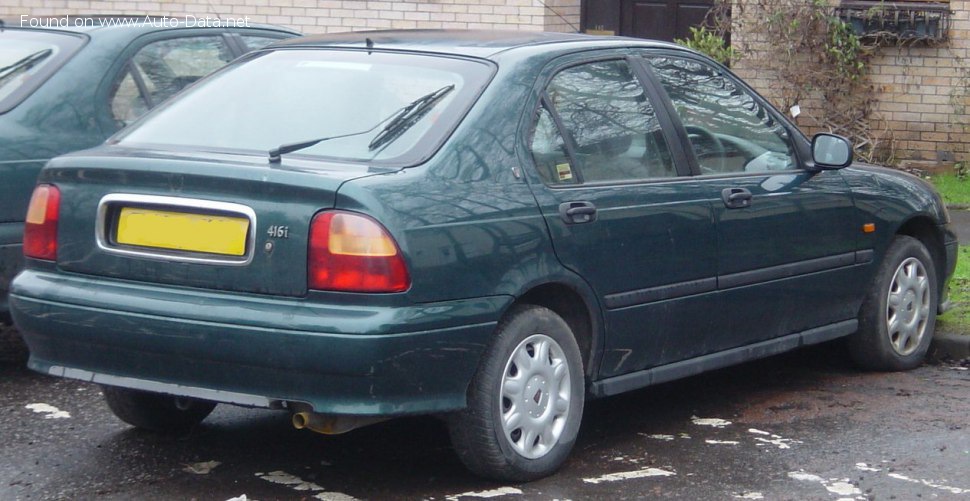
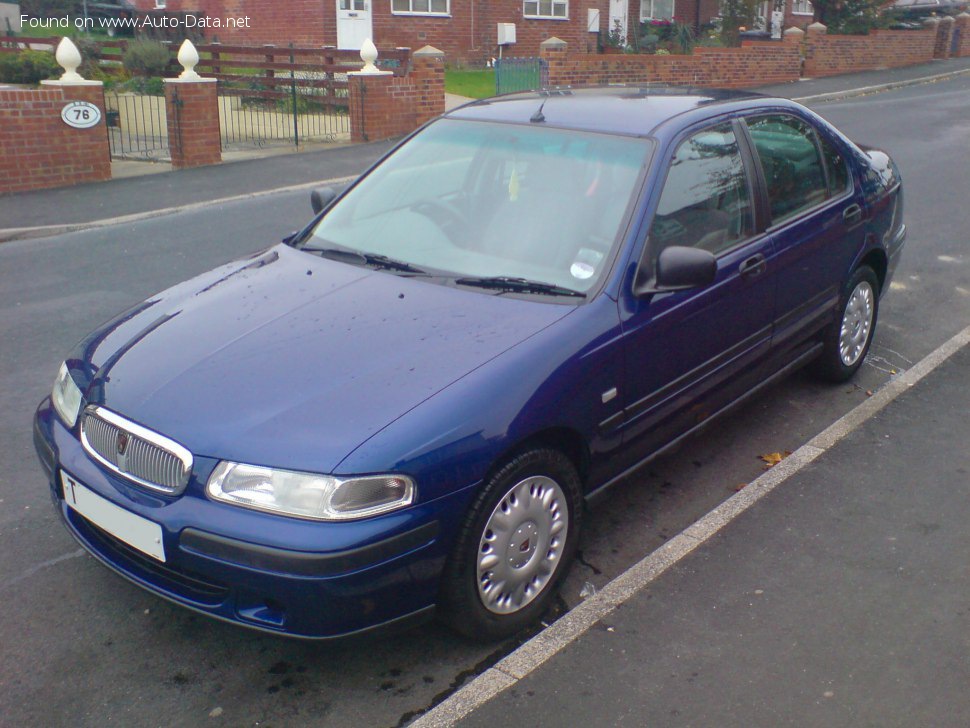
The Rover 400 (RT) adopted a conservative, yet pleasant, design aesthetic that aimed for a more upscale feel than its price point might suggest. The vehicle was offered as a 4-door sedan, providing seating for five occupants. Its dimensions – 176.81 inches in length, 66.73 inches in width, and 54.53 inches in height, with a wheelbase of 103.23 inches – placed it firmly in the compact sedan category. The styling was characterized by smooth lines, a modest chrome grille, and a generally understated appearance that was typical of Rover’s design language during this era. It avoided the more avant-garde styling trends seen from some continental European manufacturers, opting instead for a timeless, if somewhat anonymous, look.