The Rover 400 (XW) 414 GSI/SI CAT: A British Compact for the European Market
The Rover 400 (XW) represents a significant chapter in the history of the British automotive manufacturer Rover Group. Launched in 1990, the first generation of the Rover 400 series, internally codenamed “R8,” was a compact family car designed primarily for the European market. The specific variant under discussion, the 414 GSI/SI CAT (103 Hp), produced between 1993 and 1995, exemplified Rover’s strategy of combining British styling and comfort with reliable Japanese engineering, thanks to its deep collaboration with Honda.
Positioned in the highly competitive C-segment, the Rover 400 (XW) was intended to be a more upscale and refined alternative to its mass-market rivals. While not officially sold in the United States, its design and engineering principles were closely watched by automotive experts globally, showcasing a blend of traditional European elegance with modern efficiency. The 414 GSI/SI CAT model, with its 1.4-liter engine, offered a compelling balance of performance and fuel economy, making it a popular choice for families and company car fleets across the UK and continental Europe.
Engine and Performance of the Rover 400 (XW) 414 GSI/SI CAT
At the heart of the Rover 400 (XW) 414 GSI/SI CAT was Rover’s renowned K-Series engine. This particular iteration, coded K16, was a naturally aspirated 1.4-liter (1396 cm³ or 85.19 cu. in.) inline four-cylinder powerplant. The K-Series was celebrated for its lightweight, all-aluminum construction and advanced DOHC (Double Overhead Camshaft) valvetrain with four valves per cylinder, which was quite sophisticated for a compact engine of its era.
The engine delivered a respectable 103 horsepower at 6000 rpm, translating to a power-per-liter ratio of 73.8 Hp/l. Torque output stood at 93.67 lb.-ft. (127 Nm) achieved at 5000 rpm. This power was efficiently managed by a 5-speed manual transmission, driving the front wheels. The powertrain architecture, with its front, transverse engine layout, was conventional for a compact front-wheel-drive vehicle, optimizing interior space and handling dynamics.
In terms of performance, the 414 GSI/SI CAT was capable of accelerating from 0 to 60 mph in a brisk 9.6 seconds (0-100 km/h in 10.1 seconds), and could reach a top speed of 111.85 mph (180 km/h). These figures placed it firmly in contention with its European rivals, offering a lively driving experience for its class. Fuel efficiency was also a strong suit, with a combined cycle rating of 32.2 US mpg (7.3 l/100 km), demonstrating its practicality for daily commuting and longer journeys across the continent.
Design and Features
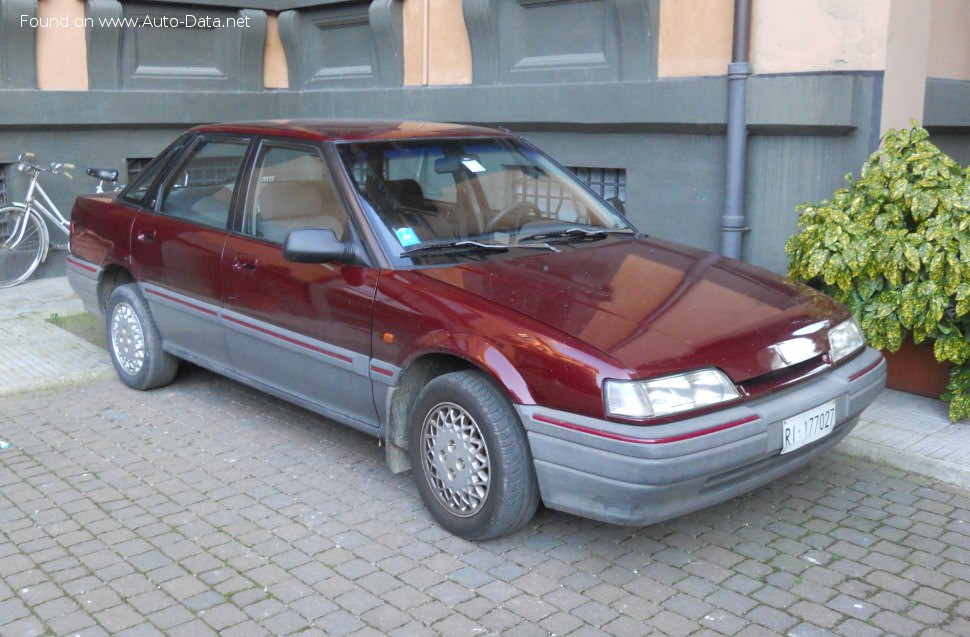
The Rover 400 (XW) adopted a classic four-door sedan body type, seating five occupants comfortably. Its design was a collaborative effort between Rover and Honda, sharing its platform with the Honda Concerto. However, Rover’s design team meticulously crafted a distinctive exterior and interior that exuded a more traditional British character, distinguishing it from its Japanese twin. The sedan’s lines were clean and understated, featuring a subtle elegance that appealed to buyers seeking a touch of sophistication in the compact segment.
Measuring 172.05 inches (4370 mm) in length, 66.14 inches (1680 mm) in width, and 55.12 inches (1400 mm) in height, the 400 (XW) offered a compact footprint while providing a generous wheelbase of 100.39 inches (2550 mm), contributing to a stable ride and ample interior room. The trunk space was practical, offering 14.48 cu. ft. (410 liters) of cargo capacity, suitable for family needs.
Key features for the 414 GSI/SI CAT trim level included hydraulic power steering, making maneuvering easier in urban environments. For its time, safety was addressed with the inclusion of an Anti-lock Braking System (ABS), a significant feature in the early 1990s compact car market. The braking system utilized ventilated discs at the front and disc brakes at the rear, providing confident stopping power. The suspension setup, featuring a wishbone design at the front and coil springs at the rear, was tuned for a comfortable ride, a hallmark of Rover vehicles, while maintaining competent handling characteristics. Standard tire size was 175/65 R14, balancing grip with ride comfort.
Technical Specifications
| Category | Specification |
|---|---|
| Brand | Rover |
| Model | 400 |
| Generation | 400 (XW) |
| Type (Engine) | 414 GSI/SI CAT (103 Hp) |
| Production Start | 1993 year |
| Production End | 1995 year |
| Body Type | Sedan |
| Seats | 5 |
| Doors | 4 |
| Performance Specifications | |
| Fuel Consumption (Urban) | 26.4 US mpg (8.9 l/100 km) |
| Fuel Consumption (Extra Urban) | 42.8 US mpg (5.5 l/100 km) |
| Fuel Consumption (Combined) | 32.2 US mpg (7.3 l/100 km) |
| Fuel Type | Petrol (Gasoline) |
| Acceleration 0-60 mph | 9.6 sec |
| Maximum Speed | 111.85 mph (180 km/h) |
| Weight-to-Power Ratio | 10.4 kg/Hp |
| Engine Specifications | |
| Power | 103 Hp @ 6000 rpm |
| Torque | 93.67 lb.-ft. (127 Nm) @ 5000 rpm |
| Engine Layout | Front, Transverse |
| Engine Model/Code | K16 |
| Engine Displacement | 1.4 Liters (1396 cm³ / 85.19 cu. in.) |
| Number of Cylinders | 4 |
| Engine Configuration | Inline |
| Cylinder Bore | 2.95 in. (75 mm) |
| Piston Stroke | 3.11 in. (79 mm) |
| Compression Ratio | 9.5:1 |
| Valves per Cylinder | 4 |
| Fuel Injection System | Multi-port manifold injection |
| Engine Aspiration | Naturally Aspirated |
| Valvetrain | DOHC |
| Engine Oil Capacity | 4.76 US qt (4.5 l) |
| Coolant Capacity | 6.13 US qt (5.8 l) |
| Dimensions, Volume, and Weights | |
| Kerb Weight | 2369.97 lbs (1075 kg) |
| Maximum Weight | 3417.17 lbs (1550 kg) |
| Maximum Load | 1047.2 lbs (475 kg) |
| Trunk (Boot) Space – Minimum | 14.48 cu. ft. (410 l) |
| Fuel Tank Capacity | 14.53 US gal (55 l) |
| Length | 172.05 in. (4370 mm) |
| Width | 66.14 in. (1680 mm) |
| Height | 55.12 in. (1400 mm) |
| Wheelbase | 100.39 in. (2550 mm) |
| Front Track | 58.07 in. (1475 mm) |
| Rear (Back) Track | 57.87 in. (1470 mm) |
| Drivetrain, Brakes, and Suspension | |
| Drivetrain Architecture | Front-wheel drive, Internal Combustion Engine |
| Drive Wheel | Front Wheel Drive |
| Gearbox Type | 5-speed Manual Transmission |
| Front Suspension | Wishbone |
| Rear Suspension | Coil Spring |
| Front Brakes | Ventilated Discs |
| Rear Brakes | Disc |
| Assisting Systems | ABS (Anti-lock Braking System) |
| Steering Type | Steering Rack and Pinion |
| Power Steering | Hydraulic Steering |
| Tires Size | 175/65 R14 |
Legacy and Market Impact
The Rover 400 (XW) series played a critical role in Rover’s lineup during the early to mid-1990s. It was a strong contender in the European compact car market, competing against well-established rivals such as the Ford Escort, Vauxhall Astra (Opel Astra), Volkswagen Golf/Jetta, and Renault 19. What set the Rover 400 apart was its distinctively British character, often perceived as offering a more luxurious and refined experience than its direct competitors. This was evident in its interior appointments, ride quality, and a general sense of understated elegance.
The collaboration with Honda, which provided the robust platform and much of the underlying engineering, was a double-edged sword for Rover. While it granted access to reliable and modern technology, it also meant that Rover was largely dependent on Honda’s goodwill. The K-Series engine, despite its advanced design, would later gain a reputation for head gasket issues in certain applications, though the 1.4-liter variant in the 400 (XW) was generally considered reliable in its early years.
The Rover 400 (XW) was significant as one of the last true products of the Rover-Honda alliance before their eventual separation. It showcased Rover’s ability to imbue a foreign platform with a unique British identity, offering a compelling blend of comfort, style, and efficiency. Although it was never officially imported to the North American market, its presence in Europe helped maintain Rover’s brand image as a producer of quality, refined vehicles, carving out a niche for itself amidst fierce competition. Its legacy is one of a solid, if sometimes overlooked, compact sedan that provided a touch of class and driving pleasure to its owners in its primary markets during a transformative period for the British automotive industry.