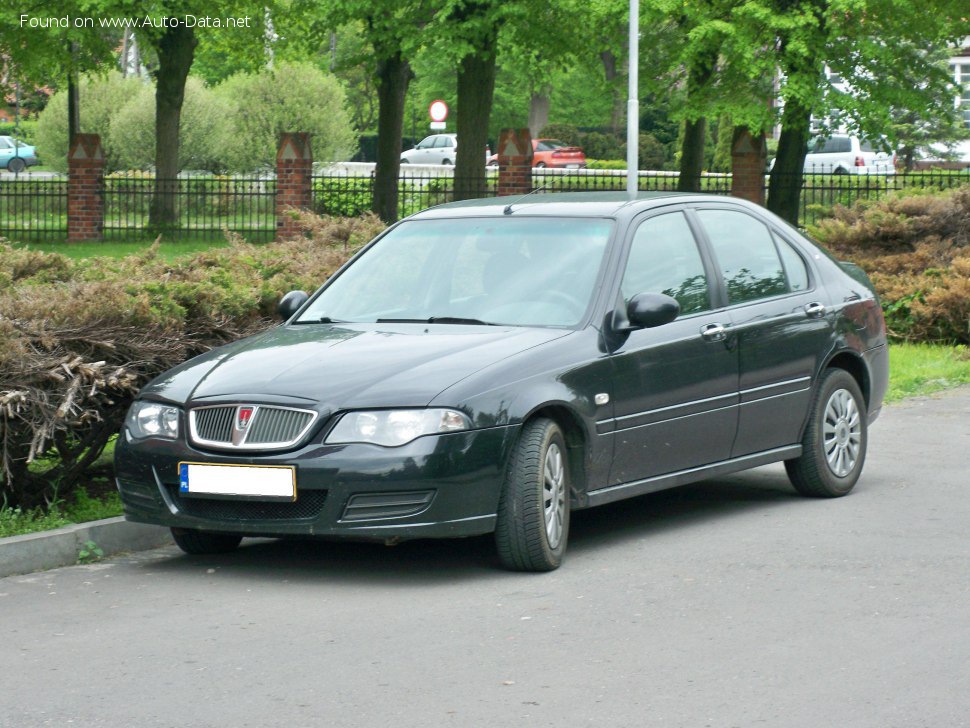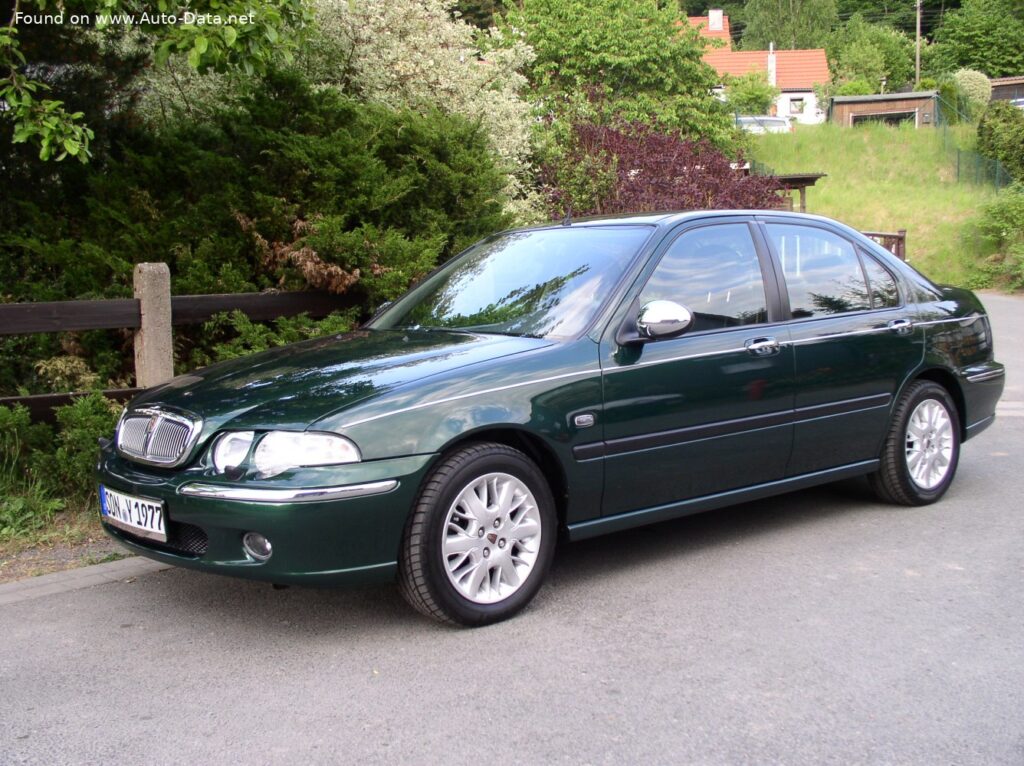
The Rover 45 (RT) 2.0 i V6 24V (150 Hp): A Refined Compact Sedan from the Turn of the Millennium
The Rover 45 (RT) 2.0 i V6 24V (150 Hp) represents a significant chapter in the history of the British automotive manufacturer Rover, particularly as the company navigated the challenging landscape of the late 1990s and early 2000s. Introduced in 1999 as a facelifted and rebadged version of the Rover 400 Series (HH-R), the 45 was positioned in the highly competitive European C-segment, or compact car segment, though its dimensions and available V6 engine pushed it towards the upper end of that category, sometimes even overlapping with entry-level D-segment (mid-size) offerings. Produced from 1999 to 2005, the Rover 45 sought to combine traditional British styling cues with a focus on refinement and comfort, a hallmark of the Rover brand. The 2.0-liter V6 variant, in particular, offered a unique proposition within its class, delivering a level of smoothness and power typically reserved for larger, more expensive vehicles.
While never officially sold in the United States, the Rover 45 played a crucial role in Rover’s lineup in its primary markets, predominantly the United Kingdom and continental Europe. It aimed to capture buyers looking for an alternative to mainstream offerings from Ford, Opel (Vauxhall), and Volkswagen, by emphasizing a more premium feel, a comfortable ride, and a distinct British character. The RT generation, specifically, was an evolution intended to modernize the 400’s design and features, bringing it more in line with contemporary expectations while retaining its fundamental architecture.
Engine and Performance: The Distinctive KV6 Powerplant in the Rover 45 (RT)
At the heart of the Rover 45 (RT) 2.0 i V6 24V (150 Hp) lies its most distinguishing feature: the 2.0-liter KV6 engine. This naturally aspirated, 24-valve V6 engine, designated as the KV6 / 20K4F, was a proprietary Rover design, showcasing the company’s engineering capabilities despite its broader challenges. With an engine displacement of 1997 cubic centimeters (121.86 cubic inches), the V6 configuration was notably compact for its class, allowing it to fit transversely in the front-wheel-drive sedan.
The KV6 engine delivered a respectable 150 horsepower at 6500 revolutions per minute, translating to a power-per-liter output of 75.1 horsepower per liter. This power output was competitive for its time, especially for a non-turbocharged 2.0-liter engine. Torque was rated at 185 Newton-meters (136.45 lb.-ft.) peaking at 4000 rpm, providing a broad powerband that contributed to the car’s smooth acceleration. The engine’s DOHC (Double Overhead Camshaft) valvetrain with four valves per cylinder ensured efficient breathing, while multi-port manifold injection handled fuel delivery with precision.
Paired with a 5-speed automatic transmission, the Rover 45 (RT) 2.0 i V6 offered a refined driving experience. The automatic gearbox was chosen to complement the V6’s inherent smoothness, prioritizing comfort and ease of driving over outright sportiness. Performance figures included an acceleration time from 0 to 60 mph (0-97 km/h) in approximately 9 seconds, and a 0 to 100 km/h sprint in 9.5 seconds. The top speed was rated at 203 km/h (126.14 mph), making it capable of comfortable highway cruising. The V6’s characteristic smooth power delivery and distinctive exhaust note were often cited as key advantages over the more common four-cylinder engines found in its direct competitors.
Fuel Economy and Efficiency
Given its V6 engine and automatic transmission, the fuel economy of the Rover 45 (RT) 2.0 i V6 24V (150 Hp) was moderate for its era. Combined fuel consumption was rated at 9.4 liters per 100 kilometers, which translates to approximately 25 US miles per gallon. Urban driving naturally saw higher consumption at 14 liters per 100 kilometers (16.8 US mpg), while extra-urban (highway) driving was more efficient at 6.7 liters per 100 kilometers (35.1 US mpg). The 55-liter (14.53 US gallon) fuel tank provided a reasonable range for typical use.
Design and Features of the Rover 45 (RT) Sedan
The Rover 45 (RT) was offered predominantly as a 4-door sedan, with a 5-door hatchback also available in other engine configurations. The sedan body style emphasized classic, understated elegance, adhering to Rover’s traditional design philosophy. Its exterior dimensions measured 4517 mm (177.83 inches) in length, 1696 mm (66.77 inches) in width, and 1394 mm (54.88 inches) in height, with a wheelbase of 2620 mm (103.15 inches). These dimensions placed it firmly in the compact-to-mid-size category.
Inside, the Rover 45 aimed for a more upscale ambiance than many of its rivals. It featured traditional wood trim and chrome accents, along with comfortable seating for five occupants. The interior design, while a refinement of the preceding 400 Series, still carried some vestiges of its Honda origins, particularly in the layout of certain controls. However, Rover’s designers worked to instill a distinct British character through material choices and finishing.
Safety features for the Rover 45 (RT) included an Anti-lock Braking System (ABS) as standard, which was becoming increasingly common in vehicles of this segment by the late 1990s. The braking system comprised ventilated discs at the front and solid discs at the rear, providing adequate stopping power for the vehicle’s performance. The suspension setup featured wishbones at the front and spring struts at the rear, tuned to provide a comfortable and compliant ride, consistent with Rover’s brand image. Power steering was hydraulic, offering a traditional, communicative feel. The car rode on 205/45 R16 V tires, providing a good balance of grip and ride quality.
Practicality was also a consideration, with a trunk (boot) space ranging from 470 liters (16.6 cubic feet) with the rear seats up, expanding to 810 liters (28.6 cubic feet) when the rear seats were folded down, offering versatility for luggage and cargo. The curb weight of the 2.0 i V6 model was 1340 kg (2954.19 lbs.), with a maximum permissible gross weight of 1720 kg (3791.95 lbs.), allowing for a maximum load of 380 kg (837.76 lbs.).
Technical Specifications
| Category | Specification |
|---|---|
| Brand | Rover |
| Model | 45 |
| Generation | 45 (RT) |
| Type (Engine) | 2.0 i V6 24V (150 Hp) |
| Start of Production | 1999 year |
| End of Production | 2005 year |
| Powertrain Architecture | Internal Combustion engine |
| Body Type | Sedan |
| Seats | 5 |
| Doors | 4 |
| Performance Specs | |
| Fuel Consumption (Urban) | 14 l/100 km (16.8 US mpg) |
| Fuel Consumption (Extra Urban) | 6.7 l/100 km (35.1 US mpg) |
| Fuel Consumption (Combined) | 9.4 l/100 km (25 US mpg) |
| Fuel Type | Petrol (Gasoline) |
| Acceleration 0 – 60 mph | 9 sec |
| Acceleration 0 – 100 km/h | 9.5 sec |
| Maximum Speed | 203 km/h (126.14 mph) |
| Weight-to-Power Ratio | 8.9 kg/Hp (111.9 Hp/tonne) |
| Weight-to-Torque Ratio | 7.2 kg/Nm (138.1 Nm/tonne) |
| Engine Specs | |
| Power | 150 Hp @ 6500 rpm |
| Power per Liter | 75.1 Hp/l |
| Torque | 185 Nm @ 4000 rpm (136.45 lb.-ft. @ 4000 rpm) |
| Engine Layout | Front, Transverse |
| Engine Model/Code | KV6 / 20K4F |
| Engine Displacement | 1997 cm3 (121.86 cu. in.) |
| Number of Cylinders | 6 |
| Engine Configuration | V-engine |
| Cylinder Bore | 80 mm (3.15 in.) |
| Piston Stroke | 66.2 mm (2.61 in.) |
| Compression Ratio | 10.5:1 |
| Number of Valves per Cylinder | 4 |
| Fuel Injection System | Multi-port manifold injection |
| Engine Aspiration | Naturally aspirated engine |
| Valvetrain | DOHC |
| Engine Oil Capacity | 6 l (6.34 US qt) |
| Coolant Capacity | 5.75 l (6.08 US qt) |
| Space, Volume and Weights | |
| Kerb Weight (Curb Weight) | 1340 kg (2954.19 lbs.) |
| Max. Weight (Gross Weight) | 1720 kg (3791.95 lbs.) |
| Max Load | 380 kg (837.76 lbs.) |
| Trunk (Boot) Space – Minimum | 470 l (16.6 cu. ft.) |
| Trunk (Boot) Space – Maximum | 810 l (28.6 cu. ft.) |
| Fuel Tank Capacity | 55 l (14.53 US gal) |
| Dimensions | |
| Length | 4517 mm (177.83 in.) |
| Width | 1696 mm (66.77 in.) |
| Height | 1394 mm (54.88 in.) |
| Wheelbase | 2620 mm (103.15 in.) |
| Front Track | 1475 mm (58.07 in.) |
| Rear (Back) Track | 1465 mm (57.68 in.) |
| Drivetrain, Brakes and Suspension Specs | |
| Drivetrain Architecture | Front-wheel drive, Internal Combustion engine |
| Drive Wheel | Front wheel drive |
| Number of Gears and Type of Gearbox | 5 gears, automatic transmission |
| Front Suspension | Wishbone |
| Rear Suspension | Spring Strut |
| Front Brakes | Ventilated discs |
| Rear Brakes | Disc |
| Assisting Systems | ABS (Anti-lock braking system) |
| Steering Type | Steering rack and pinion |
| Power Steering | Hydraulic Steering |
| Tires Size | 205/45 R16 V |
Legacy and Market Impact of the Rover 45 (RT)
The Rover 45 (RT) entered a highly competitive market segment in Europe, facing formidable rivals such as the Ford Focus, Opel Astra, Volkswagen Bora (Jetta in North America), Honda Civic, and Toyota Corolla. In this crowded field, the 45 struggled to carve out a dominant niche. Its underlying platform, derived from the Honda Domani/Civic of the early 1990s, was already aging by the time the 45 launched in 1999. While Rover had made significant efforts to update the styling and interior, the car couldn’t quite match the dynamic prowess of newer rivals like the Ford Focus or the perceived quality and modernity of Volkswagen offerings.
Despite these challenges, the Rover 45, particularly the V6 variant, earned a reputation for its refinement and comfortable ride. The KV6 engine was a particular highlight, offering a smoothness and aural character that was rare in its class. This made the 45 an appealing choice for buyers who prioritized comfort and a more traditional, executive feel over cutting-edge dynamics or aggressive styling. It was often seen as a car for those who appreciated understated luxury and British heritage, even if that heritage was by this point intertwined with various international partnerships.
However, the broader context of Rover’s financial instability and eventual collapse cast a long shadow over the 45’s production run. The brand’s struggles, frequent changes in ownership (from British Aerospace to BMW, then to the Phoenix Consortium), and a perception of outdated technology hampered sales. The Rover 45’s production ceased in 2005 with the final demise of MG Rover Group, marking the end of a long and storied chapter in British automotive manufacturing.
Today, the Rover 45 (RT) 2.0 i V6 24V (150 Hp) is viewed as a testament to Rover’s attempts to maintain its identity and offer unique propositions in a challenging market. While not a sales leader, it remains a distinctive vehicle, particularly for enthusiasts of British automotive history and those who appreciate the unusual luxury of a small V6 sedan. Its legacy is tied to the final years of an iconic British marque, representing both the aspirations and the ultimate limitations of the company in the face of global competition.