The Rover 75 2.0 CDT (115 Hp): A Quintessential British Executive Sedan
The Rover 75 2.0 CDT (115 Hp) represents a significant chapter in British automotive history, embodying a blend of traditional elegance and modern engineering. Launched in 1999, the Rover 75 was the last entirely new model developed by the Rover Group before its eventual collapse, and arguably one of its most ambitious. Positioned in the competitive European mid-size executive sedan segment, the 75 was designed to appeal to buyers seeking refinement, comfort, and a distinctive classic aesthetic, setting it apart from its German and Japanese rivals. While never officially imported to the United States, its influence and design philosophy were keenly observed globally, representing a final, valiant effort by a storied British marque to reclaim its premium standing.
Produced from 1999 to 2004, this generation of the Rover 75, particularly the 2.0 CDT variant, was a testament to the brand’s commitment to offering a sophisticated driving experience with an emphasis on fuel efficiency, a crucial factor in its primary European markets. The “CDT” designation referred to its Commonrail Direct Injection Turbo-diesel engine, a technology that was rapidly gaining popularity for its balance of power and economy. The Rover 75 was more than just a car; it was a statement, a nostalgic nod to Rover’s illustrious past, wrapped in a package intended for the new millennium.
Engine and Performance: The Heart of the Rover 75
Under the hood, the Rover 75 2.0 CDT (115 Hp) featured a robust and efficient 2.0-liter (1951 cm³) inline-four turbo-diesel engine, internally designated M47R / 204D2. This powerplant was a critical component of the Rover 75’s appeal, especially in Europe where diesel engines were highly favored for their torque and fuel economy. Developed during Rover’s ownership by BMW, this engine shared its lineage with BMW’s well-regarded M47 diesel unit, albeit with specific modifications for the Rover application. This German engineering input provided the Rover 75 with a level of refinement and reliability that was crucial for its market segment.
The engine delivered a respectable 115 horsepower at 4000 rpm, which, while not class-leading in terms of outright power, was more than adequate for the car’s executive positioning. More importantly, it produced a strong 191.77 lb.-ft. of torque at a low 2000 rpm. This ample low-end torque was a hallmark of the Commonrail diesel system, providing excellent drivability and effortless cruising, making the 75 a comfortable long-distance cruiser. Power was channeled to the front wheels via a smooth-shifting 5-speed manual transmission, a popular choice in European markets for its engagement and efficiency.
In terms of performance, the Rover 75 2.0 CDT (115 Hp) achieved a 0 to 60 mph acceleration time of 11.1 seconds, with a top speed of 119.92 mph. These figures underscored its role as a comfortable cruiser rather than an outright performance machine. Where the 2.0 CDT truly shined was in its fuel economy. It boasted an impressive combined fuel consumption of 40.6 US mpg (5.8 l/100 km), with extra-urban figures reaching an outstanding 50 US mpg (4.7 l/100 km). This efficiency, coupled with CO2 emissions of 163 g/km, made it an economical choice for motorists, particularly those covering significant mileage. The engine’s front, transverse layout and front-wheel-drive architecture were standard for its class, contributing to predictable handling and interior space.
Design and Features: A Nod to Heritage
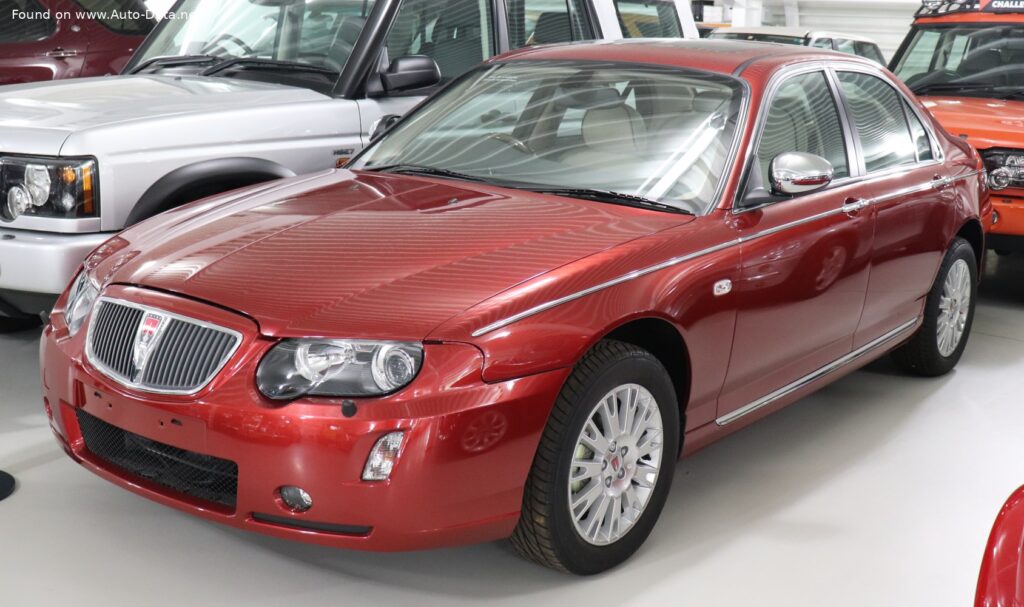
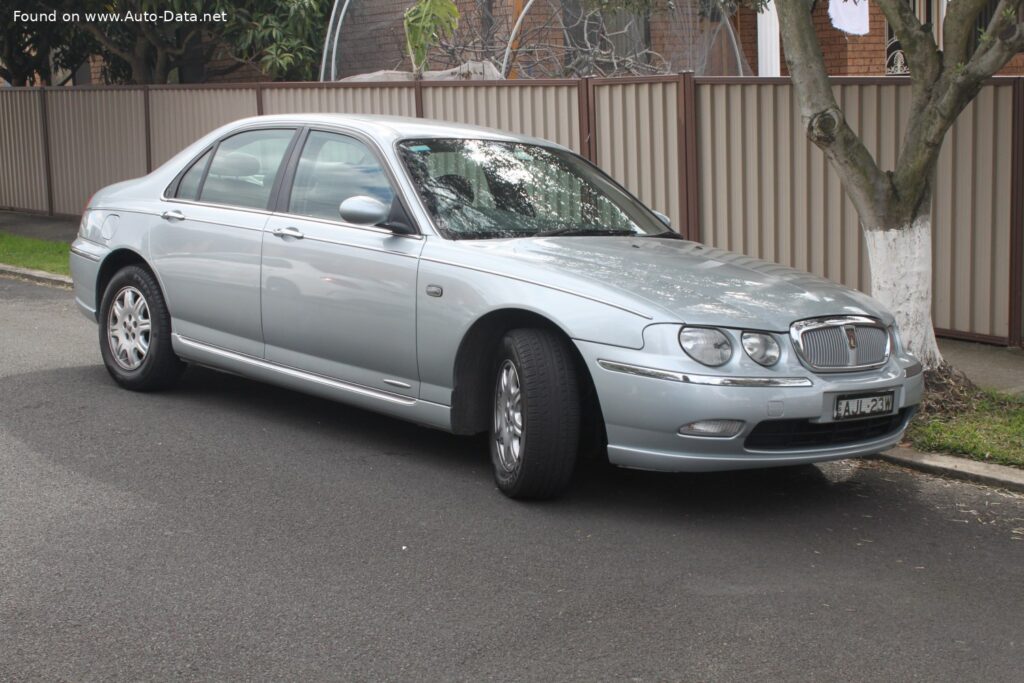
The design of the Rover 75 was one of its most distinctive attributes. It was a four-door sedan, designed to comfortably seat five occupants, and it exuded a timeless, retro-futuristic aesthetic that paid homage to classic British luxury cars of the 1940s and 1950s, while incorporating modern touches. Its long hood, short trunk, and elegant chrome detailing, including the distinctive “wavy grille,” gave it a unique identity in a market increasingly dominated by more aggressive, contemporary designs. With an overall length of 186.89 inches, a width of 70 inches, and a height of 56.06 inches, it had a substantial road presence, further accentuated by its 108.11-inch wheelbase, which contributed to a spacious and comfortable cabin.
The interior of the Rover 75 was crafted to evoke a sense of traditional British luxury. High-quality materials, often featuring wood and chrome accents, created an inviting and sophisticated ambiance. The dashboard design was elegant and uncluttered, with clear instrumentation. Comfort was a priority, with well-cushioned seats and a refined ride quality achieved through its suspension setup, which comprised a wishbone system at the front and coil springs at the rear. The hydraulic rack and pinion steering provided a communicative and precise feel, enhancing the driving experience.
For its era, the Rover 75 incorporated essential safety and convenience features. Standard equipment included an Anti-lock Braking System (ABS), which was crucial for maintaining control during emergency braking. The braking system itself featured ventilated discs at the front and solid discs at the rear, providing reliable stopping power. The trunk offered a practical 15.26 cubic feet (432 liters) of cargo space, suitable for executive travel or family use. The vehicle rode on 195/65 R15 tires, a size that balanced comfort with handling characteristics.
Technical Specifications: Rover 75 2.0 CDT (115 Hp)
| Category | Specification |
|---|---|
| Brand | Rover |
| Model | 75 |
| Generation | 75 |
| Type (Engine) | 2.0 CDT (115 Hp) |
| Start of Production | 1999 year |
| End of Production | 2004 year |
| Powertrain Architecture | Internal Combustion engine |
| Body Type | Sedan |
| Seats | 5 |
| Doors | 4 |
| Performance Specifications | |
| Fuel Consumption (Urban) | 7.7 l/100 km (30.5 US mpg) |
| Fuel Consumption (Extra Urban) | 4.7 l/100 km (50 US mpg) |
| Fuel Consumption (Combined) | 5.8 l/100 km (40.6 US mpg) |
| CO2 Emissions | 163 g/km |
| Fuel Type | Diesel |
| Acceleration 0 – 60 mph | 11.1 sec |
| Acceleration 0 – 62 mph (0-100 km/h) | 11.7 sec |
| Maximum Speed | 119.92 mph (193 km/h) |
| Weight-to-Power Ratio | 12.9 kg/Hp (77.4 Hp/tonne) |
| Weight-to-Torque Ratio | 5.7 kg/Nm (175.1 Nm/tonne) |
| Engine Specifications | |
| Power | 115 Hp @ 4000 rpm |
| Power per Liter | 58.9 Hp/l |
| Torque | 191.77 lb.-ft. (260 Nm) @ 2000 rpm |
| Engine Layout | Front, Transverse |
| Engine Model/Code | M47R / 204D2 |
| Engine Displacement | 119.06 cu. in. (1951 cm³) |
| Number of Cylinders | 4 |
| Engine Configuration | Inline |
| Cylinder Bore | 3.31 in. (84 mm) |
| Piston Stroke | 3.46 in. (88 mm) |
| Compression Ratio | 18:1 |
| Number of Valves per Cylinder | 4 |
| Fuel Injection System | Diesel Commonrail |
| Engine Aspiration | Turbocharger |
| Valvetrain | DOHC |
| Engine Oil Capacity | 7.19 US qt (6.8 l) |
| Coolant Capacity | 8.66 US qt (8.2 l) |
| Space, Volume, and Weights | |
| Kerb Weight | 3273.86 lbs. (1485 kg) |
| Max. Weight (Gross Vehicle Weight) | 4475.38 lbs. (2030 kg) |
| Max Load | 1201.52 lbs. (545 kg) |
| Trunk (Boot) Space – Maximum | 15.26 cu. ft. (432 l) |
| Fuel Tank Capacity | 17.17 US gal (65 l) |
| Dimensions | |
| Length | 186.89 in. (4747 mm) |
| Width | 70 in. (1778 mm) |
| Height | 56.06 in. (1424 mm) |
| Wheelbase | 108.11 in. (2746 mm) |
| Front Track | 59.25 in. (1505 mm) |
| Rear (Back) Track | 59.25 in. (1505 mm) |
| Drivetrain, Brakes, and Suspension Specifications | |
| Drivetrain Architecture | Front-wheel drive, Internal Combustion engine |
| Drive Wheel | Front wheel drive |
| Number of Gears and Type of Gearbox | 5 gears, manual transmission |
| Front Suspension | Wishbone |
| Rear Suspension | Coil spring |
| Front Brakes | Ventilated discs |
| Rear Brakes | Disc |
| Assisting Systems | ABS (Anti-lock braking system) |
| Steering Type | Steering rack and pinion |
| Power Steering | Hydraulic Steering |
| Tires Size | 195/65 R15 |
Legacy and Market Impact: The End of an Era
The Rover 75 occupied a unique position in the European automotive landscape. It competed against established rivals like the Ford Mondeo and Vauxhall Vectra in the mainstream executive segment, while also attempting to offer a more traditional, “premium” alternative to the likes of the BMW 3-Series, Audi A4, and Mercedes-Benz C-Class. Its distinct styling and focus on comfort and refinement earned it a loyal following, particularly among those who appreciated its classic British charm and understated luxury. The diesel variants, like the 2.0 CDT, were especially popular in markets like the UK, Germany, and Italy, where their efficiency and torque characteristics were highly valued.
Despite critical acclaim for its ride quality, interior ambiance, and sophisticated design, the Rover 75 faced an uphill battle. Launched shortly after BMW acquired Rover Group, and later produced under the struggling MG Rover Group, the 75 was burdened by the financial instability and eventual demise of its parent company. Its reputation for quality was often overshadowed by the broader perception of Rover’s reliability issues, even though the 75 itself was a well-engineered vehicle, especially with its BMW-derived diesel engine.
The 75’s legacy is complex. It is widely regarded as one of the best cars Rover ever produced, a genuine attempt to revive the brand’s fortunes. It showcased what British design and engineering could achieve, especially when paired with robust German components. Its distinctive “retro” styling, initially controversial, has aged gracefully, making it a modern classic for many enthusiasts. The platform also spawned the sportier MG ZT, demonstrating the versatility of its underpinnings. Ultimately, the Rover 75 stands as a poignant reminder of a bygone era for the British automotive industry, a testament to a brand that, despite its challenges, delivered a truly unique and characterful executive sedan before fading into history.