The Rover 75 (facelift 2004) 2.5 V6 Automatic: An Expert Overview
The Rover 75 (facelift 2004) represents a significant, albeit late-stage, chapter in the history of the British automotive marque, Rover. Launched initially in 1998, the Rover 75 was conceived during Rover’s ownership by BMW, aiming to combine traditional British luxury and styling with German engineering prowess. The facelifted model, introduced in 2004, sought to modernize its appeal while retaining the distinctive “retro-modern” aesthetic that had defined its earlier iteration. This particular variant, equipped with the 2.5-liter V6 engine and an automatic transmission, was positioned as a premium offering in the mid-size executive sedan segment in its primary markets, predominantly Europe and other Commonwealth nations. It was never officially sold in the United States, making its role within the European automotive landscape particularly noteworthy as a final attempt to revitalize the struggling Rover brand.
The Rover 75 (facelift 2004) aimed to compete with established players from Germany and Sweden, offering a unique blend of comfort, refinement, and a distinctly British character. Despite its relatively short production run from 2004 until Rover’s collapse in 2005, the facelifted 75 served as a testament to the engineering and design capabilities that still existed within the company, even during its most challenging period. It was a car that prioritized passenger comfort and a smooth driving experience over outright sporty dynamics, a characteristic that endeared it to a specific segment of buyers seeking a more traditional, understated form of luxury.
Engine and Performance: The KV6 Heart of the Rover 75 (facelift 2004)
Under the hood of the Rover 75 (facelift 2004) 2.5 V6 Automatic lay the much-praised KV6 engine, a 2.5-liter (2497 cm³ or 152.38 cu. in.) naturally aspirated V-engine. This powerplant was renowned for its smoothness and refinement, attributes perfectly aligned with the Rover 75’s executive cruiser persona. Delivering a respectable 177 horsepower at 6500 rpm and 177.01 lb.-ft. (240 Nm) of torque at 4000 rpm, the engine provided ample power for comfortable highway cruising and confident overtaking.
The KV6 engine featured a DOHC (Double Overhead Camshaft) valvetrain with four valves per cylinder, ensuring efficient breathing and a broad powerband. Its multi-port manifold injection system provided precise fuel delivery, contributing to both performance and a relatively smooth power delivery. Paired exclusively with a 5-speed automatic transmission, this drivetrain architecture emphasized effortless driving. The engine was transversely mounted, driving the front wheels, a common configuration for front-wheel-drive sedans in this class.
Performance figures for this variant were competitive for its segment and era, especially given its focus on comfort rather than raw speed. The Rover 75 (facelift 2004) could accelerate from 0 to 60 mph in 8.9 seconds and achieve a maximum speed of 133.59 mph (215 km/h). Fuel economy, while not segment-leading, was acceptable for a large V6 automatic sedan of its time. The combined fuel consumption was rated at 22.4 US mpg (10.5 l/100 km), with extra-urban figures reaching 31.4 US mpg (7.5 l/100 km) and urban consumption at 15.2 US mpg (15.5 l/100 km). The vehicle complied with the Euro 3 emission standard, reflecting the environmental regulations of its time.
Design and Features: Classic British Elegance Meets Practicality
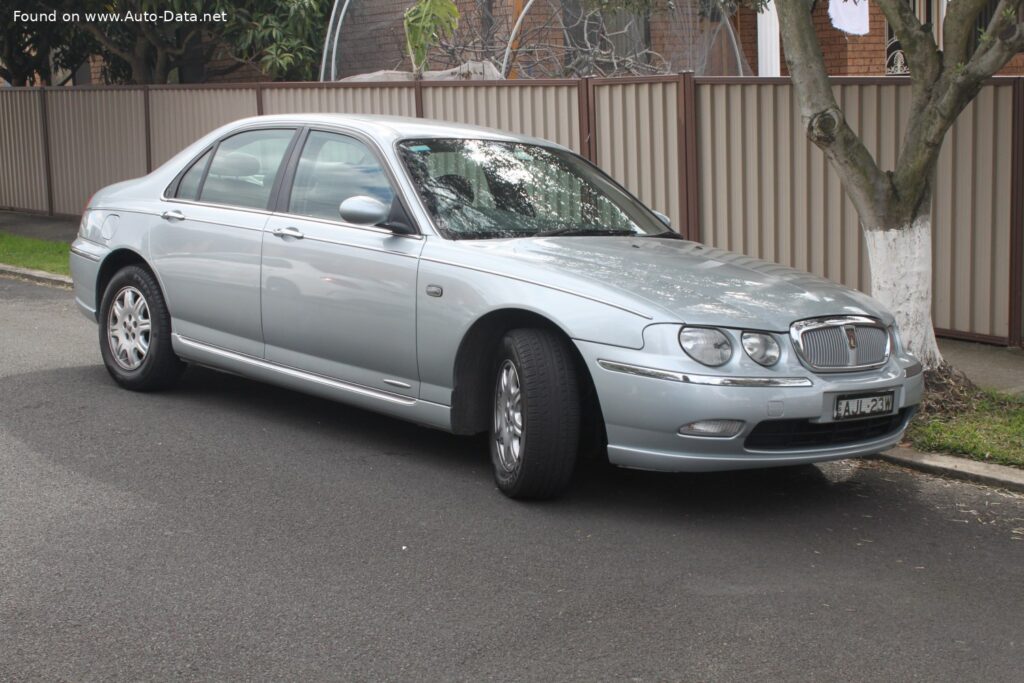
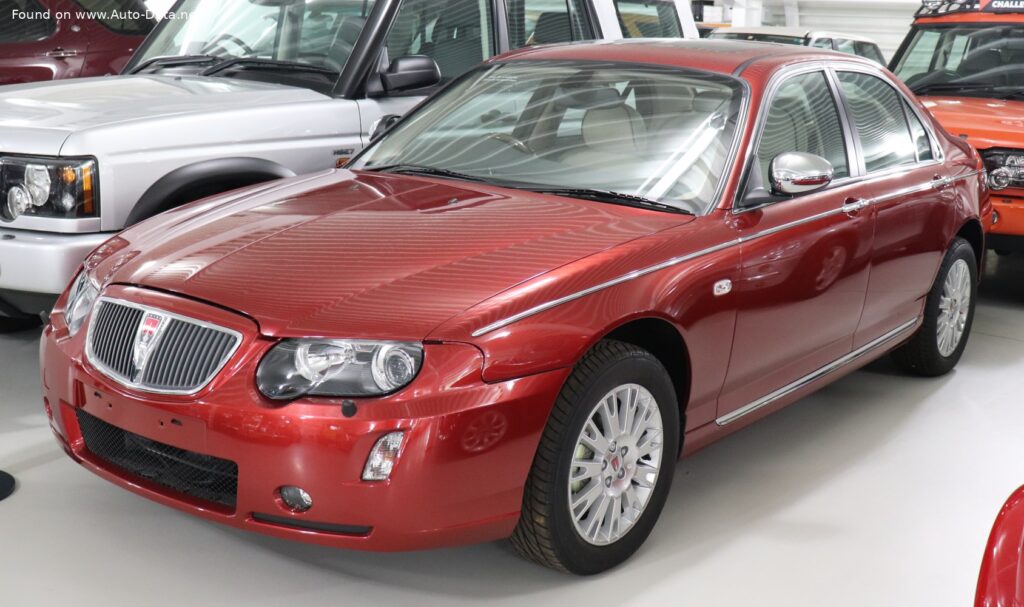
The Rover 75 (facelift 2004) retained the distinctive four-door sedan body style that had garnered praise for its elegant, albeit polarizing, design. Measuring 186.97 inches (4749 mm) in length, 70 inches (1778 mm) in width, and 54.84 inches (1393 mm) in height, it presented a substantial yet graceful presence on the road. The facelift introduced subtle changes, including revised headlamps, a new grille, and updated bumpers, which aimed to give the car a more contemporary look without abandoning its original character. The interior, known for its comfortable seating for five and generous use of high-quality materials, continued to be a strong selling point. Wood trim, chrome accents, and soft-touch plastics created an inviting and upscale cabin ambiance, reminiscent of traditional British luxury cars.
Practicality was also a key consideration. The trunk offered a respectable 15.26 cu. ft. (432 liters) of cargo space, expandable to 23.8 cu. ft. (674 liters) with the rear seats folded, providing ample room for luggage or groceries. The Rover 75 (facelift 2004) also boasted a significant towing capacity, with a permitted trailer load of 3527.4 lbs. (1600 kg) with brakes, underscoring its versatility.
In terms of chassis and safety, the Rover 75 was well-equipped for its era. It featured an independent suspension setup, with McPherson struts at the front and a sophisticated multi-link system at the rear, both complemented by anti-roll bars. This configuration provided a comfortable ride quality, effectively soaking up road imperfections while maintaining stable handling. Braking duties were handled by ventilated discs at the front and solid discs at the rear, augmented by an Anti-lock Braking System (ABS) for enhanced safety and control during emergency stops. The hydraulic power steering, utilizing a rack and pinion system, offered a smooth and precise feel, contributing to the car’s refined driving experience. Standard tire sizes were 215/55 R16, with 215/50 R17 available on larger wheel rims, providing a good balance of grip and ride comfort.
Technical Specifications
| Category | Specification |
|---|---|
| Brand | Rover |
| Model | 75 (facelift 2004) |
| Type (Engine) | 2.5 V6 (177 Hp) Automatic |
| Start of Production | 2004 year |
| End of Production | 2005 year |
| Body Type | Sedan |
| Seats | 5 |
| Doors | 4 |
Performance Specs |
|
| Fuel Consumption (Urban) | 15.5 l/100 km (15.2 US mpg) |
| Fuel Consumption (Extra Urban) | 7.5 l/100 km (31.4 US mpg) |
| Fuel Consumption (Combined) | 10.5 l/100 km (22.4 US mpg) |
| CO2 Emissions | 249 g/km |
| Fuel Type | Petrol (Gasoline) |
| Acceleration 0 – 60 mph | 8.9 sec |
| Maximum Speed | 133.59 mph (215 km/h) |
| Emission Standard | Euro 3 |
| Weight-to-Power Ratio | 8.5 kg/Hp (117.6 Hp/tonne) |
| Weight-to-Torque Ratio | 6.3 kg/Nm (159.5 Nm/tonne) |
Engine Specs |
|
| Power | 177 Hp @ 6500 rpm |
| Power per Liter | 70.9 Hp/l |
| Torque | 177.01 lb.-ft. (240 Nm) @ 4000 rpm |
| Engine Layout | Front, Transverse |
| Engine Model/Code | KV6 / 25K4F |
| Engine Displacement | 2497 cm³ (152.38 cu. in.) |
| Number of Cylinders | 6 |
| Engine Configuration | V-engine |
| Cylinder Bore | 3.15 in. (80 mm) |
| Piston Stroke | 3.26 in. (82.8 mm) |
| Compression Ratio | 10.25:1 |
| Number of Valves per Cylinder | 4 |
| Fuel Injection System | Multi-port manifold injection |
| Engine Aspiration | Naturally aspirated engine |
| Valvetrain | DOHC |
| Engine Oil Capacity | 5.2 l (5.49 US qt) |
| Coolant Capacity | 7.5 l (7.93 US qt) |
Space, Volume and Weights |
|
| Kerb Weight | 3317.96 – 3582.51 lbs. (1505-1625 kg) |
| Max. Weight | 4409.25 lbs. (2000 kg) |
| Max Load | 826.73 – 1091.29 lbs. (375-495 kg) |
| Trunk (Boot) Space – Minimum | 15.26 cu. ft. (432 l) |
| Trunk (Boot) Space – Maximum | 23.8 cu. ft. (674 l) |
| Fuel Tank Capacity | 17.17 US gal (65 l) |
| Max. Roof Load | 176.37 lbs. (80 kg) |
| Permitted Trailer Load with Brakes (12%) | 3527.4 lbs. (1600 kg) |
| Permitted Trailer Load without Brakes | 1653.47 lbs. (750 kg) |
| Permitted Towbar Download | 220.46 lbs. (100 kg) |
Dimensions |
|
| Length | 186.97 in. (4749 mm) |
| Width | 70 in. (1778 mm) |
| Width Including Mirrors | 77.56 in. (1970 mm) |
| Height | 54.84 in. (1393 mm) |
| Wheelbase | 108.11 in. (2746 mm) |
| Front Track | 59.49 in. (1511 mm) |
| Rear (Back) Track | 59.21 in. (1504 mm) |
| Front Overhang | 36.02 in. (915 mm) |
| Rear Overhang | 42.8 in. (1087 mm) |
| Minimum Turning Circle (Turning Diameter) | 37.17 ft. (11.33 m) |
Drivetrain, Brakes and Suspension Specs |
|
| Drivetrain Architecture | Front wheel drive, Internal Combustion engine |
| Drive Wheel | Front wheel drive |
| Number of Gears and Type of Gearbox | 5 gears, automatic transmission |
| Front Suspension | Independent, type McPherson with coil spring and anti-roll bar |
| Rear Suspension | Independent multi-link spring suspension with stabilizer |
| Front Brakes | Ventilated discs |
| Rear Brakes | Disc |
| Assisting Systems | ABS (Anti-lock braking system) |
| Steering Type | Steering rack and pinion |
| Power Steering | Hydraulic Steering |
| Tires Size | 215/55 R16; 215/50 R17 |
| Wheel Rims Size | 16; 17 |
Legacy and Market Impact of the Rover 75 (facelift 2004)
The Rover 75 (facelift 2004) arrived at a tumultuous time for the Rover Group. Despite its inherent qualities, the car faced an uphill battle against deeply entrenched German rivals like the BMW 3 Series, Audi A4, and Mercedes-Benz C-Class, as well as strong offerings from Volvo (S60) and Saab (9-3) in the European executive segment. Its distinct styling, which blended classic British automotive cues with modern lines, was both its strength and its weakness; it appealed to those seeking something different from the ubiquitous German executive cars but could deter others looking for a more contemporary or aggressive aesthetic.
The car’s reputation was built on its exceptional ride comfort, quiet cabin, and overall refinement. The 2.5 V6 engine, in particular, contributed significantly to this perception of luxury and effortless progress. Its interior quality and traditional ambiance often drew comparisons to more expensive vehicles, offering a compelling value proposition for buyers in its home market and across Europe. However, the overarching corporate instability of Rover, which culminated in its administration in 2005, cast a long shadow over the 75’s market performance. Issues surrounding brand perception, perceived reliability (which was often better than the brand’s reputation suggested), and the lack of a strong dealer network outside its core markets hindered its broader success.
In hindsight, the Rover 75 (facelift 2004) stands as one of the last truly British-designed and built executive sedans. It represented a valiant effort by Rover to reclaim its position as a purveyor of refined, comfortable, and stylish automobiles. Today, it holds a niche appeal as a modern classic, particularly among enthusiasts who appreciate its unique character, comfortable ride, and the engineering efforts that went into its development. Its legacy is one of a well-engineered car that, despite its qualities, could not overcome the financial and corporate challenges of its parent company, ultimately becoming a poignant symbol of the end of an era for the British automotive industry.