The Rover 75 Tourer (facelift 2004) 1.8 (120 Hp): A Refined British Estate
The Rover 75 Tourer (facelift 2004) 1.8 (120 Hp) represents a significant, albeit late-stage, chapter in the storied history of the British Rover marque. Unveiled in 2004, this refreshed iteration of the 75 Tourer (station wagon, or estate as it’s known in Europe) aimed to bolster the appeal of Rover’s executive segment offering. Positioned as a mid-size luxury vehicle, the Rover 75 was designed to evoke classic British motoring heritage while offering modern comfort and refinement. While never officially sold in the United States, the 75 Tourer played a crucial role in its primary European market, competing against established German and Swedish rivals by emphasizing a unique blend of traditional luxury, distinctive styling, and a comfortable ride. This particular variant, equipped with the 1.8-liter petrol engine, offered a balance of performance and efficiency for its target demographic.
Evolution and Market Positioning
The original Rover 75 debuted in 1998, developed under BMW ownership. It quickly garnered praise for its retro-modern styling, which cleverly blended classic Rover cues with contemporary design elements. The Tourer variant, introduced later, added practicality and versatility to the luxurious sedan platform. The 2004 facelift, applied to both sedan and Tourer models, was a subtle but important update. It sought to modernize the car’s aesthetics to keep pace with evolving design trends, featuring revised headlights, grille, and bumper designs that gave it a slightly more assertive and contemporary appearance. Despite these updates, the core philosophy remained: a comfortable, well-appointed vehicle offering a distinct alternative to the more Teutonic offerings from BMW, Mercedes-Benz, and Audi, or the more mainstream Ford Mondeo and Opel Vectra in Europe. The 1.8-liter engine variant was typically positioned as an entry to mid-range option, appealing to buyers seeking a refined driving experience without the higher running costs associated with larger engines or diesel alternatives.
Engine & Performance of the Rover 75 Tourer (facelift 2004) 1.8 (120 Hp)
Powering this iteration of the Rover 75 Tourer (facelift 2004) 1.8 (120 Hp) is a naturally aspirated 1.8-liter (1796 cm³ or 109.6 cu. in.) inline four-cylinder petrol engine, designated by the code 18K4F. This powerplant, a familiar unit within the Rover and MG Rover lineup, was known for its smooth operation and adequate, if not exhilarating, performance for the vehicle’s executive cruiser aspirations. The engine features a Double Overhead Camshaft (DOHC) valvetrain with 4 valves per cylinder, optimizing airflow for combustion and contributing to its respectable power output.
The engine produces 120 horsepower (Hp) at 5500 revolutions per minute (rpm), with a power per liter rating of 66.8 Hp/l. Torque peaks at 160 Newton-meters (Nm), or 118.01 lb.-ft., delivered at 4000 rpm. This torque figure, while not segment-leading, was sufficient for comfortable cruising and urban maneuverability. Power is transmitted to the front wheels via a 5-speed manual transmission, a common choice for its direct feel and efficiency. The powertrain architecture is a conventional front, transverse engine layout, driving the front wheels.
In terms of performance, the Rover 75 Tourer 1.8 (120 Hp) accelerates from 0 to 60 mph in 11.4 seconds, a leisurely but acceptable pace for a vehicle focused more on comfort than outright speed. Its maximum speed is rated at 116.82 mph (188 km/h). Fuel economy, a key consideration for many European buyers, was a combined 30.2 US mpg (7.8 l/100 km). Urban consumption stood at 22.2 US mpg (10.6 l/100 km), while extra-urban driving yielded 38.6 US mpg (6.1 l/100 km). These figures were competitive for its class at the time, particularly given the car’s weight, which ranged from 3218.75 to 3450.23 lbs (1460-1565 kg) curb weight. The vehicle met Euro 3 emission standards, with CO2 emissions of 184 g/km. The engine’s compression ratio was 10.5:1, and it utilized a multi-port manifold injection system, indicating a conventional but reliable approach to fuel delivery.
Design & Features
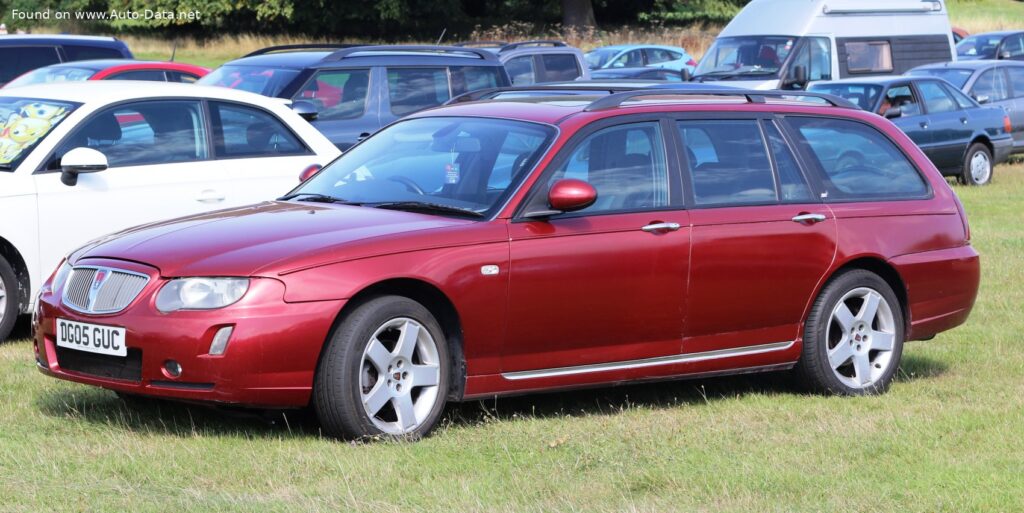
The Rover 75 Tourer (facelift 2004) maintained the elegant and distinctive styling that characterized the original 75, with the facelift bringing subtle enhancements. The body type is a 5-door station wagon (estate), offering enhanced practicality and cargo capacity compared to its sedan counterpart. Its exterior dimensions, with a length of 188.58 inches (4790 mm), a width of 70 inches (1778 mm), and a wheelbase of 108.11 inches (2746 mm), placed it firmly in the European mid-size executive segment. The refreshed design introduced redesigned headlights, a more prominent grille, and updated bumpers, aiming for a more contemporary and less overtly retro aesthetic. Despite these changes, the 75 retained its characteristic chrome accents, long hood, and flowing lines, projecting an image of understated British luxury.
Inside, the Rover 75 Tourer was renowned for its comfortable and well-appointed cabin. The interior design continued the classic theme, featuring high-quality materials, often including wood veneers and chrome accents, creating a warm and inviting atmosphere. Seating for five passengers was standard, with a focus on ride comfort, particularly for long journeys. The Tourer’s primary advantage was its versatile cargo space, offering a minimum of 14.13 cubic feet (400 liters) with all seats in place, expanding to a generous 43.15 cubic feet (1222 liters) with the rear seats folded. This made it a highly practical choice for families or those needing significant luggage capacity.
Key features for the era included a comprehensive safety package, with Anti-lock Braking System (ABS) as a standard assisting system. The drivetrain architecture featured front-wheel drive, a common and efficient layout for this class of vehicle. Steering was a hydraulic rack and pinion system, providing a traditional, communicative feel that many enthusiasts preferred over early electric power steering systems. The suspension setup was designed for comfort and stability: an independent McPherson strut system with coil springs and an anti-roll bar at the front, and an independent multi-link spring suspension with a stabilizer bar at the rear. Braking was handled by ventilated discs at the front and solid discs at the rear, offering confident stopping power. Various tire and wheel options were available, ranging from 195/65 R15 to 215/55 R16, mounted on 15-inch or 16-inch alloy rims.
Technical Specifications: Rover 75 Tourer (facelift 2004) 1.8 (120 Hp)
| Category | Specification |
|---|---|
| Brand | Rover |
| Model | 75 |
| Generation | 75 Tourer (facelift 2004) |
| Engine Type | 1.8 (120 Hp) |
| Production Start | 2004 |
| Production End | 2005 |
| Powertrain Architecture | Internal Combustion Engine |
| Body Type | Station wagon (estate), 5 Doors, 5 Seats |
| Fuel Consumption (Urban) | 10.6 l/100 km (22.2 US mpg) |
| Fuel Consumption (Extra-Urban) | 6.1 l/100 km (38.6 US mpg) |
| Fuel Consumption (Combined) | 7.8 l/100 km (30.2 US mpg) |
| CO2 Emissions | 184 g/km (Euro 3) |
| Fuel Type | Petrol (Gasoline) |
| Acceleration 0-60 mph | 11.4 seconds |
| Maximum Speed | 116.82 mph (188 km/h) |
| Power | 120 Hp @ 5500 rpm |
| Power per Liter | 66.8 Hp/l |
| Torque | 160 Nm (118.01 lb.-ft.) @ 4000 rpm |
| Engine Layout | Front, Transverse |
| Engine Model/Code | 18K4F |
| Engine Displacement | 1796 cm³ (109.6 cu. in.) |
| Number of Cylinders | 4, Inline |
| Cylinder Bore | 80 mm (3.15 in.) |
| Piston Stroke | 89.3 mm (3.52 in.) |
| Compression Ratio | 10.5:1 |
| Valves per Cylinder | 4 |
| Fuel Injection System | Multi-port manifold injection |
| Engine Aspiration | Naturally aspirated |
| Valvetrain | DOHC |
| Engine Oil Capacity | 4.5 l (4.76 US qt) |
| Coolant Capacity | 6.2 l (6.55 US qt) |
| Kerb Weight | 1460-1565 kg (3218.75 – 3450.23 lbs.) |
| Maximum Weight (GVWR) | 1980 kg (4365.15 lbs.) |
| Maximum Load | 415-520 kg (914.92 – 1146.4 lbs.) |
| Trunk Space (Minimum) | 400 l (14.13 cu. ft.) |
| Trunk Space (Maximum) | 1222 l (43.15 cu. ft.) |
| Fuel Tank Capacity | 65 l (17.17 US gal) |
| Maximum Roof Load | 100 kg (220.46 lbs.) |
| Permitted Trailer Load (with brakes) | 1200 kg (2645.55 lbs.) |
| Permitted Trailer Load (without brakes) | 750 kg (1653.47 lbs.) |
| Permitted Towbar Download | 100 kg (220.46 lbs.) |
| Length | 4790 mm (188.58 in.) |
| Width | 1778 mm (70 in.) |
| Width Including Mirrors | 1970 mm (77.56 in.) |
| Wheelbase | 2746 mm (108.11 in.) |
| Front Track | 1511 mm (59.49 in.) |
| Rear Track | 1504 mm (59.21 in.) |
| Minimum Turning Circle | 11.33 m (37.17 ft.) |
| Drive Wheel | Front-wheel drive |
| Gearbox | 5 gears, Manual transmission |
| Front Suspension | Independent, McPherson with coil spring and anti-roll bar |
| Rear Suspension | Independent multi-link spring suspension with stabilizer |
| Front Brakes | Ventilated discs |
| Rear Brakes | Disc |
| Assisting Systems | ABS (Anti-lock braking system) |
| Steering Type | Steering rack and pinion |
| Power Steering | Hydraulic Steering |
| Tire Sizes | 195/65 R15; 205/60 R15; 215/55 R16 |
| Wheel Rim Sizes | 6J x 15; 6.5J x 16 |
Legacy & Market Impact
The Rover 75 Tourer (facelift 2004) 1.8 (120 Hp) holds a somewhat bittersweet place in automotive history. It was one of the final models produced by the MG Rover Group before its collapse in 2005, making it a poignant symbol of the end of an era for a venerable British automaker. In its primary European market, the Rover 75, particularly in Tourer guise, carved out a niche for itself as an executive car that offered a distinct alternative to the dominant German premium brands. While it couldn’t match the dynamic performance or cutting-edge technology of a BMW 3 Series Touring or an Audi A4 Avant, nor the sheer prestige of a Mercedes-Benz C-Class Estate, the Rover 75 excelled in its own right.
Its reputation was built on its exceptional ride comfort, quiet cabin, and a sense of “olde world” British charm that resonated with a segment of buyers. The styling, with its neo-classical elements, was polarizing but ultimately distinctive, allowing it to stand out in a crowded market. Competitors in its segment included not only the aforementioned German rivals but also the Volvo V50, Saab 9-3 SportCombi, and more mainstream but well-equipped options like the Ford Mondeo Estate and Volkswagen Passat Variant. The Rover 75 Tourer offered a more luxurious and refined experience than the latter, often at a more accessible price point than the former.
The 1.8-liter engine variant was a popular choice, offering a good balance of running costs and performance for everyday use. While it lacked the punch of the V6 or the efficiency of the diesel engines also available in the 75 range, it provided a smooth and adequate driving experience for its intended purpose. The facelift in 2004 was an attempt to inject new life into the model, addressing some criticisms about its slightly dated original styling and aiming to broaden its appeal. However, these efforts were ultimately overshadowed by the severe financial difficulties plaguing MG Rover Group.
Today, the Rover 75 Tourer is remembered as one of the last truly “British” executive cars, embodying a specific philosophy of luxury and comfort. Its historical significance lies in its role as the final flagship passenger car for Rover and a testament to the engineering and design capabilities that existed within the company, even in its twilight years. While its market impact was limited by the company’s fate, it remains appreciated by enthusiasts for its unique character, comfortable ride, and timeless design. It stands as a reminder of what Rover aspired to be in the modern era, a blend of heritage and contemporary refinement, even as the brand itself faded into history.