
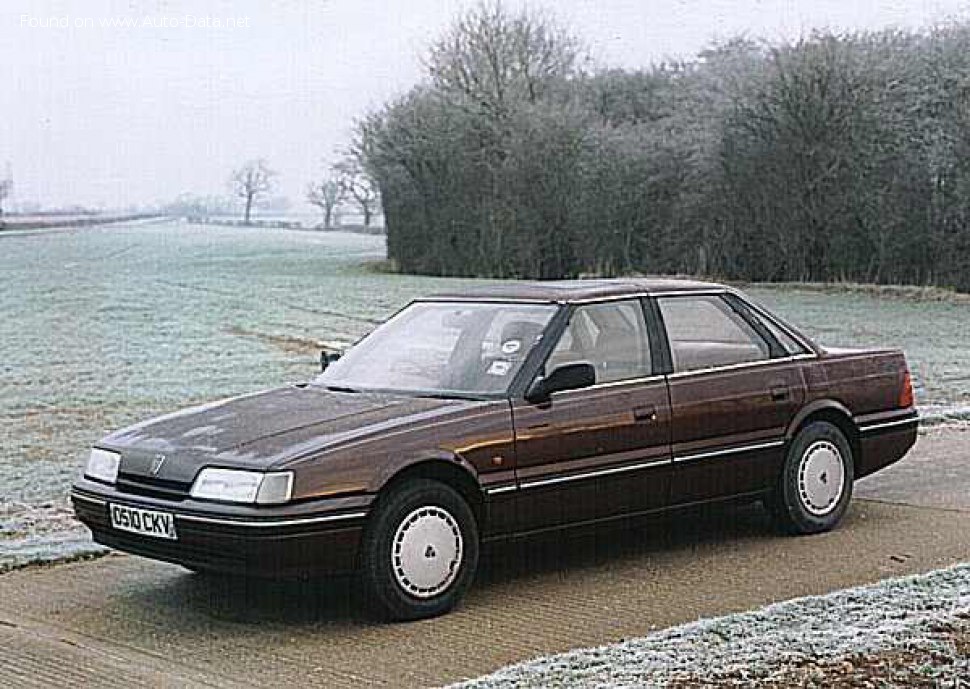
In the annals of North American automotive history, certain vehicles arrive with grand ambitions, only to leave a complex, often debated, legacy. The Rover 800 series, a joint venture between the British Leyland (later Rover Group) and Honda, represents one such fascinating chapter. While known across the pond simply as the Rover 800, this executive sedan made its way to the United States and Canada under the short-lived Sterling brand, aiming to carve out a niche in the burgeoning luxury import market of the late 1980s. The Rover 800 820 16 V I/SI (XS) (140 Hp) Automatic, a key variant of the first-generation platform, embodies the engineering spirit and design philosophy that sought to blend British elegance with Japanese reliability, even if its North American counterpart ultimately struggled to deliver on the latter.
The Genesis of the Rover 800 Series
The Rover 800, internally codenamed “Project XX,” was a crucial car for Rover Group, marking a strategic partnership with Honda that also yielded the Acura Legend (Honda’s “Project HX”). Launched in 1986, the 800 was designed to replace the aging Rover SD1 and compete in the highly competitive executive car segment against established German rivals such as the BMW 5 Series and Mercedes-Benz W124, as well as Swedish contenders like the Saab 9000 and Volvo 700 series. Its sleek, contemporary design and advanced engineering, particularly its sophisticated suspension and choice of powertrains, initially garnered praise across Europe. While North American Sterlings primarily featured Honda V6 engines, the 820 16V I/SI (XS) model, with its Rover-developed M16i four-cylinder engine, was a cornerstone of the European lineup, offering a blend of performance and efficiency more suited to the diverse taxation and fuel cost landscapes of its primary markets.
The Development Partnership with Honda
The collaboration between Rover and Honda was a significant undertaking, born out of necessity for Rover Group, which was struggling financially. Honda provided not only the platform architecture but also significant engineering input, especially in areas like chassis design, electronics, and manufacturing processes. This partnership was intended to elevate Rover’s engineering standards and improve its reputation for reliability, while also giving Honda a foothold in the European executive car market. The resulting Rover 800 and Honda Legend (Acura Legend in North America) shared core components, including the floorpan, suspension geometry, and much of the electrical architecture, but diverged significantly in styling, interior design, and powertrain options, particularly in the lower-displacement variants like the 820.
The Rover 800 820 16 V I/SI (XS) (140 Hp) Automatic: Power and Poise
At the heart of the Rover 800 820 16 V I/SI (XS) (140 Hp) Automatic lay Rover’s M16i engine, a naturally aspirated 2.0-liter (1996 cm³ or 121.8 cu. in.) inline four-cylinder unit. This engine featured a modern Double Overhead Camshaft (DOHC) valvetrain with four valves per cylinder, a setup that was quite advanced for a mass-produced sedan in the mid-1980s. The multi-valve design allowed for improved breathing and combustion efficiency, contributing to both power output and fuel economy. Fuel was delivered via a multi-port manifold injection system, ensuring precise fuel metering and improved efficiency compared to carbureted predecessors, while also meeting increasingly stringent emissions regulations in Europe.
This sophisticated powerplant delivered a respectable 140 horsepower at 6000 rpm, translating to a power-per-liter output of 70.1 Hp/l, which was competitive for a non-turbocharged 2.0-liter engine of its era. Torque figures stood at 178 Nm (131.29 lb-ft) at 4500 rpm, providing a decent mid-range punch suitable for everyday driving and highway cruising. Paired with a 4-speed automatic transmission, the 820 16V I/SI (XS) was designed for smooth, effortless operation rather than outright acceleration. It could sprint from 0 to 60 mph in a leisurely 11.4 seconds, eventually reaching a top speed of 124 mph (200 km/h). While not a performance leader, its acceleration was adequate for its class, prioritizing refinement and comfort. Fuel economy, while not a primary selling point for executive cars, was reasonable for the era, with a combined rating of approximately 28.7 US mpg (8.2 l/100 km). The engine’s front, transverse layout and front-wheel-drive architecture were typical for its class, contributing to efficient packaging and predictable handling characteristics.
Design and Features of the Rover 800
The Rover 800 series, including the 820 variant, showcased a design language that was decidedly modern and international for its time. Penned by Rover’s Roy Axe, the exterior was sleek, aerodynamic, and understated, featuring clean lines and a low hood profile. It eschewed the more angular, boxy designs prevalent in some European and Japanese competitors, opting for a smoother, more sophisticated aesthetic that hinted at its luxury aspirations. The four-door sedan body style provided ample room for five occupants and a generous trunk space of 15.72 cu. ft. (445 liters), making it practical for executive travel and family use.
Inside, the Rover 800 aimed for a blend of traditional British luxury and contemporary ergonomics. Higher trim levels often featured wood veneer trim, plush seating (available in velour or leather), and a comprehensive array of power accessories. The dashboard layout was logical and driver-focused, with clear instrumentation. While the 820 I/SI (XS) was not the absolute top-tier model, it still offered a high level of standard equipment for its class in Europe, including power windows, central locking, power steering, and often air conditioning. The focus was on creating a comfortable and refined cabin environment, distinct from the more austere interiors of some German rivals.
Innovation and Safety for its Era
Innovation in the 800 series was a blend of British engineering and Honda’s influence. While the specific 820 model’s engine was Rover’s own, the platform itself benefited from Honda’s expertise in areas like suspension design, particularly the double wishbone front suspension, which provided excellent ride comfort and handling precision. The rack and pinion steering system, complemented by hydraulic power assist, offered good feedback and ease of maneuverability. Safety features, such as ventilated disc brakes at the front and solid disc brakes at the rear, were complemented by an Anti-lock Braking System (ABS), which was a significant safety innovation for a car of this class in the mid-1980s, greatly enhancing braking control in adverse conditions. The body structure, while not tested to modern crash standards, was designed with crumple zones and reinforced passenger cell to offer reasonable occupant protection for its time.
Technical Specifications
| Rover 800 820 16 V I/SI (XS) (140 Hp) Automatic (1986-1991) | |
|---|---|
| General Information | |
| Manufacturer | Rover Group |
| Model | 800 820 16 V I/SI (XS) |
| Generation | 1st Generation (XX) |
| Body Type | 4-door Sedan |
| Seating Capacity | 5 |
| Production Years | Circa 1986 – 1991 (for this specific variant) |
| Engine & Performance | |
| Engine Type | M16i, Inline 4-cylinder |
| Valvetrain | DOHC (Double Overhead Camshaft), 16 valves |
| Displacement | 1996 cm³ (121.8 cu. in.) |
| Horsepower | 140 Hp @ 6000 rpm |
| Torque | 178 Nm (131.29 lb-ft) @ 4500 rpm |
| Power per Liter | 70.1 Hp/l |
| Fuel System | Multi-point Injection |
| Fuel Type | Gasoline |
| 0-60 mph Acceleration | 11.4 seconds |
| Top Speed | 124 mph (200 km/h) |
| Drive Type | Front-wheel drive |
| Transmission | 4-speed Automatic |
| Fuel Economy | |
| Combined (European Cycle) | ~28.7 US mpg (8.2 l/100 km) |
| Chassis & Dimensions | |
| Front Suspension | Double Wishbone |
| Rear Suspension | Independent (typical for platform) |
| Front Brakes | Ventilated Discs |
| Rear Brakes | Discs |
| ABS | Yes |
| Steering | Rack and Pinion, Hydraulic Power Assist |
| Trunk Volume | 15.72 cu. ft. (445 liters) |
Legacy and Market Impact
The Rover 800 series, particularly its European variants like the 820, holds a unique position in automotive history. In its primary European market, the 800 initially enjoyed a strong reception, praised for its modern styling, comfortable ride, and sophisticated engineering that blended British character with Honda reliability. It was seen as a credible challenger to the established executive cars and played a vital role in Rover’s efforts to modernize its image and product lineup. However, over time, the reputation of the 800, even in Europe, began to suffer from perceived build quality issues and reliability concerns, particularly with some of the Rover-developed components, despite the Honda underpinnings. Competitors like the Audi 100/200, BMW 5 Series, and Mercedes-Benz W124 continued to set high benchmarks for refinement and durability, which the 800 struggled to consistently match.
In North America, the story of the Rover 800, sold as the Sterling 825 and 827, was far more tumultuous. Launched with high hopes in 1987, the Sterling brand aimed to compete with Acura, Lexus (which launched shortly after), and entry-level European luxury brands. While the cars offered appealing styling and a comfortable interior, they quickly gained a reputation for significant reliability problems, particularly with electrical systems and trim quality. These issues were exacerbated by a sparse dealer network and a limited understanding of American consumer expectations for luxury vehicles. The Sterling brand was ultimately withdrawn from the North American market in 1991, leaving behind a legacy of a promising concept marred by execution failures. This failure significantly damaged Rover’s perception in international markets and highlighted the challenges of launching a new luxury brand without robust quality control and after-sales support.
As a classic car, the Rover 800 series, particularly its European variants like the 820, holds a unique position. While not as universally sought after as some sports cars or more exotic luxury vehicles, it represents a pivotal moment in Rover’s history and Anglo-Japanese automotive collaboration. Its collectibility in North America is limited due to the Sterling’s poor reputation and scarcity, but in the UK and parts of Europe, well-preserved examples are appreciated by enthusiasts who value its historical significance, comfortable ride, and distinctive design. The 820 16V I/SI (XS) specifically offers a more economical and characterful alternative to the V6 models, showcasing Rover’s own engine development capabilities. The 800 series remains a fascinating case study in brand partnerships, market positioning, and the intricate balance between ambition and execution in the competitive automotive industry.
