
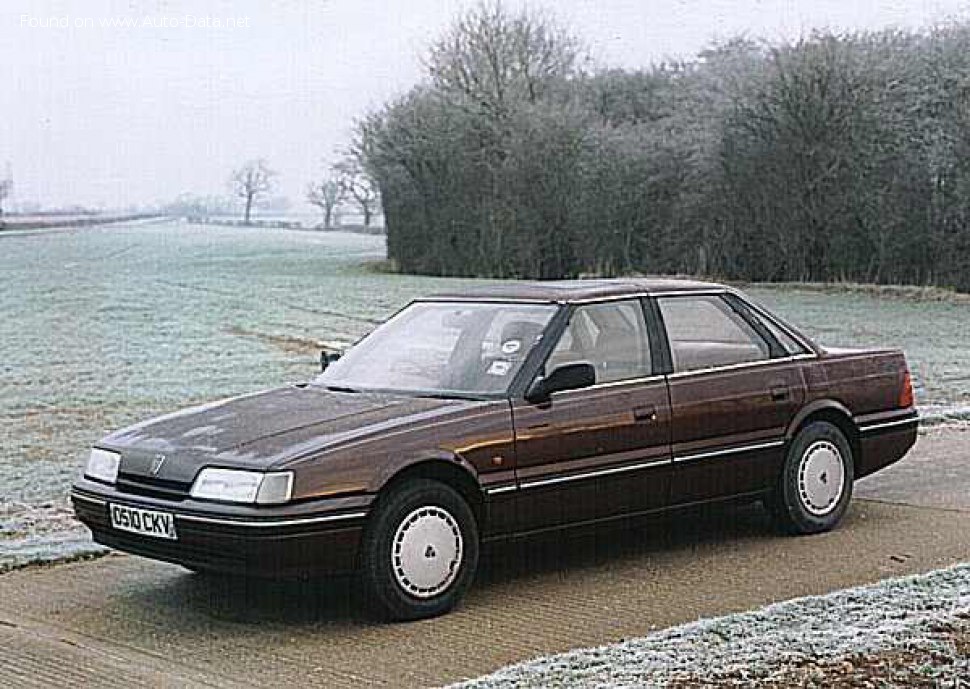
In the late 1980s and early 1990s, the automotive landscape in North America was a dynamic blend of domestic innovation and a growing influx of European and Asian luxury and performance vehicles. Amidst this competitive environment, the British marque Rover made a determined, if ultimately challenging, attempt to re-establish its presence with the Rover 800 series. Marketed in the United States and Canada as the Sterling 825 and later the Sterling 827, this executive sedan represented a bold Anglo-Japanese collaboration aimed at the discerning buyer. While the North American market received naturally aspirated V6 variants, across the Atlantic, Rover pushed the performance envelope with models like the Rover 800 820 16V Turbo (RS) (180 Hp), a potent four-cylinder turbocharged variant that showcased the company’s engineering prowess and offered a spirited alternative to the V6.
The Rover 800 Series: An Anglo-Japanese Executive Sedan
The Rover 800 series was the result of a significant collaboration between British Leyland (later Rover Group) and Honda, launched in 1986. Known internally as Project XX, it shared its platform with the Honda Legend (Acura Legend in North America). This partnership was crucial for Rover, providing access to modern engineering and manufacturing techniques, while Honda gained a foothold in the European executive car segment. The first generation of the 800 series, including the Sterling, aimed to blend traditional British luxury and styling with Honda’s renowned reliability and refinement.
By 1991, Rover introduced a significantly revised second generation of the 800, often referred to as the “R17” facelift. This update brought a more rounded, contemporary design, improved build quality, and a re-engineered interior. It was within this refreshed lineup that the high-performance Rover 800 820 16V Turbo (RS) (180 Hp) emerged, specifically from 1992 to 1999, targeting European drivers who desired a blend of executive comfort with accessible turbocharged power.
The Heart of the Beast: The Rover 800 820 16V Turbo (RS) (180 Hp)
At the core of the Rover 800 820 16V Turbo (RS) (180 Hp) was Rover’s own M16i engine, a 2.0-liter (1994 cm³ or 121.68 cu. in.) inline four-cylinder unit. Unlike its naturally aspirated siblings or the Honda-derived V6s, this engine featured a sophisticated DOHC (Double Overhead Camshaft) valvetrain with 4 valves per cylinder, coupled with a turbocharger and multi-port manifold injection. This advanced setup allowed the compact four-cylinder to punch well above its weight, delivering a robust 180 horsepower at 6000 rpm. Its power-per-liter figure stood at an impressive 90.3 Hp/l, highlighting the efficiency of its forced induction system.
Performance and Driving Dynamics
The turbocharged engine truly came alive with its torque delivery. It produced 216 Nm (159.31 lb.-ft.) of torque at a remarkably low 2000 rpm, ensuring brisk acceleration from a standstill and strong in-gear flexibility. This enabled the Rover 800 820 16V Turbo (RS) (180 Hp) to accelerate from 0 to 100 km/h (0-62 mph) in a respectable 8.6 seconds, and 0 to 60 mph in an estimated 8.2 seconds. Its top speed was rated at 220 km/h (136.7 mph), making it a capable performer on the open road.
Power was delivered to the front wheels via a precise 5-speed manual transmission, offering an engaging driving experience. The car’s weight-to-power ratio of 7.8 kg/Hp (129 Hp/tonne) and a weight-to-torque ratio of 6.5 kg/Nm (154.8 Nm/tonne) further underscored its performance credentials. The chassis featured a double wishbone front suspension and a coil spring rear suspension, designed to provide a balance of comfortable ride quality and composed handling. Ventilated discs at the front and disc brakes at the rear, complemented by an Anti-lock Braking System (ABS), ensured confident stopping power.
Design, Features, and Innovation of its Era
The Rover 800 820 16V Turbo (RS) (180 Hp), like other second-generation 800 series sedans, embodied an understated executive design language. Its smooth, rounded lines and dignified stance aimed for a sophisticated appeal. Inside, Rover continued its tradition of offering a luxurious cabin, typically featuring quality materials such as leather upholstery and wood trim, creating an environment that sought to rival more established German luxury brands.
For its time, the 800 series incorporated several innovative features. Beyond the advanced DOHC 16V turbocharged engine and multi-port fuel injection, standard equipment often included hydraulic power steering with a rack and pinion system, ensuring a comfortable and responsive steering feel. The presence of ABS was a significant safety feature for the early 1990s. While it predated modern infotainment and extensive ADAS systems, the Rover 800 offered a premium audio system and comfortable ergonomics, focusing on driver and passenger comfort for long journeys. The 205/55 R16 tires provided a good balance of grip and ride comfort.
Market Legacy in North America
The Rover 800’s journey in North America, primarily as the Sterling 825 and 827, was a complex chapter in automotive history. Launched with high hopes and a competitive MSRP (with early Sterling 825s starting around $19,000-$20,000 USD in the late 1980s, rising for later 827 models), it aimed to carve out a niche against established players like the Ford Taurus SHO, Acura Legend, Volvo 850, and even entry-level European luxury sedans such as the BMW 3 Series and Mercedes-Benz 190E.
However, the Sterling’s reception by North American drivers was unfortunately marred by persistent quality and reliability issues, particularly with its electrical systems and interior trim, which often failed to meet the high standards set by its Honda platform-mate. This led to a rapid decline in sales and a tarnished reputation, ultimately resulting in Sterling’s withdrawal from the North American market in 1991, just before the launch of the second-generation 800 series. Consequently, the potent Rover 800 820 16V Turbo (RS) (180 Hp), a highlight of Rover’s engineering for the European market, was never officially offered to North American consumers. It remains a fascinating “what if” for enthusiasts, representing the pinnacle of Rover’s own engine development for the 800 series and a testament to its performance aspirations.
Today, the Rover 800 series, including its more performance-oriented variants like the 820 16V Turbo (RS), holds a unique place in automotive history. While not a collectible in the same vein as some other European classics, it is appreciated by Rover enthusiasts for its blend of British character, Honda engineering, and, in the case of the turbo, its surprising performance. Its legacy in North America serves as a cautionary tale of market entry, but also highlights Rover’s ambition to compete on a global stage with a sophisticated and, in some guises, genuinely quick executive sedan.
Technical Specifications: Rover 800 820 16V Turbo (RS) (180 Hp)
| Category | Specification |
|---|---|
| General Information | |
| Brand | Rover |
| Model | 800 |
| Generation | 800 |
| Type (Engine) | 820 16V Turbo (RS) (180 Hp) |
| Start of Production | 1992 year |
| End of Production | 1999 year |
| Powertrain Architecture | Internal Combustion engine |
| Body Type | Sedan |
| Seats | 5 |
| Doors | 4 |
| Performance Specifications | |
| Fuel Consumption (Urban) | 12.4 l/100 km (19 US mpg / 22.8 UK mpg) |
| Fuel Consumption (Extra Urban) | 6.6 l/100 km (35.6 US mpg / 42.8 UK mpg) |
| Fuel Consumption (Combined) | 8.1 l/100 km (29 US mpg / 34.9 UK mpg) |
| Fuel Type | Petrol (Gasoline) |
| Acceleration 0 – 100 km/h | 8.6 sec |
| Acceleration 0 – 62 mph | 8.6 sec |
| Acceleration 0 – 60 mph | 8.2 sec |
| Maximum Speed | 220 km/h (136.7 mph) |
| Weight-to-Power Ratio | 7.8 kg/Hp (129 Hp/tonne) |
| Weight-to-Torque Ratio | 6.5 kg/Nm (154.8 Nm/tonne) |
| Engine Specifications | |
| Power | 180 Hp @ 6000 rpm |
| Power per liter | 90.3 Hp/l |
| Torque | 216 Nm @ 2000 rpm (159.31 lb.-ft. @ 2000 rpm) |
| Engine Layout | Front, Transverse |
| Engine Model/Code | M16i |
| Engine Displacement | 1994 cm³ (121.68 cu. in.) |
| Number of Cylinders | 4 |
| Engine Configuration | Inline |
| Cylinder Bore | 84.45 mm (3.32 in.) |
| Piston Stroke | 89 mm (3.5 in.) |
| Compression Ratio | 8.5:1 |
| Number of Valves per Cylinder | 4 |
| Fuel Injection System | Multi-port manifold injection |
| Engine Aspiration | Turbocharger |
| Valvetrain | DOHC |
| Engine Oil Capacity | 4.5 l (4.76 US qt / 3.96 UK qt) |
| Coolant Capacity | 10 l (10.57 US qt / 8.8 UK qt) |
| Space, Volume and Weights | |
| Kerb Weight | 1395 kg (3075.45 lbs) |
| Max. Weight | 1910 kg (4210.83 lbs) |
| Max Load | 515 kg (1135.38 lbs) |
| Trunk (Boot) Space – Minimum | 445 l (15.72 cu. ft.) |
| Fuel Tank Capacity | 68 l (17.96 US gal / 14.96 UK gal) |
| Dimensions | |
| Length | 4882 mm (192.2 in.) |
| Width | 1730 mm (68.11 in.) |
| Height | 1393 mm (54.84 in.) |
| Wheelbase | 2766 mm (108.9 in.) |
| Front Track | 1487 mm (58.54 in.) |
| Rear (Back) Track | 1450 mm (57.09 in.) |
| Drivetrain, Brakes and Suspension Specifications | |
| Drivetrain Architecture | The Internal combustion engine (ICE) drives the front wheels of the vehicle. |
| Drive Wheel | Front wheel drive |
