
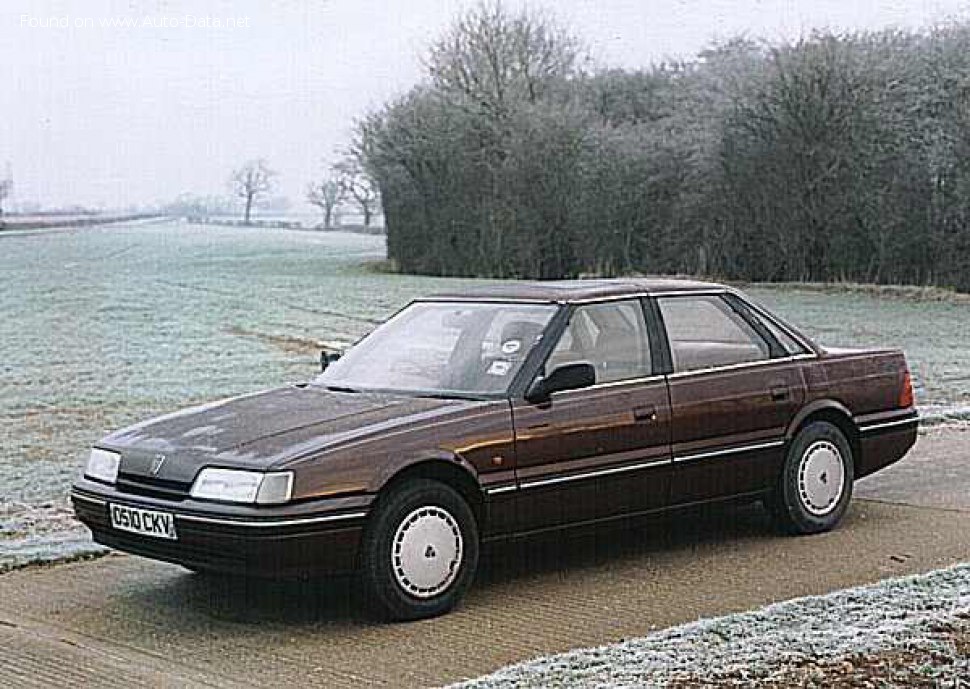
The Rover 800 825 Si Lux (RS) (175 Hp): A British Executive Sedan
The Rover 800 series represented the British automaker’s flagship offering in the executive car segment from 1986 to 1999. The specific variant, the Rover 800 825 Si Lux (RS) (175 Hp), produced between 1996 and 1999, belonged to the second and final generation, often referred to by its internal code “RS.” This generation was a significant evolution from its predecessor, aimed at refining the car’s aesthetics, improving build quality, and enhancing the driving experience to better compete in the fiercely contested European luxury market. While never officially sold in the United States, the Rover 800 series played a crucial role in Rover’s strategy to blend traditional British luxury with modern engineering, particularly through its long-standing collaboration with Honda.
The 825 Si Lux (RS) model was positioned as a premium trim level, emphasizing comfort and sophistication. It was a four-door sedan designed to transport five occupants in relative luxury, featuring a refined powertrain and a host of amenities expected of a car in its class during the late 1990s. Its existence underscored Rover’s ambition to maintain a presence in the upper echelons of the automotive market, offering a distinctively British alternative to the dominant German and Swedish executive sedans.
Engine and Performance of the Rover 800 825 Si Lux (RS) (175 Hp)
At the heart of the Rover 800 825 Si Lux (RS) (175 Hp) lay a naturally aspirated 2.5-liter V6 gasoline engine, designated with the code C25A. This powerplant was a testament to the collaborative efforts between Rover and Honda, sharing its lineage with engines found in various Honda models of the era, albeit with specific tuning for the Rover application. The V-engine configuration, coupled with a Double Overhead Camshaft (DOHC) valvetrain and four valves per cylinder, was engineered for smooth power delivery and responsiveness.
The engine produced a respectable 175 horsepower at a relatively high 6500 rpm, indicating its willingness to rev. Torque figures stood at 177.01 lb.-ft. (240 Nm) peaking at 4000 rpm, providing ample pulling power for a car of its size. Fuel delivery was managed by a multi-port manifold injection system, ensuring efficient combustion and consistent performance. With a compression ratio of 10.5:1, the engine was designed for optimal power output from its 152.38 cubic inch (2497 cm³) displacement.
Power was transmitted to the front wheels via a 4-speed automatic transmission, a common choice for executive sedans of the period prioritizing smooth shifts over outright sporting performance. This drivetrain architecture, where the internal combustion engine drives the front wheels, contributed to predictable handling characteristics. Performance metrics for the Rover 800 825 Si Lux (RS) (175 Hp) included an acceleration time from 0 to 60 mph in 9.7 seconds and a top speed of 130.49 mph (210 km/h). While not a performance car by modern standards, these figures were competitive for a luxury sedan of its time, offering brisk highway cruising and confident overtaking capability.
Fuel economy for this V6-powered sedan was rated at an average of 27 US mpg (8.7 l/100 km) in combined driving conditions, which was a reasonable figure for a vehicle of its size and engine capacity in the late 1990s. The engine required 4.76 US quarts of oil and had a coolant capacity of 10.57 US quarts, indicating a robust cooling system designed for sustained operation.
Design and Features
The Rover 800 825 Si Lux (RS) presented itself as a classic four-door sedan, embodying the understated elegance that Rover aimed for. Its exterior design, refined during the “RS” generation, moved away from some of the sharper lines of its first iteration towards a more curvaceous and contemporary aesthetic. With a length of 192.2 inches, a width of 68.11 inches, and a height of 54.84 inches, the 800 offered a substantial road presence. The generous 108.9-inch wheelbase contributed to a comfortable ride and ample interior space for its five occupants.
As a “Lux” trim level, the interior was designed with an emphasis on comfort and luxury, featuring materials and finishes that reflected its executive positioning. While specific details like leather upholstery or wood trim are not explicitly listed in the technical data, these were characteristic features of such a trim in a Rover flagship model of this era. The cabin was configured to comfortably accommodate five passengers, with a trunk (boot) space of 15.72 cubic feet (445 liters), providing sufficient cargo capacity for luggage or golf clubs.
Safety features for the 825 Si Lux (RS) included an Anti-lock Braking System (ABS), which was a significant active safety technology for the late 1990s, helping drivers maintain steering control during emergency braking. The braking system itself comprised ventilated discs at the front and solid discs at the rear, ensuring effective stopping power. The suspension setup featured a double wishbone arrangement at the front, known for its ability to provide precise handling and a comfortable ride, complemented by a coil spring rear suspension. Steering was managed by a hydraulic rack and pinion system, offering direct feedback to the driver, a preference for many enthusiasts before the widespread adoption of electric power steering. The vehicle rode on 195/65 R15 V tires, providing a good balance between comfort and grip.
Technical Specifications
| Category | Specification |
|---|---|
| General Information | |
| Brand | Rover |
| Model | 800 |
| Generation | 800 (RS) |
| Type (Engine) | 825 Si Lux (RS) (175 Hp) |
| Start of Production | 1996 |
| End of Production | 1999 |
| Powertrain Architecture | Internal Combustion engine |
| Body Type | Sedan |
| Seats | 5 |
| Doors | 4 |
| Performance Specs | |
| Fuel Consumption (Combined) | 27 US mpg (8.7 l/100 km) |
| Fuel Type | Petrol (Gasoline) |
| Acceleration 0-60 mph | 9.7 sec |
| Maximum Speed | 130.49 mph (210 km/h) |
| Weight-to-Power Ratio | 8.1 kg/Hp |
| Weight-to-Torque Ratio | 5.9 kg/Nm |
| Engine Specs | |
| Power | 175 Hp @ 6500 rpm |
| Power per Liter | 70.1 Hp/l |
| Torque | 177.01 lb.-ft. (240 Nm) @ 4000 rpm |
| Engine Layout | Front, Transverse |
| Engine Model/Code | C25A |
| Engine Displacement | 2.5 l (2497 cm³, 152.38 cu. in.) |
| Number of Cylinders | 6 |
| Engine Configuration | V-engine |
| Cylinder Bore | 3.15 in. (80 mm) |
| Piston Stroke | 3.26 in. (82.8 mm) |
| Compression Ratio | 10.5:1 |
| Number of Valves per Cylinder | 4 |
| Fuel Injection System | Multi-port manifold injection |
| Engine Aspiration | Naturally aspirated |
| Valvetrain | DOHC |
| Engine Oil Capacity | 4.76 US qt (4.5 l) |
| Coolant Capacity | 10.57 US qt (10 l) |
| Space, Volume and Weights | |
| Kerb Weight | 3141.59 lbs. (1425 kg) |
| Max. Weight | 4210.83 lbs. (1910 kg) |
| Max Load | 1069.24 lbs. (485 kg) |
| Trunk (Boot) Space – Minimum | 15.72 cu. ft. (445 l) |
| Fuel Tank Capacity | 17.44 US gal (66 l) |
| Dimensions | |
| Length | 192.2 in. (4882 mm) |
| Width | 68.11 in. (1730 mm) |
| Height | 54.84 in. (1393 mm) |
| Wheelbase | 108.9 in. (2766 mm) |
| Front Track | 58.54 in. (1487 mm) |
| Rear (Back) Track | 57.09 in. (1450 mm) |
| Drivetrain, Brakes and Suspension Specs | |
| Drivetrain Architecture | Front-wheel drive (ICE drives front wheels) |
| Drive Wheel | Front wheel drive |
| Number of Gears and Type of Gearbox | 4 gears, automatic transmission |
| Front Suspension | Double wishbone |
| Rear Suspension | Coil spring |
| Front Brakes | Ventilated discs |
| Rear Brakes | Disc |
| Assisting Systems | ABS (Anti-lock braking system) |
| Steering Type | Steering rack and pinion |
| Power Steering | Hydraulic Steering |
| Tires Size | 195/65 R15 V |
Legacy and Market Impact of the Rover 800 825 Si Lux (RS)
The Rover 800 series, including the 825 Si Lux (RS) (175 Hp) model, holds a significant place in the history of the British automotive industry. Launched in the mid-1980s as the “XX” project and later refined into the “RS” generation, it was Rover’s ambitious attempt to regain a foothold in the competitive executive car market, particularly against established German and Swedish rivals like the BMW 5 Series, Mercedes-Benz E-Class, Saab 9000, and Volvo S80. The 800 series was the flagship of the Rover brand, symbolizing its aspirations for prestige and engineering prowess.
A key aspect of the Rover 800’s legacy was its deep engineering collaboration with Honda, specifically sharing its platform and many mechanical components with the Honda Legend (Acura Legend in North America). This partnership was initially seen as a strength, bringing Japanese reliability and engineering sophistication to the British marque. The 2.5-liter V6 engine in the 825 Si Lux (RS) is a prime example of this collaboration, offering smooth power delivery and a reputation for durability.
In its primary markets, particularly the United Kingdom and continental Europe, the Rover 800 was generally well-regarded for its comfortable ride, spacious interior, and traditional British luxury appointments. The “Lux” designation for the 825 Si Lux (RS) underscored its positioning as a premium vehicle, often featuring leather upholstery, wood trim, and a high level of standard equipment for its time. It appealed to buyers seeking a blend of classic elegance and modern convenience, with a distinct character that set it apart from its often more austere German competitors.
However, the 800 series also faced challenges. Despite its refinements, it struggled to fully shake off perceptions of inconsistent build quality and a lack of the ultimate prestige associated with its German rivals. As Rover’s financial situation became more precarious in the late 1990s, the brand struggled to invest adequately in new models and technologies, which ultimately impacted the 800’s competitiveness. The model’s front-wheel-drive architecture, while practical, was often seen as less sporting than the rear-wheel-drive setups of some of its premium competitors.
The Rover 800 825 Si Lux (RS) (175 Hp) represented the culmination of Rover’s efforts with this platform before the company’s eventual decline. Its end of production in 1999 marked the close of an era for Rover’s executive sedan aspirations. Today, the Rover 800 is viewed as a classic executive car, appreciated by enthusiasts for its unique blend of Anglo-Japanese engineering, comfortable ride, and a tangible link to a significant, albeit challenging, period in British automotive history. It stands as a testament to Rover’s ambition to compete at the highest levels, even as the global automotive landscape was rapidly evolving.
