The Rover 800 Coupe 825 Si (RS): A British Grand Tourer’s Last Stand
The Rover 800 Coupe, specifically the 825 Si (RS) (175 Hp) variant, represents a significant, albeit often overlooked, chapter in the history of the British automotive manufacturer Rover. Launched in 1996 as part of the second generation (RS) of the 800 Series, this two-door, five-seat grand tourer was an ambitious attempt by Rover to carve out a niche in the premium executive coupe market, primarily in Europe. While the Rover 800 Series had its roots in a collaborative effort with Honda (known as the Honda Legend in North America), the Coupe was a distinctly British design, aiming to blend traditional Rover luxury with a sportier, more exclusive appeal. It served as a flagship model, showcasing Rover’s engineering capabilities and design prowess at a time when the company was navigating complex ownership changes and market pressures. The Rover 800 Coupe 825 Si (RS) was positioned as a sophisticated, comfortable cruiser, offering a blend of performance and luxury for discerning buyers.
Engine and Performance of the Rover 800 Coupe 825 Si (RS)
Under the hood of the Rover 800 Coupe 825 Si (RS) lay a powertrain that underscored its sophisticated ambitions. The heart of this coupe was a 2.5-liter (2497 cm3 or 152.38 cu. in.) naturally aspirated V6 engine, designated with the code C25A. This engine, a product of Rover’s enduring partnership with Honda, was a testament to smooth operation and reliable performance. It featured a Double Overhead Camshaft (DOHC) valvetrain with four valves per cylinder, a configuration that allowed for efficient breathing and a healthy power output.
The C25A V6 generated a respectable 175 horsepower at 6500 revolutions per minute (rpm), providing ample motivation for the grand tourer. Torque figures stood at 240 Nm, or approximately 177.01 pound-feet, peaking at 4000 rpm, ensuring a broad power band and responsive acceleration. Power was efficiently delivered to the front wheels via a 4-speed automatic transmission. While a manual option was available in some 800 Series models, the automatic was the standard choice for the 825 Si (RS) Coupe, emphasizing its role as a comfortable, effortless cruiser rather than an outright sports car.
Performance figures for the 825 Si (RS) were competitive for its class and era. The coupe could accelerate from 0 to 60 mph in a brisk 9.7 seconds, with a top speed rated at 130.49 mph (210 km/h). Fuel economy was rated at a combined 27 US miles per gallon (8.7 liters per 100 km), which was reasonable for a V6-powered luxury coupe of its size and weight. The engine’s layout was front-transverse, contributing to the car’s front-wheel-drive architecture. With a compression ratio of 10.5:1 and multi-port manifold injection, the engine was designed for efficiency and smooth power delivery, further enhancing the car’s refined character.
Design and Features
Exterior and Interior Design of the Rover 800 Coupe
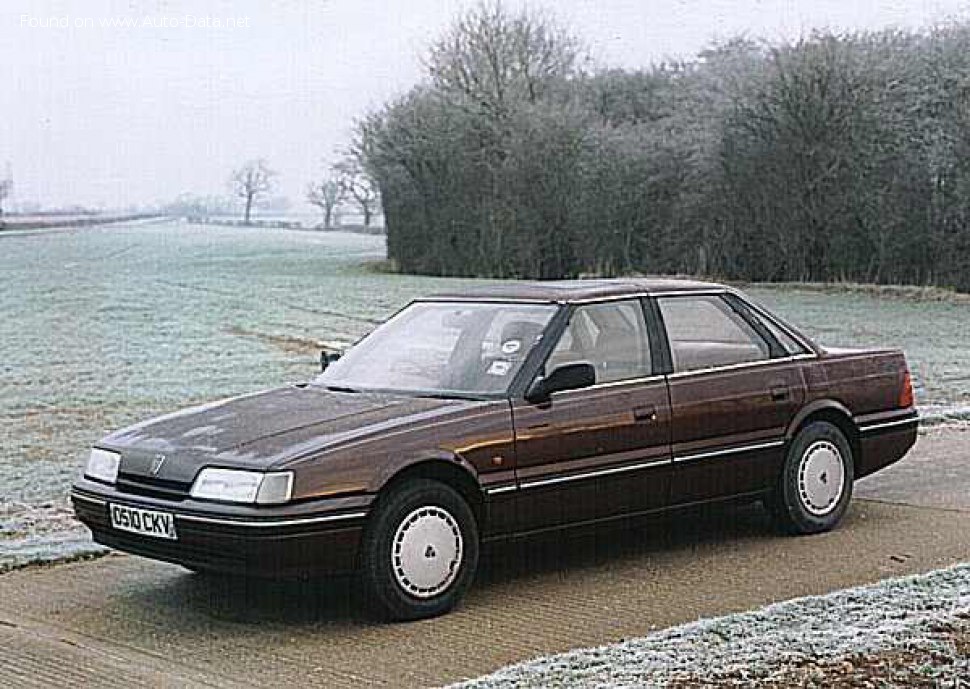
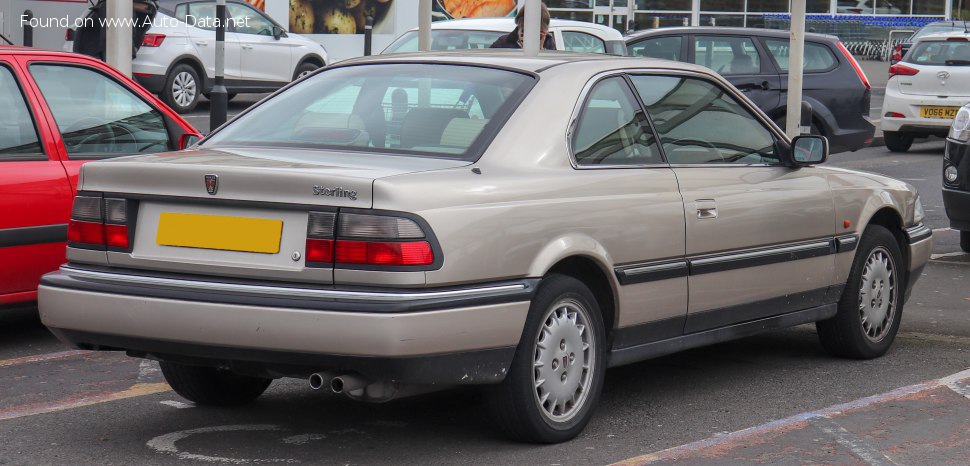
The Rover 800 Coupe stood out from its sedan and fastback siblings with a distinct and elegant two-door body style. Its design, penned by Rover’s in-house team, sought to evoke a sense of classic British sportiness and luxury. The most striking exterior feature was its pillarless hardtop design, a nod to traditional grand tourers, which offered an expansive glass area when the windows were lowered. The car’s long, flowing lines, combined with a relatively low roofline and a pronounced C-pillar, gave it a sophisticated and somewhat imposing presence. At 192.2 inches long, 68.11 inches wide, and 54.84 inches tall, with a wheelbase of 108.9 inches, the Coupe possessed substantial road presence. The 205/55 R16 tires provided a good balance of grip and ride comfort, fitting its grand touring persona.
Inside, the 800 Coupe aimed to provide a luxurious and comfortable environment for its five occupants. Rover was known for its commitment to traditional British luxury, and the 800 Coupe was no exception. High-quality materials, often including wood trim and leather upholstery, adorned the cabin. The dashboard layout was ergonomic, with controls positioned for ease of use. Despite its coupe designation, the 800 Coupe offered a surprisingly spacious interior, particularly for front-seat passengers, making it suitable for long-distance travel. The trunk space was a generous 15.72 cubic feet (445 liters), further enhancing its practicality as a grand tourer.
Chassis, Safety, and Driving Dynamics
The chassis of the Rover 800 Coupe 825 Si (RS) was designed to offer a comfortable yet composed ride. It featured a double wishbone front suspension, a sophisticated setup known for its ability to provide precise handling and excellent ride quality. The rear suspension utilized a coil spring arrangement, further contributing to the car’s smooth demeanor.
In terms of safety, the 800 Coupe was equipped with Anti-lock Braking System (ABS) as standard, a crucial feature for enhanced stopping power and control, especially in adverse conditions. The braking system comprised ventilated discs at the front and solid discs at the rear, ensuring effective deceleration. Steering was handled by a hydraulic rack and pinion system, providing direct feedback and ease of maneuverability. The combination of a well-tuned suspension, robust braking, and power steering aimed to deliver a refined and confident driving experience, consistent with its luxury positioning.
Technical Specifications: Rover 800 Coupe 825 Si (RS) (175 Hp)
| Category | Specification | Value |
|---|---|---|
General Information |
||
| Brand | Rover | |
| Model | 800 Coupe | |
| Generation | 800 Coupe (RS) | |
| Type (Engine) | 825 Si (RS) (175 Hp) | |
| Start of Production | 1996 year | |
| End of Production | 1999 year | |
| Powertrain Architecture | Internal Combustion engine | |
| Body Type | Coupe | |
| Seats | 5 | |
| Doors | 2 | |
Performance Specifications |
||
| Fuel Consumption (Combined) | 27 US mpg (8.7 l/100 km) | |
| Fuel Type | Petrol (Gasoline) | |
| Acceleration 0 – 60 mph | 9.7 sec | |
| Maximum Speed | 130.49 mph (210 km/h) | |
| Weight-to-Power Ratio | 8 kg/Hp (125.4 Hp/tonne) | |
| Weight-to-Torque Ratio | 5.8 kg/Nm (172 Nm/tonne) | |
Engine Specifications |
||
| Power | 175 Hp @ 6500 rpm | |
| Power per Liter | 70.1 Hp/l | |
| Torque | 177.01 lb.-ft. @ 4000 rpm (240 Nm) | |
| Engine Layout | Front, Transverse | |
| Engine Model/Code | C25A | |
| Engine Displacement | 2.5 liters (152.38 cu. in.) | |
| Number of Cylinders | 6 | |
| Engine Configuration | V-engine | |
| Cylinder Bore | 3.15 in. (80 mm) | |
| Piston Stroke | 3.26 in. (82.8 mm) | |
| Compression Ratio | 10.5:1 | |
| Valves per Cylinder | 4 | |
| Fuel Injection System | Multi-port manifold injection | |
| Engine Aspiration | Naturally aspirated engine | |
| Valvetrain | DOHC | |
| Engine Oil Capacity | 4.76 US qt (4.5 l) | |
| Coolant Capacity | 10.57 US qt (10 l) | |
Space, Volume and Weights |
||
| Kerb Weight | 3075.45 lbs (1395 kg) | |
| Max. Weight | 4210.83 lbs (1910 kg) | |
| Max Load | 1135.38 lbs (515 kg) | |
| Trunk (Boot) Space – Minimum | 15.72 cu. ft. (445 l) | |
| Fuel Tank Capacity | 17.44 US gal (66 l) | |
Dimensions |
||
| Length | 192.2 in. (4882 mm) | |
| Width | 68.11 in. (1730 mm) | |
| Height | 54.84 in. (1393 mm) | |
| Wheelbase | 108.9 in. (2766 mm) | |
| Front Track | 58.54 in. (1487 mm) | |
| Rear Track | 57.09 in. (1450 mm) | |
Drivetrain, Brakes and Suspension Specs |
||
| Drivetrain Architecture | Front wheel drive, Internal Combustion engine | |
| Drive Wheel | Front wheel drive | |
| Number of Gears and Type of Gearbox | 4 gears, automatic transmission | |
| Front Suspension | Double wishbone | |
| Rear Suspension | Coil spring | |
| Front Brakes | Ventilated discs | |
| Rear Brakes | Disc | |
| Assisting Systems | ABS (Anti-lock braking system) | |
| Steering Type | Steering rack and pinion | |
| Power Steering | Hydraulic Steering | |
| Tires Size | 205/55 R16 | |
Legacy and Market Impact
The Rover 800 Coupe 825 Si (RS) emerged during a challenging period for the British automotive industry and Rover itself. As a premium offering, it faced stiff competition in the European executive coupe segment from established German rivals like the BMW 3 Series Coupe and the Mercedes-Benz CLK, as well as more contemporary offerings from brands like Peugeot (e.g., the 406 Coupe) and Volvo (e.g., the C70). While the 800 Coupe was praised for its distinctive styling, comfortable ride, and the smooth performance of its Honda-derived V6 engine, it struggled to truly capture the market share its creators hoped for.
Its primary market was undoubtedly Europe, particularly the United Kingdom, where Rover held a stronger brand identity. In regions like North America, the Rover brand had long since retreated, and the 800 Coupe was never officially imported, making it a rare sight for American enthusiasts, often recognized only through its Honda Legend counterpart, which shared the platform but not the distinct coupe body.
The 800 Coupe’s historical significance lies in its role as a final attempt by Rover to assert its presence in the premium segment with a truly unique body style. It represented a blend of British design flair and Japanese engineering reliability, a legacy of the Honda partnership that underpinned the 800 series. However, by the late 1990s, Rover was facing increasing financial difficulties and a rapidly changing automotive landscape. The 800 Coupe, along with the rest of the 800 series, quietly ceased production in 1999, making way for the more modern Rover 75.
Today, the Rover 800 Coupe 825 Si (RS) is considered a classic by enthusiasts, valued for its elegant design, comfortable interior, and the robust V6 engine. It stands as a testament to Rover’s ambition to compete at the higher end of the market and serves as a reminder of a bygone era of British luxury motoring. Its relative rarity and unique styling ensure its place as a distinctive, if understated, piece of automotive history, particularly in the context of European grand tourers from the turn of the millennium. It wasn’t a sales smash hit, but it left a lasting impression as a car that dared to be different, embodying a blend of tradition and modernity for its time.