
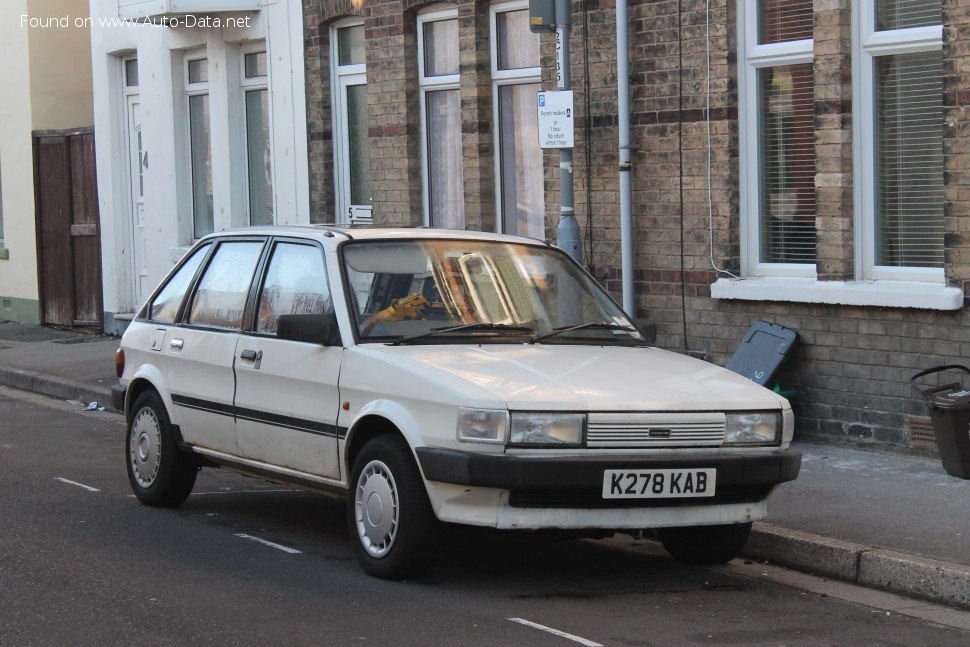
As an international automotive expert, I am pleased to present a detailed analysis of the Rover Maestro 2.0 TD (60 Hp), a notable vehicle from British automotive history, tailored for an American audience.
Introduction to the Rover Maestro 2.0 TD (60 Hp)
The Rover Maestro, a compact family car produced by British Leyland and later by the Rover Group, represented a significant chapter in British automotive manufacturing. Launched in 1983 as a successor to the Austin Allegro and Maxi, the Maestro aimed to modernize the company’s offerings in the highly competitive C-segment. While never officially sold in the United States, the Maestro played a crucial role in the European and particularly the UK market, serving as a utilitarian and often economical choice for families and fleets. The variant under review, the Rover Maestro 2.0 TD (60 Hp), was introduced in 1991 and remained in production until 1997, signifying a late-life addition to the Maestro lineup that focused on diesel efficiency and durability.
Positioned as a practical five-door hatchback, the Maestro 2.0 TD was designed to offer economical operation in an era when diesel engines were gaining traction for their fuel efficiency, especially in Europe. This particular iteration, with its naturally aspirated diesel engine, prioritized reliability and low running costs over outright performance, catering to a specific segment of buyers looking for a dependable workhorse. Its design ethos was rooted in the pragmatic British automotive tradition, emphasizing interior space, ease of maintenance, and affordability.
Engine and Performance: The Rover Maestro 2.0 TD (60 Hp) Powertrain
The heart of the Rover Maestro 2.0 TD (60 Hp) is its 2.0-liter (1994 cm3 or 121.68 cu. in.) inline four-cylinder diesel engine. This powertrain, designated as a Turbo Diesel (TD), delivered a modest 60 horsepower at 4500 revolutions per minute (rpm) and a respectable 89.25 lb.-ft. of torque at 2500 rpm. The engine’s layout was front, transverse, driving the front wheels through a 5-speed manual transmission. This configuration was standard for many compact front-wheel-drive vehicles of the era, offering a balance of manufacturing simplicity and efficient packaging.
While 60 horsepower might seem modest by today’s standards, for a naturally aspirated diesel engine in the early 1990s, it provided adequate power for daily driving and highway cruising in its intended market. The emphasis was clearly on fuel economy rather than blistering acceleration. The Maestro 2.0 TD could accelerate from 0 to 60 mph in approximately 15.2 seconds, reaching a maximum speed of 93.21 mph. These figures underscored its role as a practical, economical vehicle rather than a performance-oriented hot hatch.
Fuel efficiency was a strong selling point for this diesel variant. The combined fuel consumption was rated at an impressive 37.9 US mpg (6.2 liters per 100 km). Urban driving saw figures around 39.9 US mpg (5.9 liters per 100 km), while extra-urban (highway) driving could achieve an excellent 53.5 US mpg (4.4 liters per 100 km). These numbers were highly competitive for the time and made the Maestro 2.0 TD an attractive option for budget-conscious consumers and fleet operators in regions where diesel fuel was readily available and often taxed favorably. The engine utilized a precombustion chamber injection system, a common technology for early indirect-injection diesel engines, contributing to its robust and reliable nature.
Design and Features
The Rover Maestro 2.0 TD retained the familiar five-door hatchback body style that characterized the entire Maestro range. Measuring 157.48 inches in length, 66.54 inches in width, and 56.3 inches in height, it offered a compact footprint suitable for European city driving and parking. The wheelbase of 98.82 inches contributed to a stable ride, while the front and rear track widths of 57.68 inches and 56.85 inches, respectively, ensured decent handling for a car of its class.
Inside, the Maestro was designed for practicality. It comfortably seated five occupants, with a focus on maximizing interior space. The hatchback design provided excellent cargo versatility, boasting a minimum trunk space of 38.49 cubic feet (1090 liters), which was generous for its segment and could be expanded by folding down the rear seats. This made it a highly functional vehicle for families and those needing to transport goods.
In terms of features, the 1990s Maestro, especially in its later years, gradually incorporated more modern amenities. The 2.0 TD variant included a hydraulic power steering system, making maneuvering easier. For safety, the vehicle was equipped with front disc brakes and rear drum brakes, supplemented by an Anti-lock Braking System (ABS), which was a significant safety enhancement for a car in this segment during that period. The suspension setup, featuring coil springs at both the front and rear, aimed to provide a comfortable ride quality, suitable for varying road conditions found across Europe. The standard tire size was 175/70 SR14, offering a balance of grip and ride comfort.
Technical Specifications
The following table details the comprehensive technical specifications for the Rover Maestro 2.0 TD (60 Hp):
| Category | Specification | US Equivalent / Notes |
|---|---|---|
| General Information | ||
| Brand | Rover | |
| Model | Maestro | |
| Generation | Maestro | |
| Type (Engine) | 2.0 TD (60 Hp) | |
| Start of Production | 1991 year | |
| End of Production | 1997 year | |
| Powertrain Architecture | Internal Combustion engine | |
| Body type | Hatchback | |
| Seats | 5 | |
| Doors | 5 | |
| Performance Specifications | ||
| Fuel consumption (economy) – urban | 5.9 l/100 km | 39.9 US mpg |
| Fuel consumption (economy) – extra urban | 4.4 l/100 km | 53.5 US mpg |
| Fuel consumption (economy) – combined | 6.2 l/100 km | 37.9 US mpg |
| Fuel Type | Diesel | |
| Acceleration 0 – 60 mph | 15.2 sec | |
| Maximum speed | 150 km/h | 93.21 mph |
| Weight-to-power ratio | 18.3 kg/Hp | 54.8 Hp/tonne |
| Weight-to-torque ratio | 9 kg/Nm | 110.5 Nm/tonne |
| Engine Specifications | ||
| Power | 60 Hp @ 4500 rpm | |
| Power per liter | 30.1 Hp/l | |
| Torque | 121 Nm @ 2500 rpm | 89.25 lb.-ft. @ 2500 rpm |
| Engine layout | Front, Transverse | |
| Engine displacement | 1994 cm3 | 121.68 cu. in. |
| Number of cylinders | 4 | |
| Engine configuration | Inline | |
| Cylinder Bore | 84.46 mm | 3.33 in. |
| Piston Stroke | 89 mm | 3.5 in. |
| Compression ratio | 20:1 | |
| Number of valves per cylinder | 2 | |
| Fuel injection system | Precombustion chamber injection | |
| Engine aspiration | Turbocharger | |
| Engine oil capacity | 4.8 l | 5.07 US qt |
| Space, Volume and Weights | ||
| Kerb Weight | 1095 kg | 2414.06 lbs. |
| Max. weight | 1560 kg | 3439.21 lbs. |
| Max load | 465 kg | 1025.15 lbs. |
| Trunk (boot) space – minimum | 1090 l | 38.49 cu. ft. |
| Fuel tank capacity | 50 l | 13.21 US gal |
| Dimensions | ||
| Length | 4000 mm | 157.48 in. |
| Width | 1690 mm | 66.54 in. |
| Height | 1430 mm | 56.3 in. |
| Wheelbase | 2510 mm | 98.82 in. |
| Front track | 1465 mm | 57.68 in. |
| Rear (Back) track | 1444 mm | 56.85 in. |
| Drivetrain, Brakes and Suspension Specifications | ||
| Drivetrain Architecture | Front wheel drive (ICE drives front wheels) | |
| Drive wheel | Front wheel drive | |
| Number of gears and type of gearbox | 5 gears, manual transmission | |
| Front suspension | Coil spring | |
| Rear suspension | Coil spring | |
| Front brakes | Disc | |
| Rear brakes | Drum | |
| Assisting systems | ABS (Anti-lock braking system) | |
| Steering type | Steering rack and pinion | |
| Power steering | Hydraulic Steering | |
| Tires size | 175/70 SR14 | |
Legacy and Market Impact
The Rover Maestro, including the 2.0 TD variant, holds a complex place in automotive history. While it was never a resounding critical success and faced stiff competition from more modern and dynamically superior rivals like the Volkswagen Golf, Ford Escort, and Vauxhall Astra in Europe, it was a workhorse for the Rover Group. The Maestro 2.0 TD specifically carved out a niche as an economical and durable option for those prioritizing low running costs and practicality. Its entry into the market in 1991, late in the Maestro’s lifecycle, was an attempt to inject new life and relevance into an aging platform by leveraging the growing demand for diesel efficiency.
In its primary markets, particularly the UK, the Maestro was a common sight, often serving as a family car or a fleet vehicle. Its robust diesel engine, though not powerful, was known for its longevity and fuel economy, making it a sensible choice for high-mileage drivers. The Maestro’s practical hatchback design and generous cargo space were also key factors in its appeal. Despite its functional strengths, the Maestro suffered from build quality issues and an increasingly dated design compared to its European contemporaries, which ultimately contributed to its declining sales towards the mid-1990s.
The Rover Maestro 2.0 TD (60 Hp) represents an interesting footnote in the history of British Leyland and Rover Group, showcasing their efforts to adapt to changing market demands, even with an older platform. It highlights a period where European manufacturers were increasingly embracing diesel technology for mainstream passenger cars, focusing on efficiency and cost-effectiveness. While the Maestro itself did not achieve the iconic status of some of its rivals, this particular diesel variant underscored a pragmatic approach to motoring that resonated with a segment of the European car-buying public, embodying the spirit of accessible and economical transportation for its time.
