The Rover Mini MK I 1.3 (61 Hp): A Late-Era Icon of British Motoring
The Rover Mini MK I 1.3 (61 Hp) represents a fascinating chapter in the storied history of one of the world’s most recognizable automobiles. Produced by Rover Group between 1990 and 1993, this particular iteration, despite its “MK I” designation in the data, is a late-production version of the classic Mini design, a testament to its enduring appeal and ingenious engineering. While the original Mini MK I debuted in 1959, this 1990-1993 model continued the legacy, offering a modern interpretation of the beloved compact hatchback for its primary European and UK markets. It maintained the iconic silhouette, nimble handling, and efficient packaging that defined the Mini for decades, ensuring its place as a cultural icon even as the automotive landscape evolved around it.
Engine & Performance: The Enduring A-Series
At the heart of the 1990-1993 Rover Mini MK I 1.3 (61 Hp) was the venerable A-Series engine, a powerplant that had been propelling Minis since their inception. This particular variant featured a 1275 cm³ (77.81 cu. in.) naturally aspirated inline four-cylinder engine. Known for its robust and simple design, this engine delivered 61 horsepower at 5500 rpm and a respectable 67.12 lb.-ft. of torque at 3000 rpm. For a car weighing a mere 1532.21 pounds (695 kg), this powertrain provided a lively and engaging driving experience, perfectly suited to the Mini’s go-kart-like handling characteristics.
Fueling the engine was a carburettor system, a technology that was becoming increasingly rare in mainstream production cars by the early 1990s but maintained its presence in the Mini, underscoring its traditional engineering roots. Power was sent to the front wheels via a four-speed manual transmission, offering direct driver engagement. The Mini MK I 1.3 (61 Hp) could accelerate from 0 to 60 mph in a sprightly 10.6 seconds, reaching a top speed of 91.96 mph (148 km/h).
Despite its relatively modest power figures by contemporary standards, the Mini’s exceptional power-to-weight ratio of 87.8 Hp per tonne (11.4 kg/Hp) meant it felt much quicker than the numbers suggested. Fuel economy was also a strong suit, with a combined rating of 32.2 US mpg (7.3 l/100 km), making it an economical choice for urban commuting and spirited drives alike. The engine’s layout, mounted transversely at the front, was revolutionary for its time and allowed for the Mini’s characteristic compact footprint and spacious interior.
Design & Features: The Quintessential Mini MK I
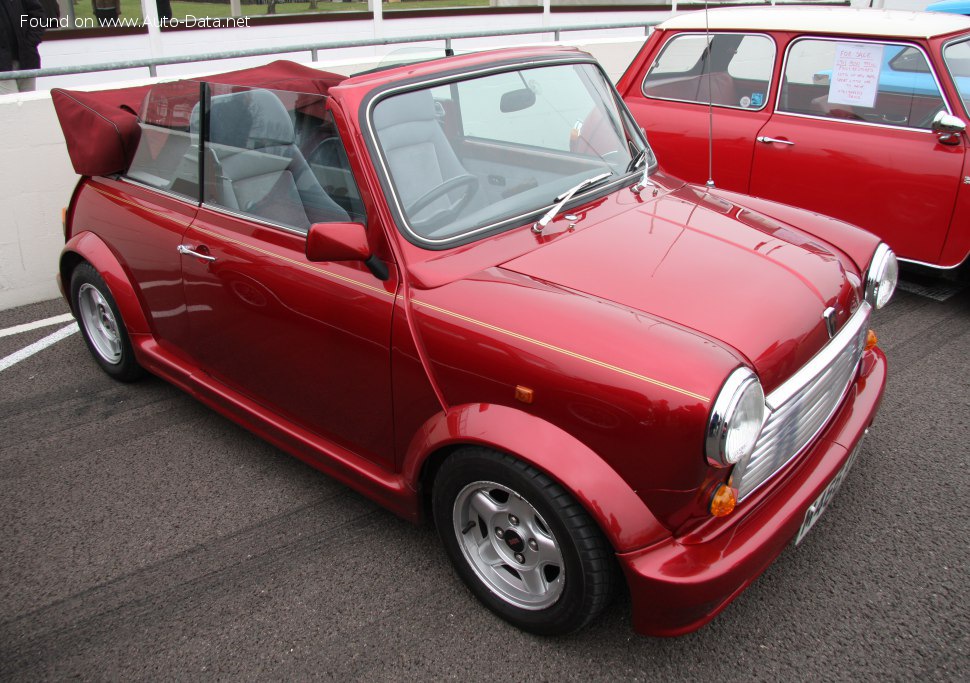
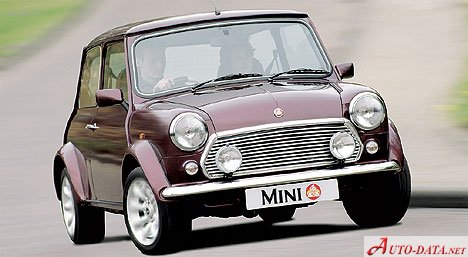
The design of the Rover Mini MK I 1.3 (61 Hp) was, by 1990, an automotive legend. It retained the classic two-box hatchback body style with three doors and seating for five, a remarkable feat of packaging for a vehicle measuring just 120.08 inches (3050 mm) in length. Its diminutive dimensions – 55.51 inches (1410 mm) wide and 53.15 inches (1350 mm) high – made it incredibly agile and easy to maneuver in congested city environments, a key factor in its enduring popularity in Europe. The short overhangs and wheels pushed to the corners were not just styling cues but functional elements that contributed to its renowned handling.
The Mini’s suspension system, featuring wishbones at the front and trailing arms at the rear, provided a firm yet communicative ride. This setup, combined with the rack and pinion steering, offered direct feedback to the driver, enhancing the “go-kart” driving sensation. Braking was handled by disc brakes at the front and drum brakes at the rear, a common and effective setup for a car of its size and weight. The 145/70 R12 tires, though small by modern standards, were perfectly matched to the Mini’s lightweight construction and suspension tuning, contributing to its legendary grip and responsiveness.
Inside, the Mini was characterized by its minimalist yet functional cabin. While the 1990s versions often featured more refined materials and updated dashboards compared to their 1960s predecessors, the core layout remained true to the original. The compact trunk offered 4.24 cu. ft. (120 liters) of space, adequate for daily errands. The ingenious packaging meant that despite its tiny exterior, it could comfortably accommodate four adults, or five in a pinch, making it a practical choice for many European families.
Technical Specifications: Rover Mini MK I 1.3 (61 Hp) (1990-1993)
| Category | Specification |
|---|---|
| General Information | |
| Brand | Rover |
| Model | Mini MK |
| Generation | Mini MK I (Late Production) |
| Type (Engine) | 1.3 (61 Hp) |
| Start of Production | 1990 year |
| End of Production | 1993 year |
| Powertrain Architecture | Internal Combustion engine |
| Body type | Hatchback |
| Seats | 5 |
| Doors | 3 |
| Performance Specs | |
| Fuel consumption (economy) – urban | 7.6 l/100 km (30.9 US mpg) |
| Fuel consumption (economy) – extra urban | 5.7 l/100 km (41.3 US mpg) |
| Fuel consumption (economy) – combined | 7.3 l/100 km (32.2 US mpg) |
| Fuel Type | Petrol (Gasoline) |
| Acceleration 0 – 60 mph | 10.6 sec |
| Acceleration 0 – 62 mph (0 – 100 km/h) | 11.2 sec |
| Maximum speed | 91.96 mph (148 km/h) |
| Weight-to-power ratio | 11.4 kg/Hp (87.8 Hp/tonne) |
| Weight-to-torque ratio | 7.6 kg/Nm (130.9 Nm/tonne) |
| Engine Specs | |
| Power | 61 Hp @ 5500 rpm |
| Power per liter | 47.8 Hp/l |
| Torque | 91 Nm @ 3000 rpm (67.12 lb.-ft. @ 3000 rpm) |
| Engine layout | Front, Transverse |
| Engine displacement | 1275 cm³ (77.81 cu. in.) |
| Number of cylinders | 4 |
| Engine configuration | Inline |
| Cylinder Bore | 70.6 mm (2.78 in.) |
| Piston Stroke | 81.33 mm (3.2 in.) |
| Compression ratio | 9.75:1 |
| Number of valves per cylinder | 2 |
| Fuel injection system | Carburettor |
| Engine aspiration | Naturally aspirated engine |
| Engine oil capacity | 4.8 l (5.07 US qt) |
| Coolant capacity | 4 l (4.23 US qt) |
| Space, Volume and Weights | |
| Kerb Weight | 695 kg (1532.21 lbs) |
| Max. weight | 1000 kg (2204.62 lbs) |
| Max load | 305 kg (672.41 lbs) |
| Trunk (boot) space – minimum | 120 l (4.24 cu. ft.) |
| Fuel tank capacity | 34 l (8.98 US gal) |
| Dimensions | |
| Length | 3050 mm (120.08 in.) |
| Width | 1410 mm (55.51 in.) |
| Height | 1350 mm (53.15 in.) |
| Wheelbase | 2035 mm (80.12 in.) |
| Front track | 1240 mm (48.82 in.) |
| Rear (Back) track | 1210 mm (47.64 in.) |
| Minimum turning circle (turning diameter) | 8.9 m (29.2 ft.) |
| Drivetrain, Brakes and Suspension Specs | |
| Drivetrain Architecture | The Internal combustion engine (ICE) drives the front wheels of the vehicle. |
| Drive wheel | Front wheel drive |
| Number of gears and type of gearbox | 4 gears, manual transmission |
| Front suspension | Wishbone |
| Rear suspension | Trailing arm |
| Front brakes | Disc |
| Rear brakes | Drum |
| Steering type | Steering rack and pinion |
| Tires size | 145/70 R12 |
Legacy & Market Impact of the Rover Mini MK I
The Rover Mini MK I 1.3 (61 Hp) from 1990-1993 holds a unique place in automotive history. By this period, the Mini was no longer a revolutionary new car but a cherished classic, continuously updated and refined by its various custodians (BMC, British Leyland, and then Rover Group). This particular model represented a commitment to keeping the original Mini spirit alive, even as the automotive world moved towards more complex and larger designs. It was primarily targeted at the European and UK markets, where its compact size, affordability, and iconic status ensured continued demand. Unlike its spiritual successor, the BMW MINI, this Rover Mini was never officially sold in the United States, meaning its market impact was concentrated across the Atlantic.
In its home market, the Mini faced competition from a new generation of superminis like the Ford Fiesta, Vauxhall Corsa (Opel Corsa), and Renault Clio, which offered modern safety features, more contemporary styling, and often more advanced engines. However, the Mini carved out its niche by appealing to buyers who valued its retro charm, unique driving dynamics, and undeniable character. It was often purchased as a second car, a city car, or by enthusiasts who appreciated its heritage.
The Mini’s influence extends far beyond its sales figures. Its original design by Sir Alec Issigonis pioneered the front-wheel-drive, transverse-engine layout, which became the standard for compact cars worldwide. The Mini’s clever use of space, its ability to seat four adults comfortably within such a small footprint, and its legendary handling characteristics set benchmarks that many manufacturers sought to emulate. Even in its late production years, the Mini continued to symbolize British ingenuity and a rebellious, fun-loving spirit.
Today, these late-era classic Minis are highly sought after by collectors and enthusiasts who appreciate their blend of vintage appeal and slightly more modern reliability compared to earlier models. They represent the culmination of decades of development on a single, enduring design. The Rover Mini MK I 1.3 (61 Hp) is not just a car; it’s a cultural icon, a testament to brilliant engineering, and a reminder of a time when small cars could have massive personalities and leave an indelible mark on the automotive world. Its legacy continues to thrive, celebrated by a global community of admirers and influencing car design to this day.